
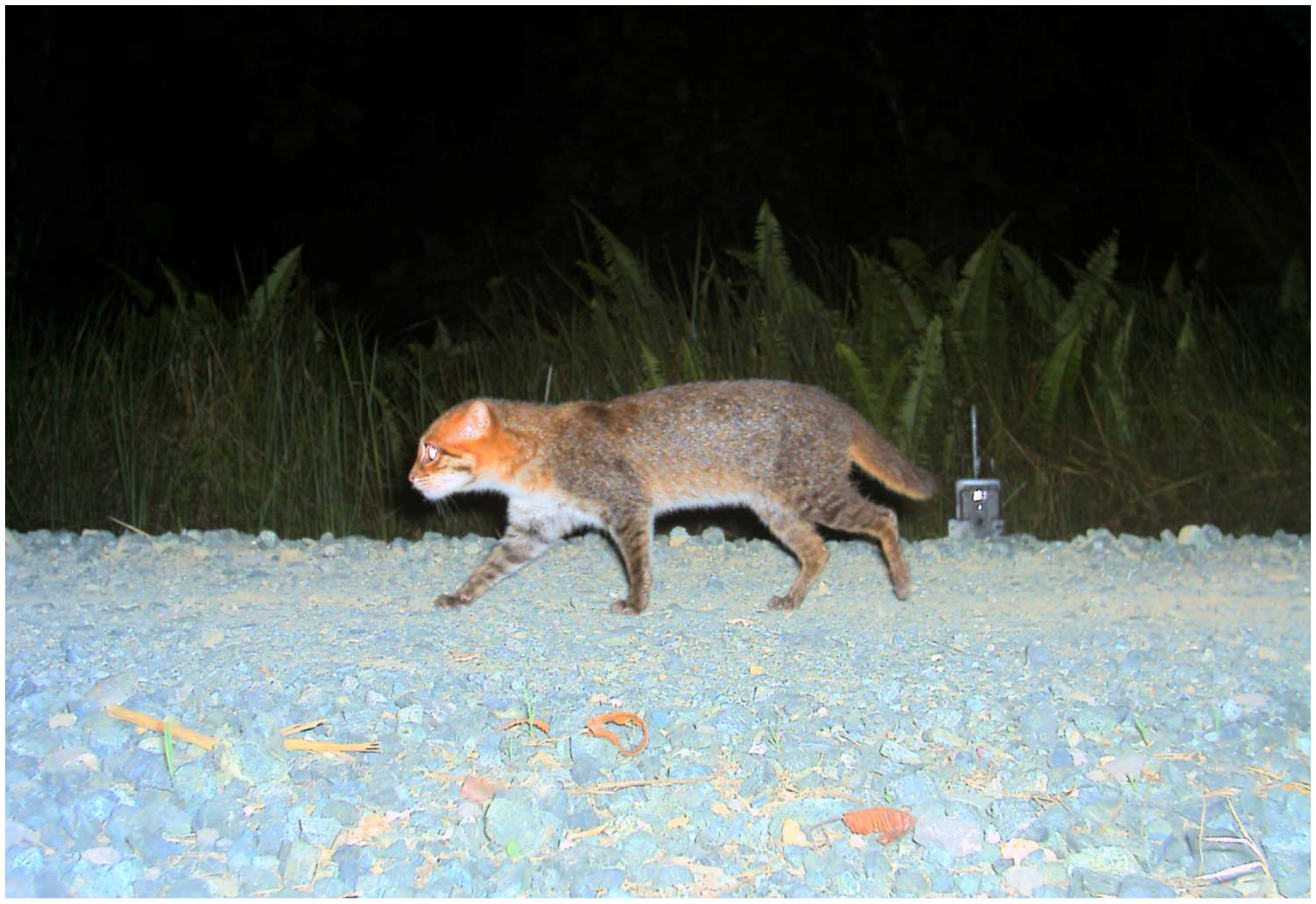
On 26 December 2025, Thailand's Department of National Parks, Wildlife and Plant Conservation (DNP) and Panthera Thailand, the Thai programme of the global wild cat conservation organisation Panthera, announced that the endangered flat-headed cat (Prionailurus planiceps), one of the rarest wild cats in the world, had been rediscovered in southern Thailand. Remote camera traps set in Princess Sirindhorn Wildlife Sanctuary, a peat swamp forest in Narathiwat province in the far south of the country, photographed the cat in 2024 and 2025. They were the first confirmed records of the species in Thailand since 1995.
The announcement was timed for Thailand's annual Wildlife Protection Day, which fell on Friday, 26 December. The cat had gone unrecorded in Thailand for 29 years, and the International Union for Conservation of Nature (IUCN) had listed it as "possibly extinct" within the country. Outside Thailand the species survives in scattered areas of Brunei, Indonesia and Malaysia, and the IUCN classifies it as Endangered, with an estimated 2,500 adults left in the wild worldwide.
What the camera traps recorded
A camera trap is an automatic camera fixed in the forest that takes a photograph when an animal passes in front of it. It lets researchers record shy, night-active animals without disturbing them. According to Panthera's release, the cameras in Princess Sirindhorn Wildlife Sanctuary made thirteen detections of flat-headed cats in 2024 and sixteen in 2025, as part of what Panthera described as the largest survey ever carried out for the species. Live Science, which reported the announcement the same day, wrote that the cameras photographed several flat-headed cats.
The scientists were especially encouraged by images of a female flat-headed cat with her cub. Panthera said this confirmed that the cats are still breeding in the region, a significant finding because a litter of this species usually has just one young.
Panthera explained why such records are so rare. The cat is small, its numbers are low and it is active mostly at night, which makes it very hard to observe. It prefers tropical rainforests, swampy and peat-swamp forests, marshes, lakes, streams and riverside forests, and the dense, waterlogged ground of these places makes field research slow and difficult.
The release said the photographs and data were the results of ecological studies that the Hala-Bala Wildlife Research Station and Panthera Thailand had been carrying out together for some time. According to Panthera, new IUCN Red List and Green List assessments of the species, led by Panthera, were expected to be published in early 2026, and the Thai survey formed part of that work.
What the officials and scientists said
The Director General of the DNP called the rediscovery "a landmark moment for Thailand and a powerful reflection of our long-standing commitment to conservation." The statement noted that for decades the flat-headed cat had been classed as "likely extinct" in the country.
"Rediscovery of the flat-headed cat in southern Thailand is a significant win for conservation in Thailand and the broader southeast Asia region where the species is still found," the Director General said. He added that the find showed the dedication of DNP officials in protecting border forests and rare wildlife populations, even though difficult political and social circumstances in the area make conservation work hard.
Panthera Thailand's Country Director said: "After nearly three decades, this rediscovery shows what's possible when science and strong protection come together." She described the country's wetlands as among its most biodiverse and threatened habitats and said the organisation was eager to expand the research and strengthen conservation measures there.
Panthera's Small Cat Conservation Science Director said: "Even species thought to be lost can be rebuilt if we invest in protecting the habitats they depend on." In his view, the cat's survival in Thailand showed that these ecosystems still hold remarkable biodiversity, but also how urgently they must be conserved and restored.
The DNP and Panthera Thailand said the rediscovery would be the basis for conservation planning for the species. The research they announced covers:
- home range size, separately for males and females;
- habitat use and prey selection;
- interactions with other species and foraging times;
- population density and spatial distribution;
- how the cats adapt to changes in their habitat.
For protection, Panthera Thailand said it would work with the DNP to strengthen the sanctuary's capacity: training park rangers in camp raid tactics, arrest report writing and SMART patrolling, supplying field gear and camera traps to watch for poachers, and interviewing community members to understand the types, patterns and seasonal trends of human threats. The release noted that local Muslim communities around the sanctuary do not hunt wildlife for food or trade, but depend on fishing and collecting forest products. It said there appeared to be no immediate threat from the community, and that outreach work would help the scientists understand local conditions and prevent conflicts before they arise.
A small cat with a flat head
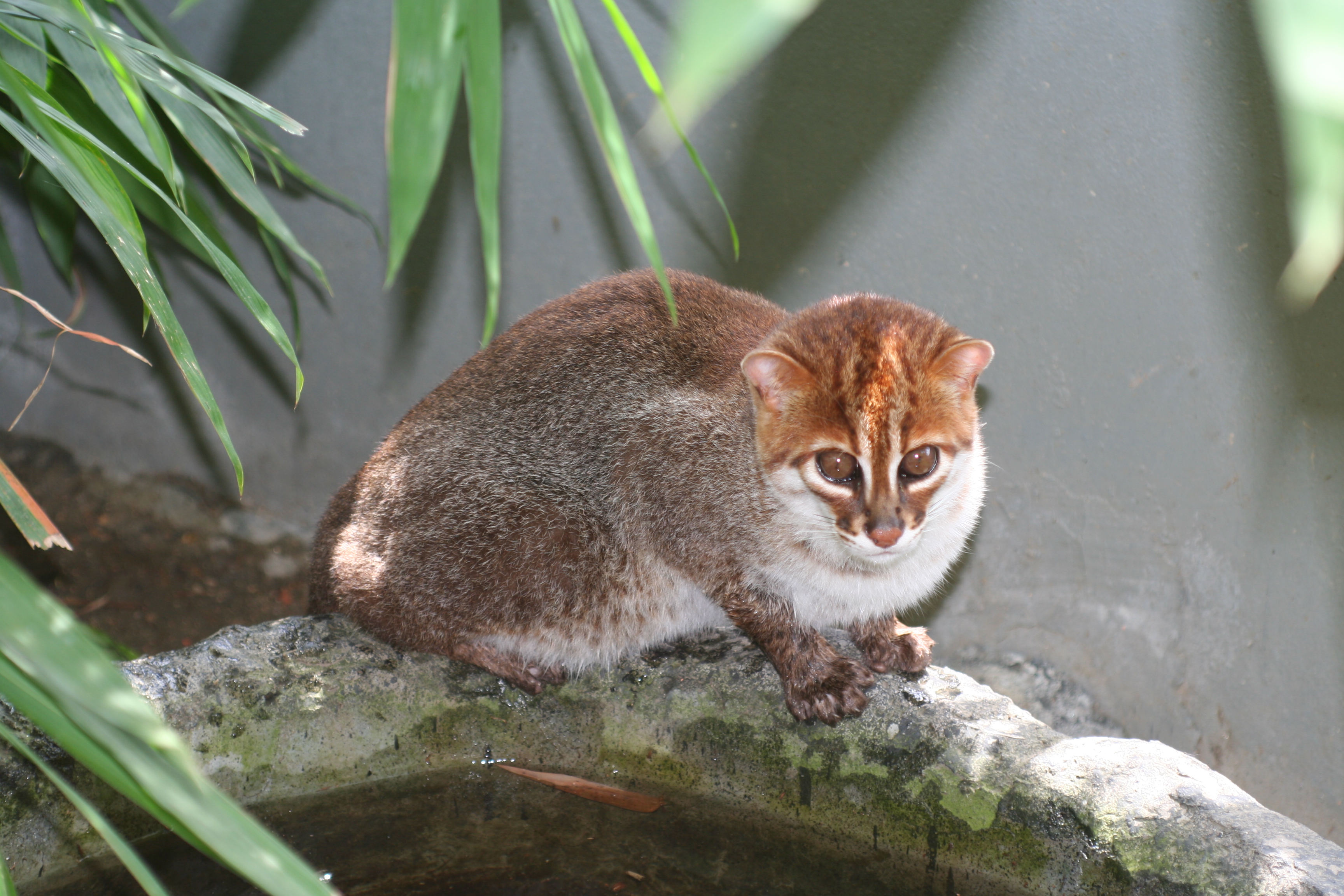
The flat-headed cat is named for its flattened forehead and long skull. Panthera describes it as the smallest wild cat in Southeast Asia, weighing less than half as much as a typical domestic cat. It has a short, tube-shaped body, slender legs and a stubby tail, and it is thought to be most closely related to the leopard cat and the fishing cat.
In the reference work Wild Cats of the World (Sunquist and Sunquist, 2002), the cat's head-and-body length is given as 41 to 50 centimetres, with a short tail of 13 to 15 centimetres, and its weight as 1.5 to 2.5 kilograms.
Its fur is reddish-brown on top of the head and a dark, grizzled brown on the body, with a mottled white underside. The face is lighter than the body, and the muzzle and chin are white. Two pale, buff-white streaks run on either side of the nose between the eyes. The ears are small and rounded, and the eyes are set close together, which gives the cat good depth perception.
Several features suit it to catching slippery prey in water. Its teeth are unusually long and its front upper premolars are larger and sharper than those of other cats, and strong jaw muscles help it grip what it catches. The sheaths of its claws are reduced, so about two-thirds of each claw stays exposed, and skin webbing between the toes gives it a better grip on mud and in water. Panthera also points to the webbed toes as an adaptation to the wetland and peat-swamp forests where the cat lives.
The species was first described scientifically in 1827 by the zoologists Nicholas Aylward Vigors and Thomas Horsfield, who named it Felis planiceps from the skin of a specimen collected in Sumatra. The genus name Prionailurus was proposed in 1858 by the Russian naturalist Nikolai Severtzov for the spotted small cats of Asia, and the flat-headed cat is now placed in that genus.
A hunter of rivers and swamps
Because it lives in thick vegetation in wet places, the flat-headed cat is very difficult to study, and camera-trap photographs of it are rare. Flat-headed cats recorded in Kalimantan, Indonesian Borneo, were active mainly at night. They are presumed to live alone and probably mark their home ranges with scent; in captivity both males and females spray urine while walking forward in a crouch. An adult captive female, however, was most active at dawn and dusk, between 8:00 and 11:30 in the morning and between 18:00 and 22:00 in the evening. Panthera says that in the swamps of Malaysian Borneo the species is most active at dawn and dusk.
Fish make up most of its diet. The stomach of an adult shot on a Malaysian riverbank held nothing but fish. Captive cats readily take live fish, plunging their whole head under water, and usually carry the catch at least two metres away from the water, apparently so that it cannot slip back. They show far more interest in prey in water than on land. Flat-headed cats are also reported to hunt frogs and are thought to catch crustaceans, and they take rats and chickens. Panthera describes the cat as an apex predator of its wetland and peat-swamp habitats, where it competes with other animals for aquatic food.
Little is known about breeding in the wild. In captivity, pregnancy lasts about 56 days. Of three litters recorded in captivity, one had two kittens and the other two had a single kitten each. Two captive flat-headed cats lived for 14 years. Adults purr and make other short-range calls, and the calls of a kitten resembled those of a domestic kitten.
Where the flat-headed cat lives
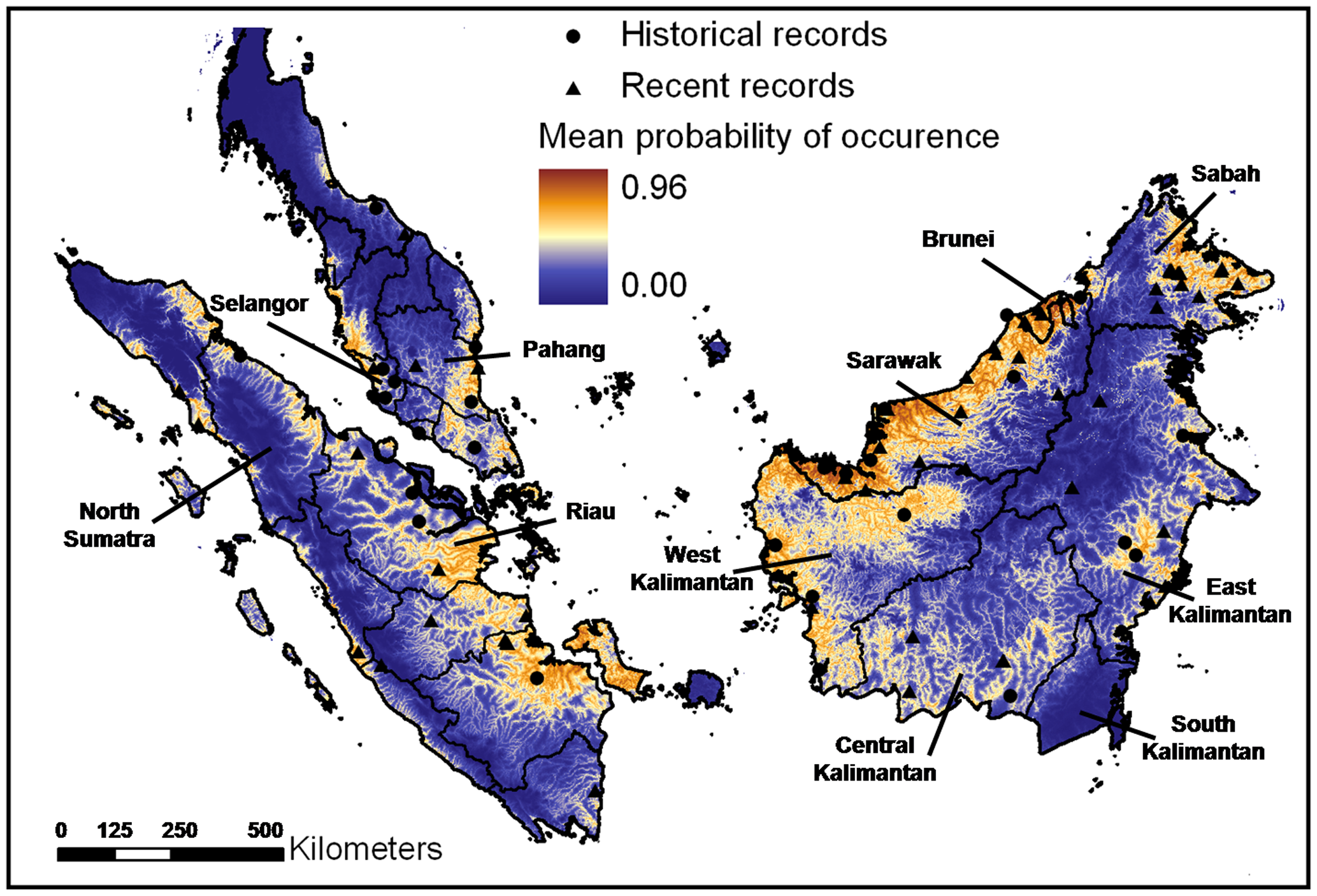
The species is found only in lowland tropical rainforest in the far south of Thailand, Peninsular Malaysia, Sumatra and Borneo, the island shared by Brunei, Indonesia and Malaysia. It lives mostly in freshwater habitats near the coast and in the lowlands, such as mixed freshwater swamp forest and lowland swamps beside rivers.
The most detailed study of its range, published in the peer-reviewed journal PLOS ONE in March 2010 by Andreas Wilting and colleagues, gathered every record the authors could find from field surveys, published literature and museum collections. At the Clouded Leopard and Small Cat Summit of the IUCN Cat Specialist Group in January 2009, only 14 records of the species had been compiled. The team assembled 107 records, 47 historical and 60 recent, of which 88 were independent locations. The oldest, a museum specimen in Berlin, dated from 1864.
The study found that distance to water was the strongest predictor of where the cat occurs, explaining more than half of its distribution. More than 70 per cent of the records were collected less than three kilometres from a major river or lake, and only four were more than eight kilometres away. Almost 80 per cent of the recent records and more than 90 per cent of the historical ones were below 100 metres above sea level.
For southern Thailand and Peninsular Malaysia, the paper reported recent records from four forest areas, one of them the To Daeng peat swamp forest in Thailand, the forest now protected as Princess Sirindhorn Wildlife Sanctuary. The authors listed that forest among the key localities for the conservation of the species. None of the scientists working in southern Myanmar could confirm the cat's presence there.
Later surveys added new sites. In Peninsular Malaysia, flat-headed cats were photographed in 2013 in Pasoh Forest Reserve, less than 1.5 kilometres from oil palm plantations. In Sarawak, one was seen and photographed on the bank of the Maludam River in Maludam National Park in 2013. On the Kampar Peninsula in Sumatra, camera traps recorded the species for the first time in 2015, and 11 records were obtained there in peat swamp forest up to 2019.
Princess Sirindhorn Wildlife Sanctuary, Thailand's largest peat swamp forest
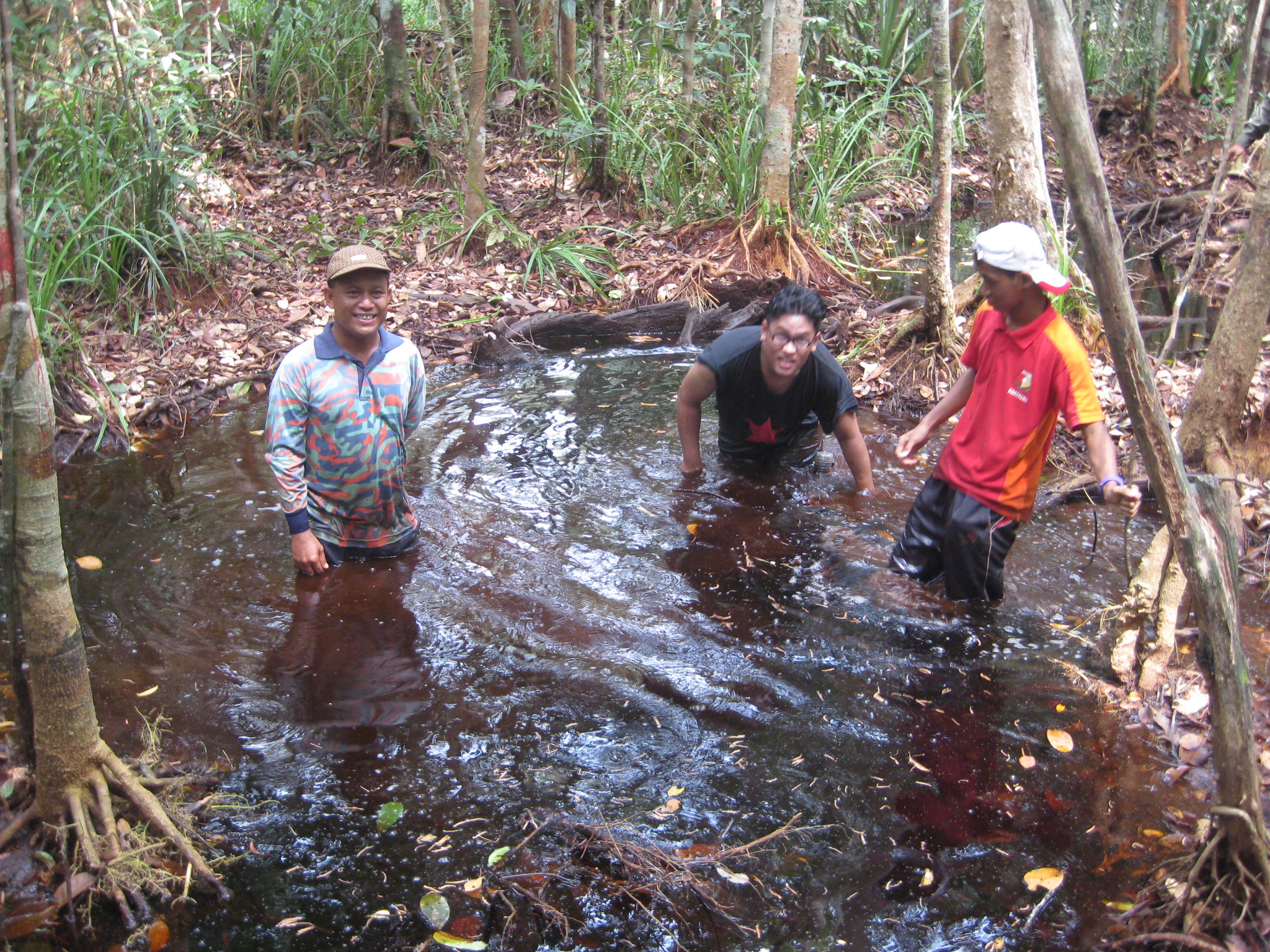
Princess Sirindhorn Wildlife Sanctuary is better known locally as Pa Phru To Daeng, the To Daeng peat swamp forest, after Khlong To Daeng, one of the three main watercourses flowing through it. Its official name honours Princess Maha Chakri Sirindhorn. The forest stretches across the Mueang Narathiwat, Tak Bai, Su-ngai Kolok and Su-ngai Padi districts of Narathiwat province.
According to the Ramsar Sites Information Service, the sanctuary covers 20,100 hectares and is the largest remaining peat swamp forest in Thailand. It was designated a Wetland of International Importance under the Ramsar Convention on 5 July 2001, as site number 1102. The Ramsar record lists 217 bird, 52 reptile and 62 fish species, 106 species of butterfly and 60 mammal species, including 13 species of bat, some of them nationally vulnerable or endangered. Surrounding communities use the forest for low-intensity fishing and for harvesting melaleuca trees for charcoal.
The forest has already suffered heavy losses. The Ramsar record says that development in the 1980s, mainly clearing for rice cultivation that failed within two years as the soil turned acidic, led to the loss of two-thirds of the forest area. The clearing was halted when the area was given wildlife sanctuary status in 1991.
A peat swamp forest is a tropical forest on permanently waterlogged ground, where fallen leaves and wood cannot fully decay. Over time this builds up a thick layer of acidic peat. In To Daeng the peat beneath the dark brown water is between half a metre and five metres thick, and trees stand on buttresses and stilt roots that support them on the spongy ground. Besides the flat-headed cat, the forest is home to the hairy-nosed otter and the black hornbill, one of 13 hornbill species in Thailand.
Peat swamp forests store large amounts of carbon in their soil and are among the most threatened and least studied forest types in the tropics. Since the 1970s their clearance and drainage have increased greatly in Southeast Asia. About 62 per cent of the world's tropical peatland lies in the Indomalayan region, mostly in Indonesia and Malaysia, with small pockets in Brunei, Vietnam, the Philippines and Thailand. Panthera's release said protecting these habitats is critical for the flat-headed cat, especially through proper management of water levels and fire prevention.
Why the species is endangered
The flat-headed cat has been listed as Endangered on the IUCN Red List since 2008, when its status was changed from Vulnerable. The most recent published assessment, by Wilting and colleagues, appeared in 2015. Panthera put the world population at an estimated 2,500 adults. The species is listed on Appendix I of CITES, the convention that controls international trade in wild species, and it is fully protected by national law in the countries where it lives, with hunting and trade prohibited in Thailand, Malaysia and Indonesia.
Panthera named the main threats as habitat loss caused by people, through land conversion, fishing, agricultural encroachment, hunting, pollution of waterways and the spread of disease from domestic animals. Competition for land shrinks the cat's range and leaves fewer places where it can live and hide, so it survives mostly in remote, undisturbed landscapes. Reference works add the clearing of wetlands and lowland forest for settlements, plantations, farming and aquaculture, the clearing of mangroves, overfishing and the spread of oil palm plantations. Some cats are caught by accident in traps set to protect poultry, and road accidents and competition with domestic cats may also be serious threats.
The 2010 PLOS ONE study estimated that between 54 and 68 per cent of the cat's suitable habitat had already been converted to unsuitable land such as croplands and plantations, and that only 10 to 20 per cent of the suitable land was fully protected under IUCN criteria. The remaining habitat was highly fragmented, with only a few larger forest blocks left. The authors suggested that the cat could serve as a flagship species for protecting other endangered animals of lowland forests and freshwater habitats in the region.
Hard to find, hard to study
The difficulty of studying the cat was described by the environmental news site Mongabay in May 2024. It reported that as recently as 2019 only around 40 camera-trap records of the species existed, and that it was not even clear whether the cat still survived in southern Thailand, the northernmost edge of its range. A study published in 2017, Mongabay wrote, found that camera traps running for more than 100,000 nights across Borneo, Sumatra and Peninsular Malaysia had produced only 46 detections of flat-headed cats.
Mongabay also reported that in 2021 researchers in Malaysia caught and radio-collared a female flat-headed cat, which sent back data for nearly two months. The data suggested that the cat moves within a small area, up to about two kilometres, compared with up to 12 kilometres for a leopard cat, and that its core area covered only about 500 square metres. In the same report Panthera said it planned a range-wide survey of the flat-headed cat, including a pilot survey in southern Thailand to find out whether the species was still present there. Mongabay also noted that Songkhla Zoo in Thailand kept flat-headed cats and was studying them with a view to captive breeding.
Panthera's December 2025 release said the organisation also supports flat-headed cat research in Sabah, Malaysian Borneo, through satellite radio-collar tracking and camera trapping. Forty-two detections had been recorded there in prey-rich swamp habitats. With more than 200 cameras deployed across four Southeast Asian sites with local partners, Panthera said it was leading efforts to map the species' range and understand its threats, particularly disturbance from fishing and agricultural encroachment.
Its relatives in Bangladesh
The flat-headed cat belongs to Prionailurus, a genus of spotted small wild cats native to Asia that also includes the leopard cat, the Sunda leopard cat, the fishing cat and the rusty-spotted cat. Genetic studies suggest that the rusty-spotted cat was the first of the group to branch off, followed by the flat-headed cat and then the fishing cat.
The flat-headed cat does not live in Bangladesh, but two of its close relatives do. Banglapedia, the national encyclopedia of Bangladesh, lists eight species of wild cat in the country, among them the leopard cat (chita biral) and the fishing cat (mechho biral or mechho bagh), both recorded as widely distributed. Of the eight, six face different kinds of threat, and the fishing cat is among those listed as endangered in Bangladesh. Like the flat-headed cat, the fishing cat is a wetland hunter that depends on fish, so the loss of swamps and waterways threatens both.
Photo: Jim Sanderson / Wikimedia Commons (CC BY-SA 3.0)
Sources: Jagonews24, Panthera, Live Science, Ramsar Sites Information Service, PLOS ONE (Wilting et al., 2010), Mongabay, IUCN Red List, Banglapedia, Wikipedia
Comments
(0)