
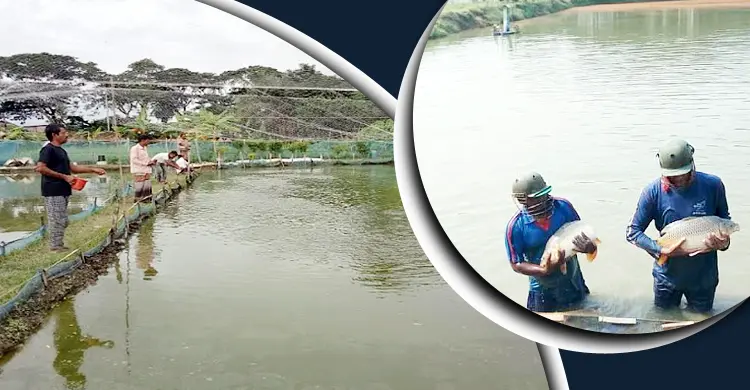
When winter arrives, fish farmers run into various problems with their fish. In the cold, fish eat much less. As a result, excess feed rots and ammonia levels rise in the pond. At the same time, through osmosis, the water runs short of the oxygen it needs, and ultimately fish die.
In the cold water of closed ponds, fish move less, so their metabolism slows and their appetite falls. The cold water also brings more outbreaks of various diseases. With shorter days, sunlight falls on the pond water for less time, lowering the water temperature.
Why winter is hard on fish
Fish metabolism, or digestion, generally works well at 28-32 degrees Celsius. Below that, digestion slows and so does growth.
With less sunlight, natural oxygen production falls, making it hard for fish to breathe. Fish start gasping at the surface, and they die from lack of oxygen. And because the production of phytoplankton in the pond water is disrupted, the amount of carbon dioxide dissolved in the water rises, which also makes breathing difficult for fish.
With natural food particles such as phytoplankton and zooplankton declining, fish run short of food and their growth slows.
The pH of water does not stay normal in winter. For fish growth, pH should be between 6 and 8. Below 6, the water becomes too acidic and fish lose interest in feed. Above 8, the water becomes alkaline, and excess alkalinity can kill fish.
In the winter season fish suffer from various parasitic, fungal and bacterial diseases. If fish are not properly cared for at this time, they can die from fish lice, nutritional diseases (blindness, bent bones), ulcer disease, tail and fin rot, gill rot and dropsy.
Caring for the fish farm in winter
- Keep tall trees on the pond banks cleared as far as possible, so that enough sunlight falls on the pond from sunrise to sunset. Raise oxygen in the water artificially.
- Raise oxygen in the water by pulling nets, swimming and beating the water with bamboo; in large ponds or ghers, artificial oxygen tablets such as SI Oxytab can be applied at 4 to 5 kg per acre in the evening.
- Pulling a net through the pond every 10-15 days also gives an idea of the fish's health, numbers and weight, and releases various harmful gases from the pond bottom.
- If fish die from the effects of the harmful gas ammonia, apply SI Amofree-L or SI Amofree-P at 5 ml per decimal with 20 ml of molasses, if needed.
- Clear away excess algae, dirt and rubbish, water hyacinth, weeds and all harmful aquatic plants.
- To keep the pond water's pH between 6 and 8, apply 6-7 kg of SI BioGeo Plus per acre at the start of winter, every 15 to 20 days or once a month.
- If pH rises too high, apply 2 litres of vinegar or an acidifier called Acidin per acre. If pH falls very low, apply 15-20 kg of SI Royal Geo per acre.
Feed, water and water quality
To boost phytoplankton in the pond, apply inorganic fertiliser, especially urea (4-5 kg per bigha a month) and triple superphosphate (5-6 kg per bigha a month), after soaking for 3 days. SI Phytogrow can also be applied at 3-4 litres per acre in strong sunshine.
To keep fish growing steadily in winter and improve their digestion of the main feed, a good-quality enzyme-rich growth promoter such as SI Grofish should be added to each kilogram of feed. This will increase the fish's appetite. Along with it, a good-quality immunomodulator gel such as SI Royal Gel must be mixed at 10 ml per kilogram of feed and fed for 15-20 days in a row.
Pond water usually falls in winter, so top up water as needed. Keep fish density normal or low.
If pond water becomes badly polluted, change the water. If needed, to prevent water pollution, scatter a good-quality granular soil probiotic such as SI Proclean directly into the water at 6-8 grams.
If needed, apply a good-quality disinfectant (SI Chlor-T) at one tablet per decimal and copper sulphate pentahydrate-10% (SI Phytoclean) at 30 ml per decimal.
To keep water quality up throughout winter, every 15 days apply a good-quality water probiotic such as SI Royal Pro, 500 grams mixed with 2 kg of brown sugar in clean water, per acre of water.
Source: Jagonews24. First published in Bengali on The Agro News.

Comments
(0)