
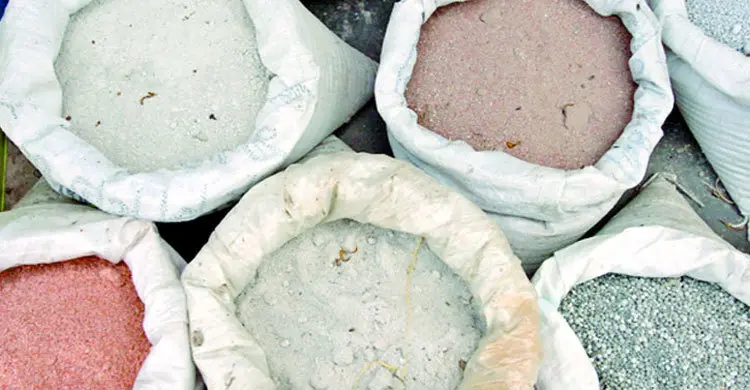
Various chemical fertilisers are used to grow crops, but some dishonest traders make and sell fertiliser mixed with adulterants. So it is important to be able to recognise genuine fertiliser, and with a little care the difference between real and fake is easy to see. Here is how.
Urea
The granules of genuine urea are uniform, so the first thing to check when buying is whether the granules are all the same size. Powdered glass or salt is added to urea as an adulterant. If a little urea is heated on a teaspoon, it should melt within a minute, giving off the sharp smell of ammonia. If it does not melt with a sharp smell, the fertiliser is adulterated.
TSP
TSP does not dissolve in water straight away. Genuine TSP mixes with water after four to five hours, but adulterated TSP dissolves or mixes with water within a short while.
DAP
If a little DAP is warmed on a spoon, it should melt within a minute with the sharp smell of ammonia. If it does not melt, the fertiliser is entirely fake; if it melts only partly, it is partly adulterated. Also, if some DAP is held in the fist, lime is added and the two are rubbed together, a sharp smell of ammonia should come out. If it does not, the fertiliser is adulterated.
MOP (potash)
Brick dust is mixed into this fertiliser. If MOP, or potash, is stirred into a glass of water, the fertiliser dissolves. But brick or anything else mixed in will not dissolve and stays at the bottom of the glass, so the sediment shows at once whether the fertiliser is real or fake.
Zinc sulphate
Potassium sulphate is mixed into zinc sulphate. To check, take a pinch of zinc sulphate in the palm with an equal amount of potassium sulphate and rub them together: it will feel cold and melt like yoghurt.
Source: Jagonews24. First published in Bengali on The Agro News.

Comments
(0)