
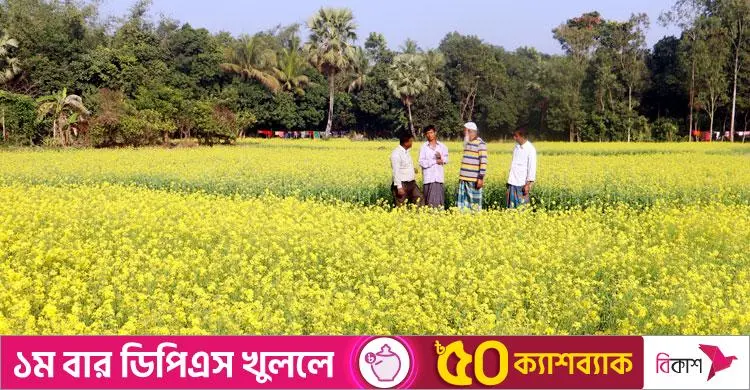
Feni's farmers are hoping to recover from the devastation that the August flood, the worst in living memory, caused to agriculture. Along with trying new crops, they have sown mustard on more land than last season, and than the target, according to the report. Agriculture officials say: "There is a chance of a bumper mustard harvest in Feni this season, which will make it easier to overcome the flood losses. The August flood caused Tk 446 crore of damage to agriculture in Feni."
Area has risen year after year
According to the Department of Agricultural Extension (DAE) in Feni, the district's mustard target this season was set at 6,500 hectares, and mustard has so far been sown on 6,064 hectares, with sowing still under way in various places. Because mustard is more profitable than other crops, interest is growing. Mustard was grown on 3,494 hectares in 2023, 1,806 hectares in 2022, 1,907 hectares in 2021 and 1,680 hectares in 2020, so the area has grown steadily. The DAE says this year's area has doubled compared with last season.
Of Feni's six upazilas, Sonagazi has the most mustard. Its target this season is 2,648 hectares, of which 2,550 hectares have been sown so far, against 2,470 hectares last year.
In Sadar upazila the target was 1,950 hectares and 2,070 hectares have been sown, against 1,930 hectares last year. Chhagalnaiya exceeded its 620-hectare target with 650 hectares, against 580 hectares last year.
In Fulgazi the target was 680 hectares and 682 hectares have been sown, against 635 hectares last year. In Parshuram the target was 242 hectares and 205 hectares have been sown, against 226 hectares last year. In Daganbhuiyan the target was 240 hectares and 200 hectares have been sown, against 225 hectares last year.
Free seed and fertiliser
Jhantu Kumar Nath, sub-assistant agriculture officer of Lemua union in Feni Sadar, said: "Mustard cultivation has increased in Lemua union, with mustard grown on about 150 hectares. Flood-hit farmers will be further encouraged by mustard and will benefit financially."
Md Ekram Uddin, deputy director of the district DAE, said: "Flood-affected farmers can become financially self-reliant by growing mustard. After the Aman harvest, 12,000 farmers were given oilseed and pulse seed as incentives, with seed and fertiliser worth about Tk 1,21,24,400 distributed. To encourage mustard cultivation, 5,000 farmers were supplied with free fertiliser and seed."
Source: Jagonews24. First published in Bengali on The Agro News.

Comments
(0)