
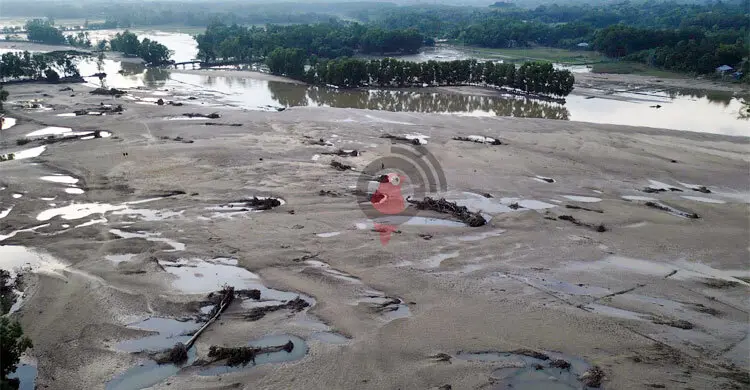
Feni in the south-east of the country has been hit by the most devastating flood in living memory. Homes, roads, trees and cropland went under the floodwater, and lakhs of people were marooned. The water has now receded, and as it goes, the full picture of the district's losses is emerging.
The current of the Muhuri river has broken miles of road. At the same time, sand carried by the river water has buried cropland in various parts of Feni. Countless fields have become unfit for cultivation, and Feni's farming people are worried about their livelihoods.
A visit on Monday (2 September) to various areas of Parshuram and Fulgazi upazilas of Feni found that huge amounts of sand brought by floodwater from the Muhuri river had settled on cultivated land. The floodwater has gone, but the sand on the farmland has not.
Up to 6 feet of sand
In No 1 Mirzanagar union of Parshuram upazila, which borders India and lies along the Muhuri river, sand 4 to 6 feet deep has fallen on cultivated land. Several thousand people in this village live by growing various vegetables, paddy and other crops on these fields.
Local farmers say the sand has put the area's cropland at risk for the next 10 to 15 years. Farming will not be possible on this land until the sand is removed.
The Bollamukha canal embankment lies on the zero line of the border at Nij Kalikapur in Mirzanagar union. After this embankment was cut, the water of the Muhuri river flowed over the cropland of Nij Kalikapur village and on to other parts of Feni. The Bollamukha canal starts at Nij Kalikapur and runs through Rangamatia, Fakirer Khil, Uttar Kautali, Bainna village, DM Sahebnagar, Melaghar, Mirzanagar, Gadanagar, Purba Sahebnagar, Sunar Bazar and Kalikrishnanagar villages before joining the Silonia river. As a result, farmland in these areas has been damaged and made unfit for cultivation by sand.
Local farmers and villagers said that unless their land is repaired quickly, farming will not be possible in the area even in the next 20 years. When a similar flood struck in 1983, the area could not be farmed properly for the following 10 years. The land had become fit for cultivation over the past 10 years, but the flood has ruined it again. As well as the sand, numerous pits and holes have destroyed the level of the fields.
Those affected say there is no way to sell the sand either, as all the roads around have been destroyed. "Everyone is giving relief now and we are eating that. In a few days we will face a food crisis. If we cannot grow paddy year after year, we will run short of rice. We will have to change our occupation," they said.
Farmers' accounts
Alam Hossain, a farmer from Nij Kalikapur village, told Jago News: "Because of the Muhuri water, 1 kani of my farmland has been damaged. Sand has piled up in various places and buried trees and crops. After the embankment was cut, a huge torrent of water about 10 feet high went over our fields."
"No paddy can be grown in so much sand. With the land raised, we will not get water in the dry season either. So there will be no crops for the next 4 or 5 years. Most people in this border village are farmers. Until the sand is removed, farming here will not be possible from next year. Also, with no grass in the fields, there is a shortage of fodder for livestock," he said.
Another farmer, Yusuf Ali, said: "Because of the sand there is now no chance to grow paddy or other crops on the land. Sandbanks have formed in various places. Now the sand must be removed to make the land fit for farming again. At the same time the embankment must be repaired to protect us from floods like this."
It is not only Parshuram: the sand carried by the floodwater has also fallen on cultivated land in Fulgazi and Sonagazi upazilas of Feni and destroyed crops. But since there is less sand in these areas, farmers said the land could be made fit for cultivation if it were repaired quickly.
Firoz, a sharecropper in Fulgazi upazila, told Jago News: "After the flood some fields have become deeper, and others have been raised by sand. The seeds have been ruined under the weight of sand. We farm other people's land and live on half the crop. In various places more than 1 foot of sand has built up, and even shifting it with spades will take a long time. Without help from the administration, farming will be difficult."
Tk 451 crore in crop losses
Ekram Uddin, deputy director of the Department of Agricultural Extension (DAE) in Feni, told Jago News: "The damage is greatest where the sand entered Parshuram. Removing sand from the land is very difficult. We will try. The Water Development Board must also be informed. We will arrange compensation for farmers. Now the top priority must be building the embankment."
According to the district DAE, crop losses alone in the six upazilas of Feni district from the devastating flood exceed Tk 451 crore 20 lakh, affecting more than about two lakh farmers. In all, 30,352 hectares of cropland in the district have been damaged, 79.69 per cent of the total. This includes 1,865 hectares of Aman seedbeds, 26,000 hectares of Aman, 1,854 hectares of Aus, the entire 525 hectares of autumn vegetables planted, 69 hectares of orchards, 7 hectares of ginger, 16 hectares of turmeric and 16 hectares of sugarcane.
Source: Jagonews24. First published in Bengali on The Agro News.


Comments
(0)