
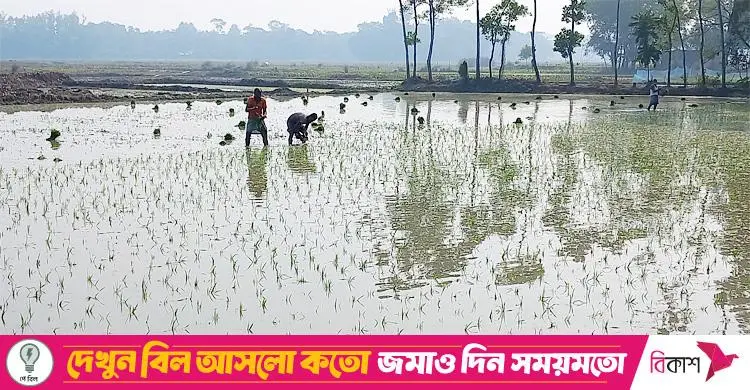
Boro cultivation in Feni's six upazilas is exceeding its target this season, as farmers have turned to boro with extra enthusiasm to make up for heavy flood losses in the last aman season. Seed, fertiliser and other government support under post-flood rehabilitation have encouraged them further. But farmers are uncertain about having enough water for irrigation.
According to the district agricultural extension department, 5,115 hectares of hybrid have been planted against 5,335 hectares, and 21,680 hectares of high-yielding varieties against 25,965 hectares, across the district's six upazilas. Boro planting will continue until 15 March, and the agriculture department is hopeful that boro will be grown on more land than the target.
The source said the seedbed target was 1,511 hectares, and seedbeds have already exceeded the target by 100 hectares, so cultivation is also likely to be higher.
Md Ekram Uddin, deputy director of the district Department of Agricultural Extension (DAE), said that thanks to incentives, more vegetables and other rabi crops have been grown than in other years. Mustard, grass pea and various other crops have started to be harvested, and farmers are preparing to plant boro on this land once the rabi harvest is over.
Worries over irrigation
A field visit found that although farmers started early using flood and rain water, they are anxious about water towards the end of the season.
"As soon as winter ends and the heat arrives, a power crisis starts, and then we cannot water the boro fields as needed. Besides, irrigation machines broke down in various parts of the district in this year's flood, so farmers are worried about water from the very start," said Abu Taher, a farmer from Omrabad village in Dagonbhuiyan upazila.
Abdul Haque, a farmer from Bir Chandra Nagar in Parshuram, said about 8 acres used to be farmed under his pump. It was ruined in the flood this time, so he is buying water from a neighbouring pump at a higher cost. Several shallow tube wells in the area were damaged in the flood, so farmers are getting water from nearby pumps, and others are unsure whether the water supply will stay normal to the end.
According to the government's figures, more than 800 fewer irrigation machines are running. Of the 17 deep tube wells used in the last boro season, 13 are running this time. In addition, 2,391 of 2,930 shallow tube wells and 1,031 of 1,235 LLPs are running.
Pushpendu Barua, additional deputy director (crops) of the agriculture department, said more boro is being grown this time than last year, and he is hopeful that production too will exceed the target if the water supply stays normal.
Md Ekram Uddin, deputy director of district agricultural extension, said farmers have become more keen on boro after receiving post-flood farm incentives, and the extension department is advising them in various ways to help them recoup their flood losses.
Source: Jagonews24. First published in Bengali on The Agro News.

Comments
(0)