
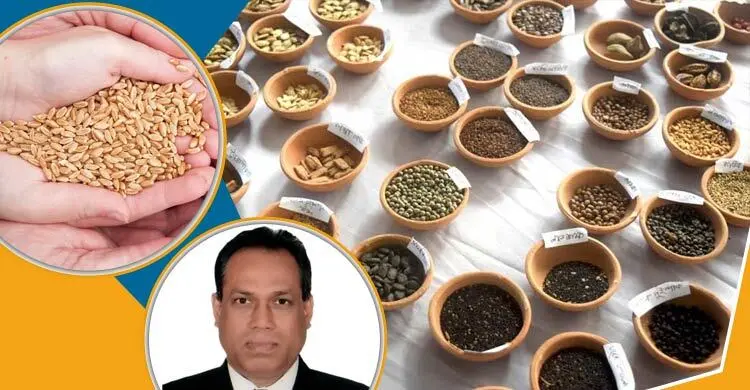
For hundreds of years farmers around the world have acted as guardians of crops and of new varieties of crop seed. Policymakers often see recognising farmers' ancient right to produce and save their own seed, alongside commercial varieties, as a challenge. But farmers are becoming increasingly aware of their rights and of the value of their own varieties. As farmers put it: "It is my right to say that the local crops I grow are mine, and no one else controls my seed. Whether I sell it or not is my decision."
Today researchers multiply the yields of farmers' local seed and then sell it back to farmers. But when farmers grow the crop, it no longer serves as seed, and researchers say farmers need to buy seed every year. In the past, farmers could use their local seed again and again. As before, farmers can still use their local varieties, which also serve the culture, traditions and social rituals of their children and later generations. Besides their families, seed is the one thing farmers hold closest to their hearts.
They are proud to be farmers. Farmers feed and support their children; indeed, farmers feed the world. So readers will surely agree with farmers on how important it is for them to keep their own seed. Farmers now have the right to know how well they can save their seed. We can ask farmers: where do they get their seed? Do they keep some from the previous crop? Do they swap some with other farmers, or sometimes buy from the local market? Some of us buy seed from farmer organisations or local agricultural agents. However, the varieties they sell are mostly produced elsewhere and often have to be bought every season at a high price.
Local varieties and culture
Local crop varieties grow well in our country's climate, and we have some fine varieties worth praising. They need to be preserved to maintain our cultural identity. When your child marries, when you invite someone as chief guest or hold a festival in your village, the guest must be welcomed with local rice as part of the celebration and music. Farmers say: "We are very happy that we have got back seed from our ancestors. We elders know that when you cook local rice, it smells lovely, the jau (rice porridge) is thicker, and you enjoy eating it."
Local varieties also play an important part in helping farmers adapt to climate change. Farmers say: "In the past there was no one to look after us, so we only grew rice. But now we can see how the rain is changing year after year. We get this information from experts. We also have extra information about different crop varieties, so when one crop fails, we profit from another."
As the weather changes, crop breeders increasingly rely on local varieties to develop modern ones that meet new needs. In a farmer's words: "They cannot get the varieties they need without our local seed. They rely on germplasm collected from local seed, which farmers like us produce. As soon as they gather seed from us, they cross two seeds to improve quality, and they keep doing so until they get the seed they want. So they cannot do their work without our help."
Seed laws and an international treaty
Seed laws discourage farmers from saving seed, making it harder to preserve the seed that breeders depend on to develop new, modern varieties. Fortunately, the government has recognised farmers' rights. Did you know that our government has signed an international treaty on plant genetic resources for food and agriculture? It did so together with the governments of 140 countries. The treaty reminds us of our right to share and sell farm-saved seed and to protect our traditional knowledge. It also recognises our right to take part in decisions and to share in the benefits arising from the use of seed.
Farmers say: "Seed breeders benefit not only from our seed but also from our knowledge and experience. Because we produce seed locally as its owners, they can learn a lot from us. So when they come to us with their varieties, they first check our experience and then apply it. In the end it looks as if they have come to us with a special variety of their own knowledge. But we are the ones who can help them. So we must make sure we learn about our own rights and stand up for ourselves. We must always use our government's laws to actively save, use, exchange and sell our own local seed."
Seed fairs
Farmers also say: "I know some of our rights are like those of other entrepreneurs; we farmers need support too. One way to share our local crop varieties is the seed fair. Our farmers come to exchange and sell their local seed. The opportunity for crop diversity this way is truly remarkable. We discuss traditional crop varieties, to make sure they are not lost, that our children will know about them, get them and not lose them. Women exchange seed and knowledge, not only on growing crops but on how to prepare and eat them. Seed fairs give young people the chance to learn from their elders about local varieties and lost crop varieties. Some even think of business opportunities in producing local varieties.
"When I learned about this seed and food fair, I became interested in growing other diverse foods such as potatoes, millet, groundnuts and beans. This seed fair is very important to me because I saw many new varieties. I saw local barley of both young and mature kinds, and also some particular crop varieties I had never seen before. We have not lost anything, but we want to secure the crops our parents grew. We are young, and we want to be part of this."
Community seed banks
Another big way to support farmers' rights is the community seed bank. Farmers deposit local seed in community seed banks to make sure it is available at planting time. A farmer says: "When we keep seed at home, we think of selling it to buy certain necessities. Or we sometimes find the children use the seed kept for planting. But when we deposit seed in the seed bank, we can rest assured that we have seed, because when the rain comes, we get this seed for planting."
"To sustain community seed banks, government seed laws should allow farmers to use local seed. We need government support to sustain the country's local varieties and knowledge. Farmers must work together in groups or clubs to save seed and make the government hear their demands, so that what they want is demanded by many at once, and the government will listen. These groups will work with NGOs and speak with one voice, stressing the need to save their own local crop seed."
Let us make sure our voices are strong when decisions vital to us are made, and that we get the most from the varieties we have improved for ourselves and the useful new varieties introduced for us. Above all, farmers' rights are our rights. We will stay together for a better future for our families and our country. If farmers stand together and speak in one voice, the government will listen and act on farmers' rights.
Source: Jagonews24. First published in Bengali on The Agro News.
Comments
(0)