
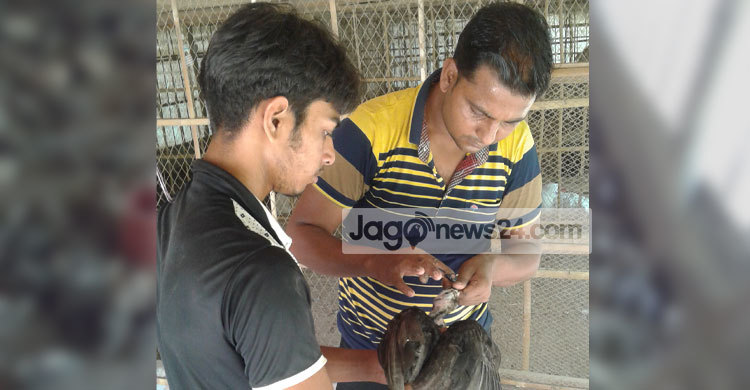
With self-belief, will, patience and effort, there are many ways to earn a living. A young man named Chunnu has set such an example. His quail farm has stirred the unemployed in his area, and he has become self-reliant. Following his lead, jobless young men in Faridpur are increasingly turning to quail and turkey rearing, and with good demand and prices, many are becoming self-reliant.
Chunnu Mia, son of Abdul Malek Mia of Ghanashyampur village in Machchar union of Faridpur Sadar upazila, started rearing quail a few years ago with Tk 16,000 of capital. His capital now stands at Tk 23 lakh, and he rears turkeys and guinea fowl as well as quail.
In a household short of money, Chunnu could not study far. He studied up to class nine and has had to support the family ever since, so he could not continue his education.
How the farm began
Chunnu is the fifth of five brothers and one sister, and is the father of a son and a daughter. He began with Tk 16,000 of his own, leasing 20 decimals of land near Khalilpur bazar at Tk 10,000 a year and building a shed for the quail farm. Setting it up cost Tk 58,000 in all; apart from his own Tk 16,000, a relative provided the rest.
Jago News spoke to Chunnu at the 'Friend Quail Hatchery Turkey and Guinea Fowl Farm' beside Khalilpur bazar. He said he started the farm with 335 quail brought from Naogaon at Tk 10 each, or Tk 12 including transport. Each quail lays 300 eggs a year, he said, and when they stop laying he sells them for Tk 30/35 each. He does not sell the eggs, but hatches them and supplies chicks to at least 25 farmers in Faridpur, Rajbari, Gopalganj, Madaripur, Shariatpur and other districts.
Using an incubator he bought two years ago, Chunnu hatches and sells an average of 30,000 quail chicks a month to farmers. Some time after starting with quail he tried layer chickens but did not do well with them. Now he rears turkeys and guinea fowl alongside quail, having become interested after learning about them on the internet.
Prices and hatching times
He said guinea fowl and turkeys are sold by weight. Guinea fowl are usually bought by hobbyists to keep as ornamental birds, at Tk 900 a kg. Turkeys are sold for meat, which is firmer than chicken, cholesterol-free and tasty, at Tk 800 a kg. A turkey yields from eight or ten up to 18 kg of meat. Quail eggs take 18 days to hatch, while turkey and guinea fowl eggs take 28 days.
Chunnu complained that little help is available at the district animal hospital, and often no one can be found there. With the hospital's support he could have profited more, he said.
"My livelihood has come through quail," Chunnu said. "Because of poverty I could not study much, so instead of trying in vain for a job I went straight into quail rearing and became a farmer. Quail has kept me alive, and given me financial comfort and recognition too."
Officials respond
Faridpur district livestock officer Dr Md Habibul Haque said it is a good sign that the district's young people are being encouraged to rear quail. Calling quail farming very profitable, he said the birds eat little and hardly suffer from disease. Asked about the difficulties at the animal hospital, he said: "We have a severe shortage of manpower. So even though we want to, we are failing to provide the service expected."
Asked how many quail farmers there are in Faridpur, the livestock officer said there are no complete statistics at the moment, but data collection has begun and the number will be known soon. The number is rising day by day, he said.
Faridpur deputy commissioner Umme Salma Tanjia said the present government has been giving various training to make unemployed youths self-reliant. Officials of youth development, the fisheries department, agricultural extension, BSCIC and others in the district have been strictly instructed to give unemployed and educated young people training and every facility. As a result, many jobless young people in Faridpur are now turning to cattle, quail or turkey rearing, and many are becoming self-reliant.
Source: Jagonews24. First published in Bengali on The Agro News.

Comments
(0)