
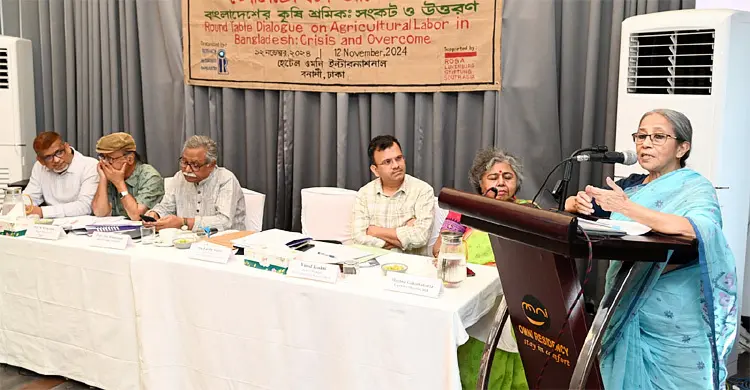
Calling for a wage-based relationship with farmers, Fisheries and Livestock Adviser Farida Akhter has said that contract farming would leave farmers without an independent existence. Contract farming is not connected with farmers, she said; big companies are operating while destroying agriculture, and "we have to see how much farmers benefit from it".
She made the remarks as chief guest at a roundtable titled "Agricultural Workers of Bangladesh: Crisis and Solutions" at Hotel Omni International in the capital on Tuesday morning (12 November).
Prices, imports and tobacco
The adviser said workers' survival is not tied to wages alone. Farmers do not get fair prices for their crops, yet when the price of rice rises various problems arise, and food often has to be imported. If food were procured from farmers at good prices with subsidies, imports would no longer be needed, "but we are not doing that", she said.
Farida Akhter said tobacco farming is growing in the country like indigo farming once did. Many farmers are being forced to give up food crops and turn to tobacco, which is extremely dangerous, she said. Women workers in tobacco farming face greater risks to their lives, and in many cases pregnant women in the work are losing their babies.
She said we need to consider how agriculture is losing importance in GDP in a planned way, and called for more attention to the point that development does not mean agriculture's share of GDP should shrink while other sectors grow. The green revolution in agriculture has turned grey, she said: the use of fertiliser and pesticides in the sector is driving up cancer and other non-communicable diseases, and everyone needs to be more aware of this.
Speakers' demands
Speakers called for priority to be given to fair wages, social protection and equal opportunities for Bangladesh's agricultural workers, especially women. They highlighted the problems of the country's farm workers, wage disparities and the struggle for their rights, and spoke of the risks to grain production from unfair crop prices and transport problems.
The discussion, organised by Research Initiatives, Bangladesh (RIB) with the support of the Rosa Luxemburg Stiftung (RLS), was chaired by RIB board member Professor MM Akash. Sher-e-Bangla Agricultural University Vice-Chancellor Professor Dr Abdul Latif spoke as special guest.
Other speakers included Jahangirnagar University Professor Anu Muhammad; Sanjida Sultana, additional executive director of Karmojibi Nari; Dhaka University Professor Monirul Islam Khan; RIB Director Suraiya Begum; RLS Project Manager Vinod Kosti; Roushan Jahan Moni, deputy executive director of ALRD; Anwar Hossain Reza, general secretary of the Bangladesh Khetmajur Samiti; Sheikh Mostafa Nurul Ashin, joint convener of the Bangladesh Krishak Samiti; and agricultural workers Mithu Sakidar and Rina Munda.
Source: Jagonews24. First published in Bengali on The Agro News.

Comments
(0)