
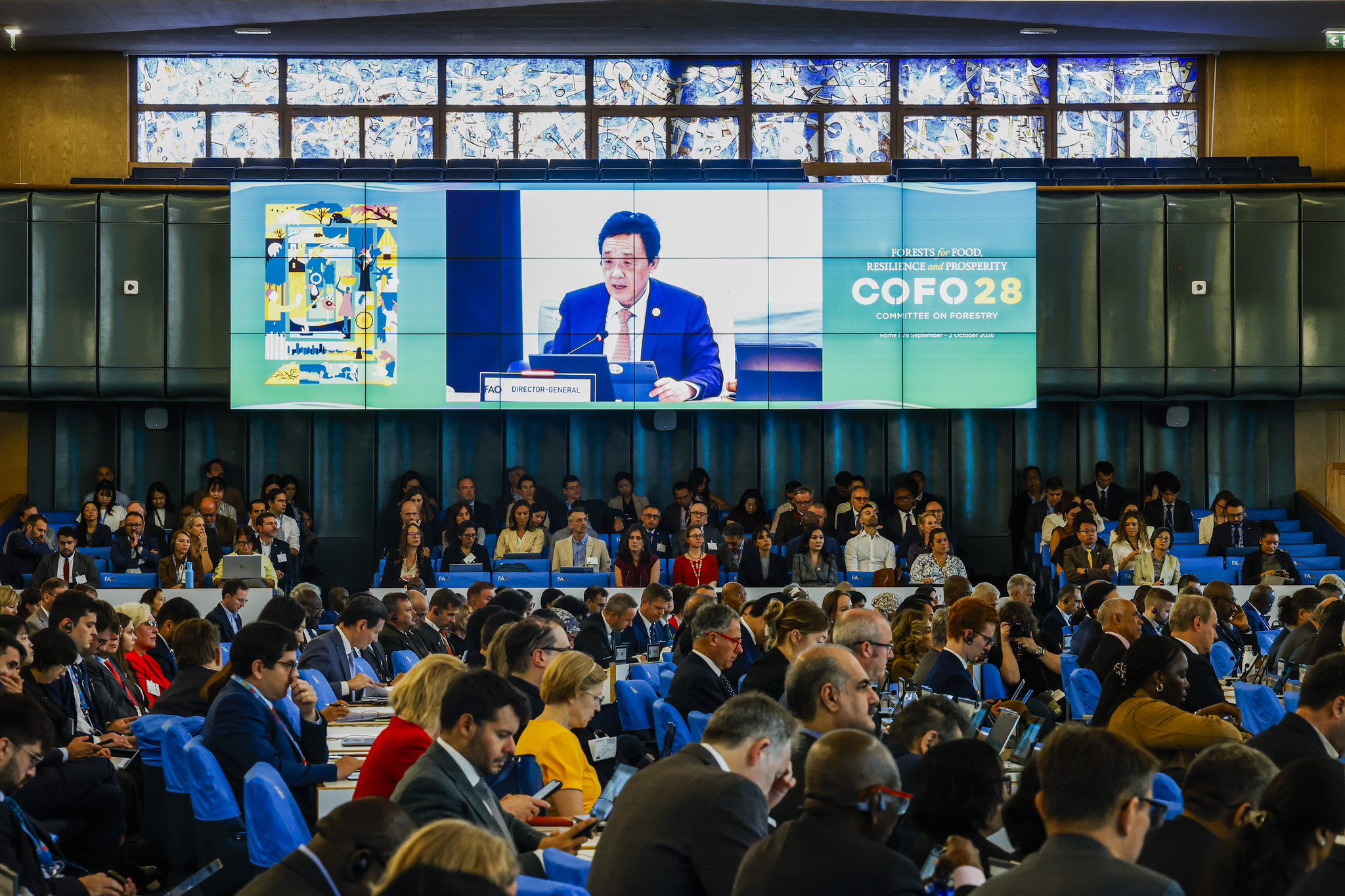
The 28th Session of FAO's Committee on Forestry (COFO) opened in Rome on Monday with a call from Director-General QU Dongyu for forests to be better integrated into food security and development policies, since many of their contributions are still missing from national statistics and strategies.
"With forests facing many threats, such as deforestation, wildfire, pests and unsustainable management, the role of COFO is more important than ever," Qu said. More than 5 billion people rely to some extent on forests for their livelihoods, and in some forest-dependent communities forest foods supply up to 80 percent of daily protein intake and half of all food eaten by weight.
Wildfire was a particular concern: fires affect at least 127 million hectares of forest a year and are becoming more frequent and severe in many regions. FAO says it is working with members through its Global Fire Management Hub on integrated fire management and cross-border cooperation.
At a high-level dialogue after the opening, Qu presented Forests for food: Nourishing people, sustaining the planet, prepared by FAO and the Landscape Alliance with partners of the Collaborative Partnership on Forests. It finds that forests support diets and livelihoods through more than 50 000 wild species used for food, energy, medicine and materials, at least 10 000 of them eaten as food, and that forests contribute up to 20 percent of household income in many rural areas.
The report also stresses what forests do for farming: protecting soils, sustaining pollinators, cycling nutrients, providing fodder and shade, and shielding crops and livestock from extreme weather. It sets four priorities: bringing forests and trees into national food security strategies, better data and research, scaling up sustainable forest management, and secure tenure with inclusive governance.
The session also launched the 2026 State of the World's Forests report on restoration. COFO and the 10th World Forest Week run until 2 October, with sessions on agroforestry, the forest bioeconomy, wildlife management and forest monitoring.
Photo: ©FAO
Source: FAO Newsroom


Comments
(0)