
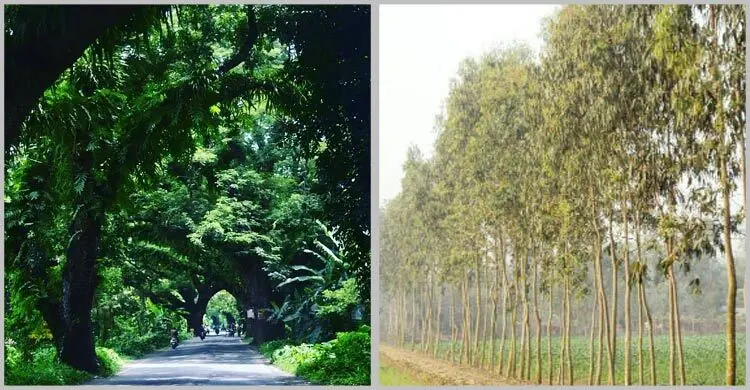
In the intense heat there is a rush on Facebook to plant trees, with people announcing how many they have planted. Because they are cheap and fast-growing, many are planting eucalyptus and rain tree. Yet because eucalyptus absorbs large amounts of water, the Ministry of Environment and Forests banned the production of its seedlings by a notification in 2008. On social media too, eucalyptus and rain tree are described as harmful and bad for the environment, and people are discouraged from planting them or raising seedlings. Still, tree lovers are not backing away from planting the two species.
Eucalyptus and rain tree are exotic plants (brought in from abroad), like mahogany and teak, that have adapted well to Bangladesh's environment.
Eucalyptus is a timber tree native to Australia. Three kinds are usually seen in Bangladesh: camaldulensis, citriodora and tereticornis. Rain tree, on the other hand, grows naturally in various countries of South Africa.
Why eucalyptus is discouraged
According to scientific research, eucalyptus is discouraged broadly for two reasons: it has some adverse effect on biodiversity, and it takes up too much water. Rain tree has no particular harmful side. Rather, because it grows fast and has a large canopy (branches and foliage), it quickly gives shade and helps cool the surroundings.
Although eucalyptus has been banned, it has not yet been possible to get rid of it. The reason given is that the country's poor farmers and disadvantaged people grow trees mainly for cash, and eucalyptus is their first choice: its seedlings are cheap, it grows fast, and with few branches it does not shade other crops. Teak, mahogany and other timber trees take at least 15 to 20 years to give good timber, whereas eucalyptus needs only five to eight. Having earned cash quickly from eucalyptus, they grow other crops or eucalyptus again on the same land.
Dr Md Shahriar Zaman, chairman and associate professor of the Department of Agroforestry and Environmental Science at Sher-e-Bangla Agricultural University, told Jago News that farmers across the country, particularly in the north, had planted eucalyptus haphazardly on paddy field ridges and cropland. It was banned because it reduced water in the fields and meant crops needed extra water.
He said a study in the well-known journal Forest Ecology and Management in 2023 found that a single eucalyptus tree takes up 50 to 90 litres of water a day, depending on availability. Growing one kg of rice, meanwhile, needs about 2,500 to 3,000 litres of water. If eucalyptus is planted in paddy fields without following any agroforestry plan, water shortage for the rice increases, costs rise, and yields fall because of root competition. He therefore advised that the tree should never be planted where water is scarce.
Potential benefits
However, if eucalyptus is grown according to an agroforestry plan after checking that water is plentiful, there is scope for good profit. An extract of its leaves yields a very important antiseptic oil known abroad as cineole oil, which commands high prices and a large market overseas. It relieves pain in the knees and bone joints. Eucalyptus oil is also widely used in Ayurvedic treatment in India. Research by the environment department of the Australian state of New South Wales has classed eucalyptus as a nectar-feeding tree, which is very important for pollinating insects.
Dr Md Shahriar Zaman added that a 2018 paper in Elsevier's journal Global Ecology and Conservation found that planting eucalyptus in a planned way with nitrogen-fixing akashmoni, or white or black koroi trees, increases soil fertility and yields. "Sadly, though, we have not yet learned to use or commercialise the useful products that come from eucalyptus. So it appears at first sight that growing eucalyptus is more likely to do harm than good," he said.
Of rain tree, he said everything in nature has both harms and benefits. Rain tree branches grow fast, so they can sometimes break in heavy storms, and its large roots sometimes push up through roads or footpaths. Apart from that, rain tree has no seriously harmful side at first sight.
Source: Jagonews24. First published in Bengali on The Agro News.

Comments
(0)