
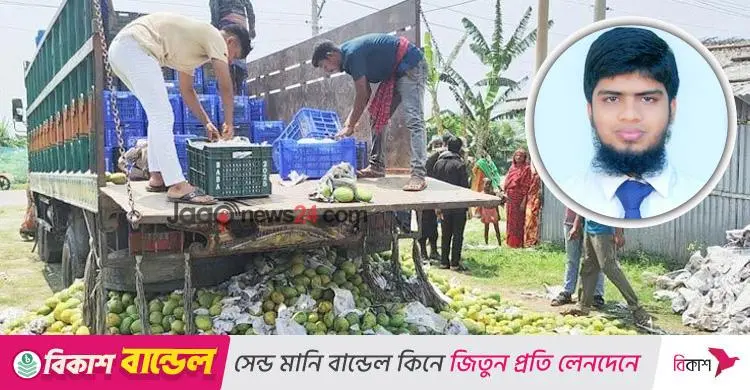
This opinion piece is by Md Taif Ali, research officer at the Bangladesh Food Safety Authority.
It is mango season in Bangladesh, a time when farmers look forward to selling the crop they have worked on all year and breathing a little easier. But for years, because of misconceptions and lack of knowledge, tonnes of mangoes have been seized and destroyed by the authorities on the charge of being 'ripened with chemicals'. Recently about 8,500 kg of mangoes were destroyed in Satkhira on that charge alone. The question is whether this stance is scientific and reasonable.
What ethephon is
Around the world, including in Bangladesh, there are approved fruit-ripening chemicals. One of the main ones is ethephon, sold as a ripener or plant growth regulator (PGR). It is a substance that regulates plant development and helps fruit ripen quickly and evenly.
The World Health Organization, the UN Food and Agriculture Organization (FAO) and the Codex Alimentarius Commission recognise ethephon as an approved ripener. In Bangladesh too, ethephon is safe within set limits. The maximum residue limit (MRL) for ethephon in mangoes is 2.0 mg/kg.
Many farmers in our country still do not apply ripeners fully by scientific methods and often do not know the details of dose or application. Yet various laboratory tests have found that even then, no harmful ethephon residue is found in the edible part, because it is water-soluble, breaks down quickly and stays mainly on the outer skin of the fruit.
If the skin is removed or the fruit washed, the risk is close to zero. We have previously tested pineapples from Madhupur for ethephon residue and found none in the edible part.
Destroying fruit on suspicion
So is it reasonable to destroy fruit just on hearing the word 'chemical'? Surely not. Calling something a chemical does not make it harmful. What matters is which chemical was used, in what amount, and whether it is safe for the human body. These questions need scientific answers.
The problem is that part of the administration and the public still believe that ripening with chemicals means harm. From this misconception, farmers' mangoes are destroyed on suspicion alone, without proper checks. Destroying fruit that farmers have laboured over for days on guesswork, without analysis, is not fair, and such indiscriminate destruction can seriously damage the farm economy.
What should be done
We should raise science-based awareness among the administration, farmers and the public. The administration, the Bangladesh Food Safety Authority, the Department of Agricultural Extension (DAE) and research institutes could together take some important steps:
- First, the administration must understand that every seized batch of mangoes should be tested in a laboratory before a decision is taken.
- If ethephon is below the permitted limit or absent from the edible part, the mangoes should be allowed to be marketed fairly.
- If the fruit is unfit for sale, instead of being destroyed it could be used in processed foods such as pickles, or for animal feed or organic fertiliser, protecting both resources and the environment.
- Training and awareness on safe use of ripeners for growers are urgent. Research has been done in Bangladesh on safe fruit-ripening chambers. The government could set up chambers in districts so that farmers can ripen different fruits safely at low cost.
- Public awareness should be raised.
Above all, no food should be considered 'risky' before scientific assessment. Doing so is unfair to farmers and is a kind of administrative failure in ensuring food safety.
What we need now is not panic but scientific awareness, practical training and coordinated policy. A safe, sustainable and sound food system can only be built through the joint efforts of farmers, the administration and the public.
Source: Jagonews24. First published in Bengali on The Agro News.
Comments
(0)