
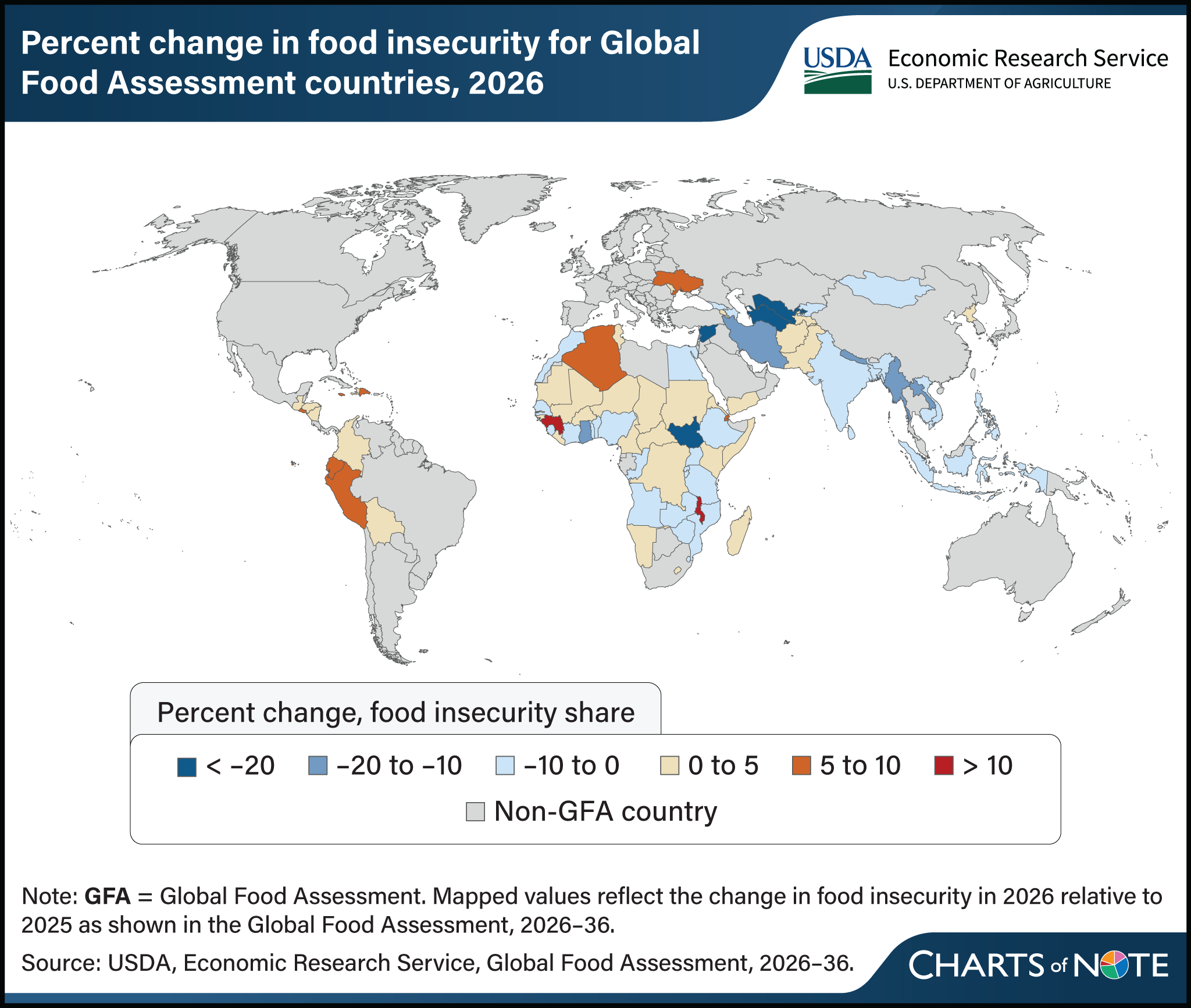
Food insecurity in 2026 is estimated to affect 884.4 million people, or 19.5% of the population, across the 83 low- and middle-income countries covered by the USDA Economic Research Service's (ERS) annual Global Food Assessment (GFA), according to a new ERS Chart of Note.
The assessment projects lower food insecurity rates than in 2025 in most countries, in part because per capita gross domestic product is rising and food price inflation is easing. The accompanying map shows the percent change in food insecurity for 2026 relative to 2025 in each country covered.
Not every country improves. ERS says local shocks and structural vulnerabilities may keep food insecurity high, or make it worse, in some countries, particularly in Sub-Saharan Africa and in Latin America and the Caribbean.
Over the longer term, food security is projected to keep improving. By 2036, ERS projects the number of food-insecure people in GFA countries to fall by 33.4% to 589 million, or 11.4% of the GFA population, based on the macroeconomic assumptions used in the report.
The GFA estimates food demand in countries where domestic production alone cannot meet it, and ERS presents it partly as a guide to where US agrifood products could fill gaps. The chart appears in the ERS report Global Food Assessment, 2026-36, released in August 2026.
Source: USDA Economic Research Service


Comments
(0)