
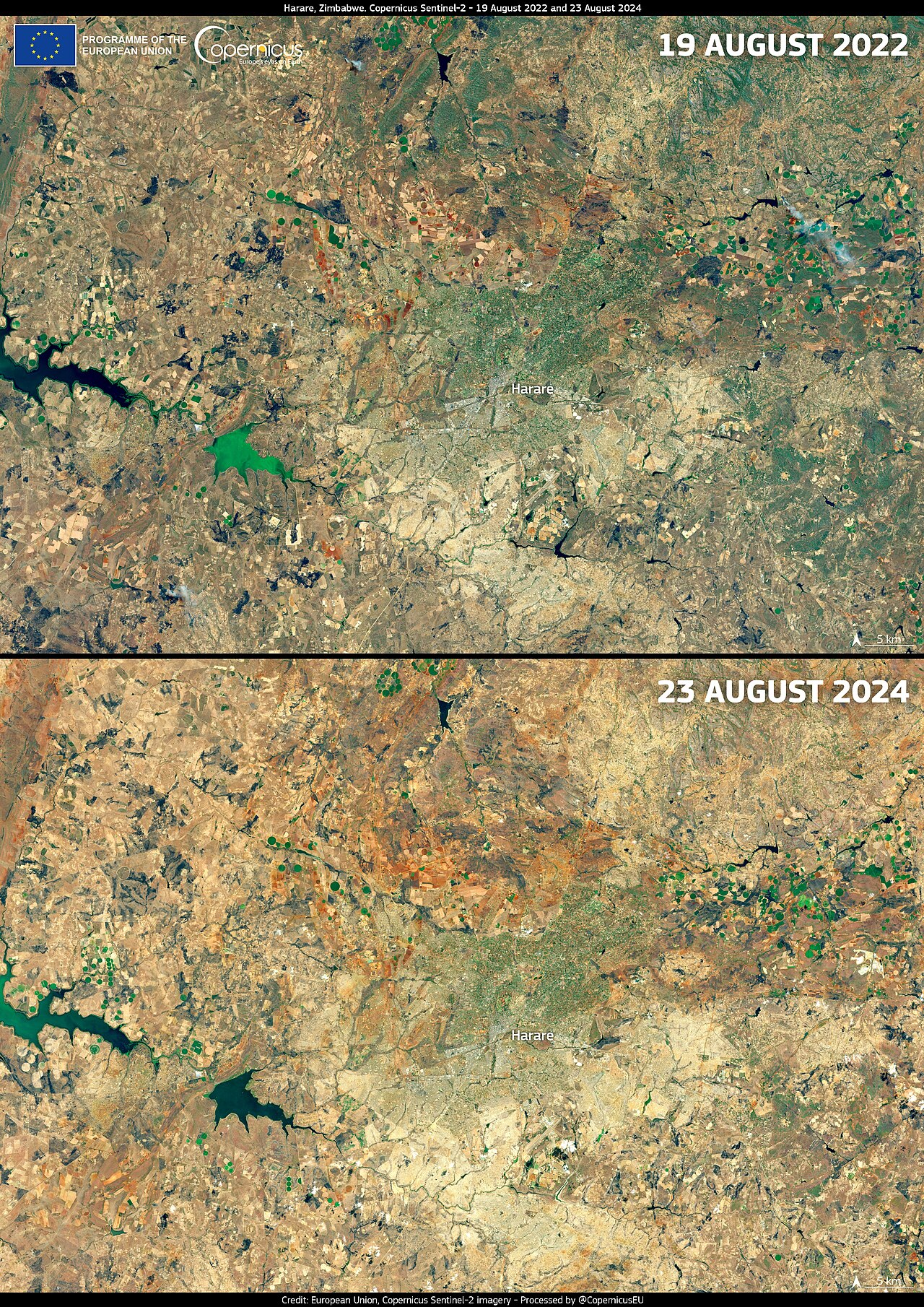
Two studies led by CIMMYT scientists on the 2023/2024 El Niño, one of the worst droughts Southern Africa has seen in decades, reach the same conclusion from different directions: diversified crops, improved varieties and good agronomy reduce the damage, but none of them can cancel an extreme drought.
The Zambia study, published in Climate Services, set district-level production against 30 years of rainfall data. A season with rainfall one standard deviation below the 30-year mean was associated with yield losses of about 30% for maize, against 9% for sorghum and 12% for millet. Rice and sweet potato also lost heavily, while sunflower, cowpea, common bean and groundnut held up better than soybean and Bambara nut. The real value of Zambia's crop production fell by 64% in 2023/2024, and the researchers attribute about 76% of that fall to the drought itself.
The Zimbabwe study, published in Food Security and supported by the CIMMYT Innovation Fund, followed 435 households and 542 maize plots in Murehwa and Zaka, two districts with contrasting rainfall. Stress-tolerant maize was linked to higher average yields and modest but consistent reductions in reported food insecurity. Its strongest effect was at the middle of the yield distribution, where it was associated with a 42% increase in yields; at the low and high ends the effect was smaller and not statistically significant.
That, the authors argue, is how the technology should be presented: not as insurance against total crop failure, but as a way of stabilising harvests under substantial yet not overwhelming stress. The gains were largest for households farming small maize areas close to the homestead, where management was more intensive, and timely planting, rainfall at critical growth stages and top-dressing fertiliser also raised yields.
The study found no evidence that stress-tolerant maize worked differently where women were the main decision-makers on maize production, but households where women decided how the harvest was used had more varied diets.
For smallholders, CIMMYT writes, the difference between losing most of a crop and keeping a little more can mean extra weeks of food and fewer forced choices over scarce resources. Its conclusion is that resilience comes from combining better genetics, crop diversification, sound agronomy and climate information, rather than from a single drought-proof solution.
Photo: European Union, Copernicus Sentinel-2 imagery (drought in Zimbabwe, 2024) / Wikimedia Commons (CC BY 4.0)
Source: CIMMYT
Comments
(0)