
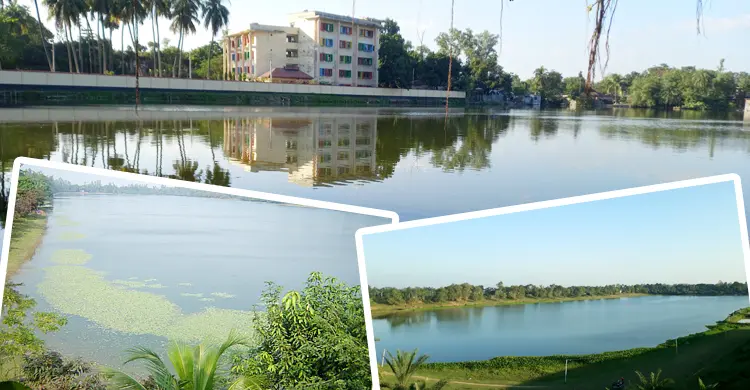
We have all heard the names of the world's famous oceans, seas and bays, which were made by nature. But how many of us have heard of man-made seas, and ponds named "sagar" at that?
You may be surprised to learn that one upazila of Dinajpur alone has six sagars. Many people know one of them, Ramsagar. But have you heard of Sukhsagar, Matasagar, Ananda Sagar, Julum Sagar and Padma Sagar?
Dinajpur, one of the main districts of northern Bengal, is well advanced in history, heritage and education, and has some special tourist attractions. Among them are six traditional ponds dating from the time of the rajas, known as "sagars". Located around the town, they draw many visitors. They are Ramsagar, Padma Sagar, Sukhsagar, Matasagar, Ananda Sagar and Julum Sagar. They were dug in the time of the rajas and maharajas, and many legends and stories are attached to them.
Ramsagar
Ramsagar is one of the largest ponds in Bangladesh. It is not a sea, but its depth and size earned it the name "sagar". Raja Ramnath dug it so that farmers in the area could irrigate their crops. Legend has it that even after it was dug, no water rose.
The raja then dreamt that the water would rise only if his son Ram gave himself up in the pond. He did not know how to tell Ram. Seeing his father sad, Ram asked why, and when he heard the whole story he agreed for the sake of the farmers. One morning, unseen by anyone, Prince Ram walked into the pond. The deeper he went, the faster the water rose, and he drowned. The pond was named Ramsagar after him.
Flowers, fruit and timber trees grow on its banks, and water lilies and lotuses bloom on its vast blue water. This setting has made it one of the country's tourist spots. There is also a zoo with pythons, deer, monkeys, birds and other animals.
Ramsagar is in Tajpur village of Auliapur union, just 8 km south of Dinajpur town. It is 1,031 metres long, 364 metres wide and 13.50 metres deep. According to historians, digging it took about Tk 30,000 of the time and 1.5 million labourers. It was dug in Raja Ramnath's time, before the Battle of Plassey (1750-1755).
Shuksagar
Shuksagar is the westernmost landmark of the palace. The long north-south pond was an important part of the palace's defences. Laid out on about 26 acres, its eroded banks have now spread it to 33 acres. Including the banks, it is 630 metres long and 350 metres wide; the water area is 476 metres by 195 metres.
Its depth is not even across the bed but is at most about 4 metres. It is not known whether it ever had a ghat. The banks are said to have been as high as hills. The western bank has been levelled as houses were built there, but the other three banks are still quite high, in places close to 3 metres.
Shukdev Roy (1644-1681), founder of the Dinajpur royal family, dug a huge pond in front of the palace, to its west, at some time during his reign and named it after himself. Hence Shuksagar. Some people wrongly say the raja found happiness (sukh) there and so named it Sukh Sagar.
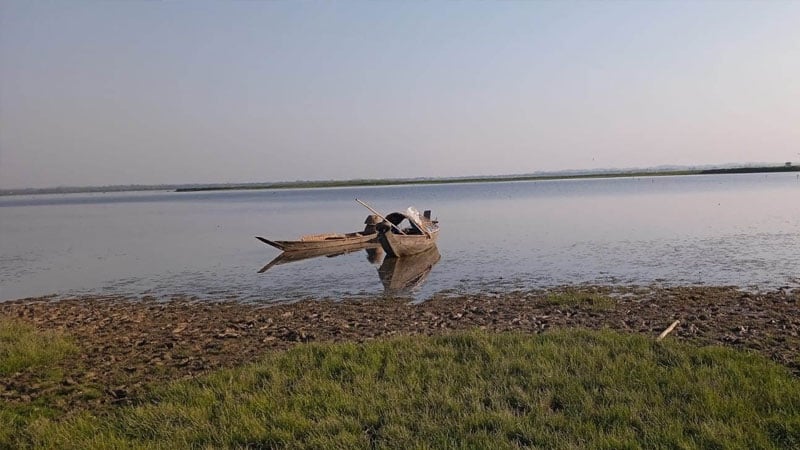
Surrounded by sal and akashmoni groves, the pond brings a breath of calm to busy town life. Its clear water and leaping fish add to its beauty, and visitors can take boats and speedboats out on it. The banks are like small hills. The main attraction in winter is migratory birds; even as this report was written, the place rang with their calls. Sukhsagar is becoming popular with the people of Dinajpur and with tourists.
Matasagar
The pond is called "Mata Sagar" because Maharaja Prannath Roy dug it and dedicated it to his stepmother, the mother of Ramdev Roy and Joydev Roy. Many believe that Raja Shukdev, the head of the Dinajpur royal family, dug it to relieve his subjects' shortage of drinking water and dedicated it to his mother, hence Matasagar, but that is not historically correct.
Its banks are low but its spread is wide. Its natural setting charms visitors, and the red glow of the sun on its water at sunrise and sunset is a delight.
It is hard to say exactly when Raja Prannath dug it. As he reigned from 1687 to 1718, it was probably dug at some point in that period. It is not known whether it had a ghat when it was dug.
The long north-south pond now covers about 100 acres. With banks it is about 630 metres long and 300 metres wide; the water alone is about 510 metres by 164 metres. The palace lies about a kilometre north of Matasagar and Shuksagar 850 metres away. The eastern part of the canal-like moats around the palace, better known as Ramdanra, links Shuksagar and Matasagar.
Ananda Sagar
Ananda Sagar lies a little over 2 km from the Phulbari bus stand on the Dinajpur-Phulbari highway, 50 yards east of Dinajpur M Abdur Rahim Medical College.
When Maharaja Baidyanath Roy set out to dig a large pond like his illustrious forefathers, a famine struck the kingdom and his first attempt failed. At a suitable time he had it dug again and dedicated it to his wife, Rani Saraswati or Anandamoyee. Named after Anandamoyee, it became "Ananda Sagar". It is also said that the rajas came here with the rani by water from the palace in a golden boat and enjoyed themselves (ananda), hence the name, though whether that is mere imagination is not certain. Ram Danra connected Shuksagar, Matasagar and Ananda Sagar, and boats could travel to all three along it. Ram Danra still exists.
The pond runs north-south. With banks it is about 320 metres long and 210 metres wide. The water area is given as about 255 and 110 square metres. It is thought to have been much deeper once; it is now 2 to 2.5 metres deep in all.
The Goshthodham Shiva temple, built in the rajas' time 150 metres north of the pond, strengthens the likelihood that there was a ghat. Hindus hold Goshtho Puja here every year, with a one-day fair. There is also an old ruined structure; no one knows when it was built and no history of it has been found, but legend says it was the home of Ram's maternal uncle. The nephew visited once a year, and the uncle held a fair for his arrival. The fair has been held there ever since and is known as the Goshther Mela. It takes place eight days after Kali Puja.
Padma Sagar
Padma Sagar is inside the Dinajpur palace. It is said the women and princesses of the palace drank from it. Because of its stone-built ghat and its depth, many call this lotus pond a sagar too, though it is small.
Beside the Rani Bhaban inside the palace, Padma Sagar now attracts many visitors. It is not known which raja dug it or when. It runs north-south and is about 210 metres long, 77 metres wide and 1-1.5 metres deep.
The palace had at least five temples, where regular worship and religious ceremonies needed a great many flowers. It is said the daily worship demanded large numbers of lotuses, so lotuses were grown in the pond to keep up the supply. They bloomed in abundance, and the pond came to be called the lotus (padma) pond.
Julum Sagar
The pond got the name Julum (oppression) Sagar because the British rulers and rajas tortured ordinary people in buildings on its bank. Those buildings long served as the office of the superintendent of police; they have recently been demolished and a new SP's office built.
The pond lies below the Dinajpur Circuit House, the SP's office and Krishnakoli, a recreation centre of Border Guard Bangladesh. Covering about 843 decimals, it is a favourite of the people of Dinajpur.
Another account is that it may once have been dug by jail prisoners forced to work, to improve the town's natural beauty and environment, hence the name Julum Sagar.
On land at the pond's south-west corner stood the Julum Sagar palace, built by the rajas. It was once the residence of the English district magistrates. After years of neglect, the pond is now overgrown.
How to get there
From Dhaka, first go to Dinajpur by coach or train. Alternatively, fly to Saidpur airport and go on to Dinajpur town by microbus, car or bus, a journey of 45 minutes to an hour. From Dinajpur town the sagars can be reached by easy-bike, car, microbus or battery-run van.
Where to stay and eat
The forest department runs a dak bungalow at Ramsagar for overnight stays. Dinajpur town also has many good residential hotels within most budgets, and all kinds of restaurants, the good ones along the town's main road.
Source: Jagonews24. First published in Bengali on The Agro News.
Comments
(0)