
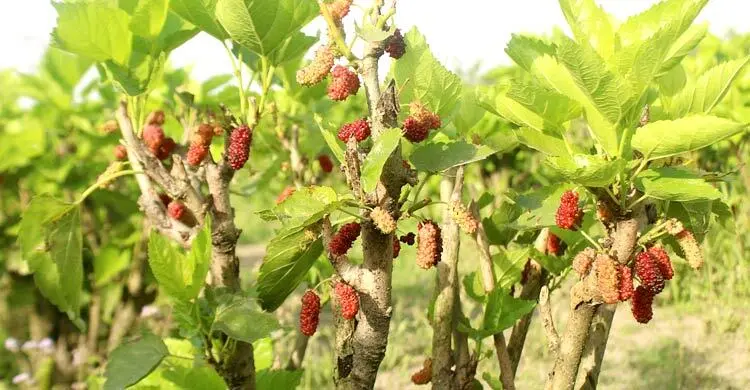
Mulberry fruit, though beneficial, is not on the list of food crops, yet it is becoming a popular snack in Dinajpur. The nutritious fruit is selling for Tk 250-300 a kg in Dinajpur's markets, and some people are supporting their families by selling it.
A visit found children, women and men picking fruit in a mulberry orchard, and the fruit on sale at fruit shops in the market. At Mahut Para, next to Sadar upazila, the Dinajpur regional silk seed store of the Bangladesh Sericulture Development Board has a 120-bigha mulberry orchard, where mulberry leaves are grown to feed silkworms. With no instructions to do so, the fruit is not collected. When it ripens, birds eat it, as do local children.
Officials say they will certainly collect the fruit if the board instructs them to.
From orchard to market
Agriculture experts say the fruit is not on the list of food crops. It can be seen at fruit shops in Bahadur Bazar, the town's biggest market. Traders buy it from gatherers for Tk 200 a kg and sell it for Tk 250-300 a kg.
Abdus Salam Miraj, a child who had come to pick mulberries, said they used to pick the fruit from the trees and eat it. This year demand has grown and it is selling in the market, with fruit traders buying it at Tk 200 a kg to resell.
Jobaidur Rahman said: "My home is in Mahut Para, next to the mulberry orchard. I gather 3-4 kg of mulberries every day and sell them to Liton, a fruit trader in Bahadur Bazar, for Tk 200 a kg. I sell Tk 600-800 worth a day, and everyone at home eats them too. At the moment the household runs on selling mulberries."
Md Liton Hossain, owner of Dinajpur Fal Bhandar in Bahadur Bazar, said many people are gathering and bringing in mulberries to sell. "We buy them at Tk 200 a kg and sell them for Tk 250-300. There is good demand. Many people buy them thinking they are blackberries."
Shahinur Islam, who hawks fruit, said: "Many people gather mulberries in the morning and afternoon and bring them to sell. We buy from them and sell at Tk 30-40 a hundred. Children are the keenest buyers."
Uses and a stalled jelly venture
Dr Shahin Alam, assistant medical officer (Unani) at Dinajpur 250-bed General Hospital, said: "The fruit has many qualities. It is widely used for rheumatic pain, as a bile remedy, as a tonic and to improve sight and hearing. Mulberries are also used for mouth and throat sores, indigestion, fever and worms."
Nurul Huda, farm manager of the Bangladesh Sericulture Development Board's Dinajpur regional silk seed store, said: "We grow mulberry leaves in our nursery to feed silkworms. There are no instructions from the board about the fruit. At one time Bangladesh started collecting mulberries to make various jellies, but because of production costs and lack of familiarity there was hardly any consumer demand, and the work was later stopped."
Nuruzzaman, additional director of the Department of Agricultural Extension in Dinajpur, said: "In Bangladesh mulberry trees are mainly used to produce silk cocoons. There is an orchard in Dinajpur too. Many people eat mulberries, but the fruit is not on Bangladesh's list of food crops."
Source: Jagonews24. First published in Bengali on The Agro News.
Comments
(0)