
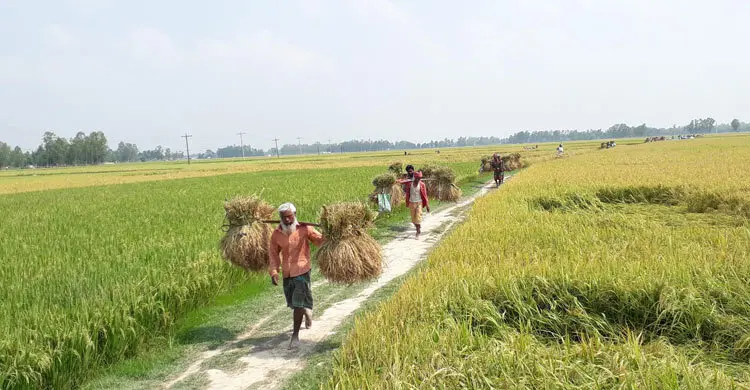
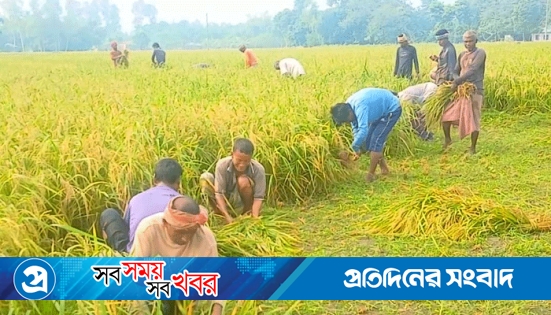
Although paddy prices this boro season are higher than last boro season, farmers are facing losses because the prices of fertiliser and pesticide and the cost of irrigation have gone up. Farmers who cultivated boro on land taken on contract are facing big losses.
With favourable weather this time, however, farmers have dried their paddy and stored it in the hope of good prices, and prices have started to rise. But those concerned say paddy prices are still well below those of the aman season.
Md Anisuzzaman, additional deputy director (crops) of the Dinajpur Department of Agricultural Extension (DAE), said boro was grown on 1,74,510 hectares in the district this season, 1,420 hectares more than last time. Average production last season was 4.54 tonnes a hectare; this time it rose to 4.59 tonnes a hectare. In rice terms, the district produced 8,02,000 tonnes this time.
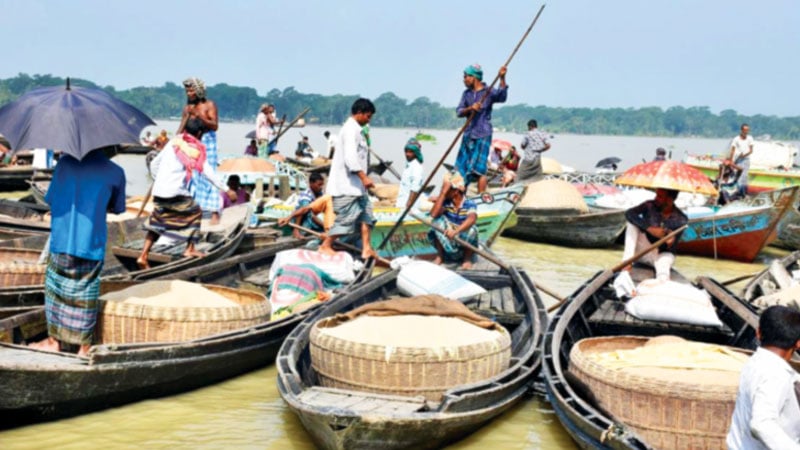
Prices at the Ambari market
Farmers say, however, that costs rose this time for various reasons, including extra irrigation needed during the severe drought and pesticides. Paddy is selling for more than last boro season but for less than in the aman season.
At the Ambari market on Friday (12 July), a 76 kg sack of dry BRRI dhan90 paddy sold for Tk 2,600 to 2,800. Indian Sampa katari sold for Tk 2,200 and Bogura Sampa katari for up to Tk 2,600. BRRI dhan28, BRRI dhan29 and Miniket paddy sold for Tk 2,600 to 2,700. Wet paddy sold for Tk 500 to 800 less, depending on the variety.
Last boro season, wet BRRI dhan90 zira paddy sold for Tk 1,700 to 1,900, and other paddy prices were low too. In the aman season in between, wet BRRI dhan90 zira sold for Tk 4,200 and dry for up to Tk 5,200.
Because of the good prices, Dinajpur farmers planted BRRI dhan90 and Sampa varieties on 60 per cent of the land this time. These two varieties need more spending on pesticides.
Sharecroppers on leased land lose out
Abdur Rahman, a farmer from Kamalpur village in Dinajpur Sadar upazila, said paddy prices this boro season are higher than last boro season. But with fertiliser, pesticide and irrigation costs up, sharecroppers who took land on contract at high rates have made losses. They took one acre on a yearly contract for Tk 80,000, and many do not have their own irrigation. Everyone who grew boro on contracted land without their own irrigation is facing losses, he said, while those with their own land and irrigation are making a profit.
He added that BRRI dhan34 fetched a high price in the aman season, selling for up to Tk 5,200. Many kept it in the hope of profit and have still not been able to sell. "I have 92 sacks of my own paddy, for which I am now being offered Tk 3,400 a sack. If I had sold then without hoping for a profit, it would have sold for Tk 5,200 a sack."
Babul Akhter, a farmer from Panikata village in Phulbari upazila, said paddy prices are higher than last boro season, but they have not risen at the rate pesticide prices have.
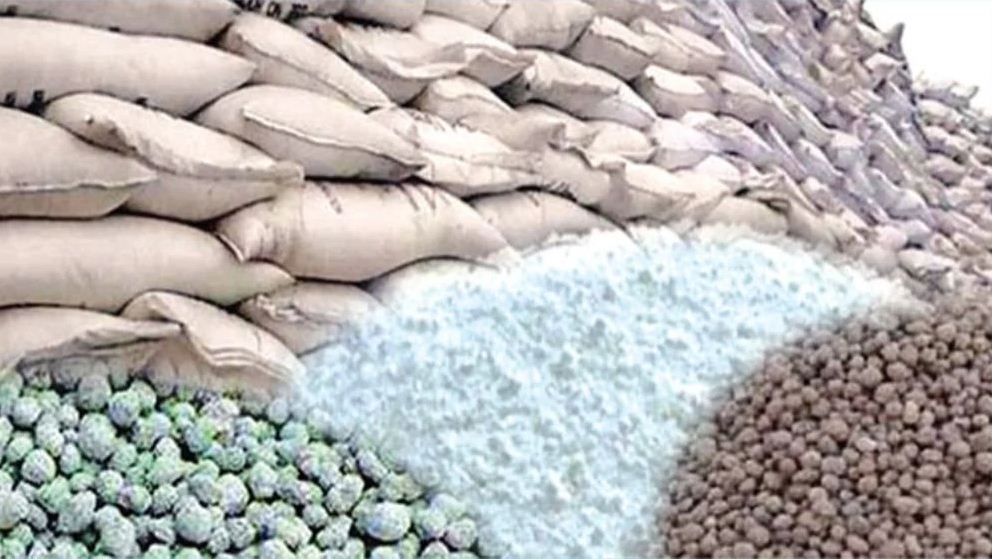
A sack of DAP fertiliser that cost Tk 800 last year now costs Tk 1,250; urea, Tk 800 last season, now costs Tk 1,000; and potash, Tk 700 a sack last year, has doubled to Tk 1,400 a sack.
In addition, more of the new aromatic variety BRRI dhan90 zira has been grown, and it needs more pesticide spraying. Four rounds of spraying cost Tk 8,000, which used to cost Tk 4,000 to 5,000. Irrigation costs have also risen because of labour wages and the lack of rain. And then there is the traders' syndicate.
A trader's view
A trader who did not want to be named said traders do not think about whether paddy production has gone up or down; they buy and sell paddy by looking at the rice market. "There will of course be the hope of profit. If fertiliser and pesticide prices and production costs go up, there is nothing we can do either. The number of traders has fallen. There used to be many husking mills; now there are only a handful of automatic rice mills. Besides, in the age of technology you can contact the whole country in an instant."
Source: Jagonews24. First published in Bengali on The Agro News.
Comments
(0)