
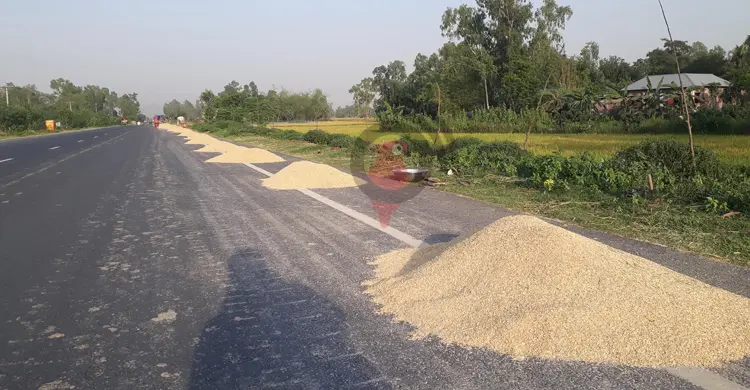
A heatwave is sweeping Dinajpur. Though exhausted by the heat, farmers are busy drying boro paddy in the sun, and instead of selling it they are drying and storing it in the hope of a good price.
Paddy is being dried everywhere, on regional roads, highways and pocket roads as well as in courtyards and open fields. Meanwhile, paddy prices have been rising for three days.
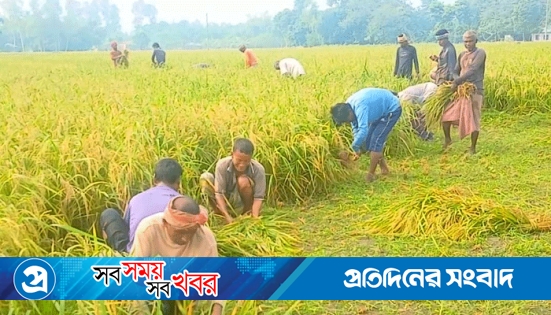
According to the agriculture office, boro paddy has been cultivated on a total of 173,790 hectares in Dinajpur this year. By Thursday, farmers had harvested paddy from 69,516 hectares, or 40 per cent of the land. The remaining 60 per cent is still in the fields.
Farmers hold back their crop
Although it is the peak of the boro harvest, farmers are not rushing to sell. With strong sunshine and no storms or rain, they are cutting, drying and storing the paddy at home, to sell when prices rise. In other years storms and rain made that impossible: unable to store their paddy, farmers had to accept whatever traders offered for wet paddy, and lost out.
Mahabur Rahman spread his paddy to dry on the road in the Narayanpur area of Phulbari upazila. "In other years the storms and rain meant we could not dry the paddy. Fearing it would rot as soon as it was cut, we had to sell it cheap. This time there is plenty of sun and we can dry both paddy and straw. We can sell when it suits us, and I hope we will get a good price. Because we can dry the straw, we will not face a shortage of cattle feed and fuel either. So we are very happy," he said.
Anwar Hossain, a farmer at Jamtali Bazar in Phulbari, said: "Even though we are burning in the sun, this time we can bring the boro paddy home. Before, keeping paddy at home was out of the question; we had to beg traders to buy it and take the money in instalments. This time they will come to us for the paddy, and we will get cash. So we are happy despite the hardship of the sun."
Aklima was filling sacks with dried paddy on the Barai-Jamtali road. Speaking in the local dialect, she said that in the past, after selling paddy, her household had no food left. "This time the sun is out, so we can dry and keep some paddy. Later we will get a better price when we sell it. This time God has given us a chance. We suffer in the sun, but we are happy."
Prices rising at the haat
Friday was the weekly haat day at Panchbari in Shashara union of Sadar upazila. Little paddy arrived, so prices were high. Trader Abdur Rashid said: "Paddy that was selling at Tk 2,200 a sack, I had to buy today for Tk 2,400. Prices have been rising for three days. With the sunshine, farmers are drying and keeping their paddy and selling only as much as they need."
Md Nuruzzaman, deputy director of the Department of Agricultural Extension (DAE) in Dinajpur, told Jagonews that the boro crop was good this year because of favourable weather and would exceed the target. Everyone knows how aggrieved farmers have been in other years over whether they would get a fair price, he said, but this time nobody will have to hear any complaint about prices. With the weather favourable, farmers can dry and store their paddy and straw and sell when it suits them.
Source: Jagonews24. First published in Bengali on The Agro News.
Comments
(0)