
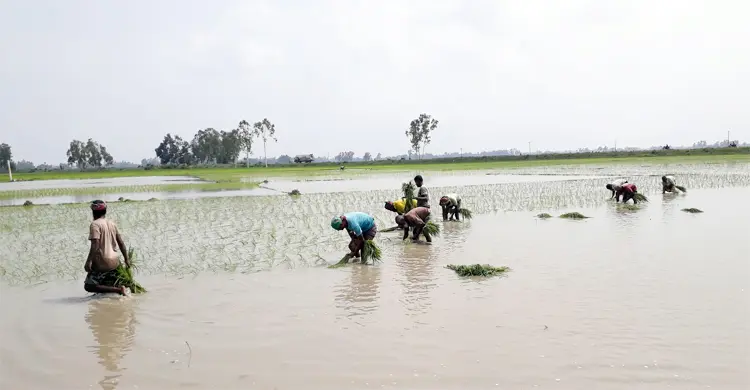
With rain soaking the fields, farmers in Dinajpur, known as the "granary" (shoshyogola), have thrown themselves into aman cultivation. Rainfall was inadequate early this year, so although seedlings were ready, farmers could not prepare their land for lack of water. Continuous rain on Monday night, however, has largely made up the shortfall.
Low-lying land is now full of water, and supplementary irrigation is under way on higher land. Planting has begun across the district. Farmers say that if the monsoon continues like this, they will not suffer much with rice this year.
Seedlings saved by the rain
Anwar Haji, a farmer from Panahar village in No 1 Eluary union of Fulbari upazila, said they had sown seed early. "Without rain things got so bad that we thought the seedlings would die in the soil. Many pulled up the seedlings and kept them in dogchi. But in the end the rain came properly and we were able to save them. Now we are ploughing and transplanting. If it rains like this and nature helps, we can move ahead with cultivation," he said.
Motiar Rahman, a farmer in Biral upazila, said farmers took to the fields after Monday night's rain. Water has collected on low land, and aman seedlings are being planted on higher land with irrigation. The late rain has set cultivation back somewhat, and with this year's weather, farmers cannot tell whether the monsoon has ended or just begun, he said.
Abdur Rahman, a farmer from Kamalpur village in Sadar upazila, said the seedlings grew too big in the seedbed after sowing, so he pulled them up and kept them in dogchi. With the rain he is now planting them on low land, but for lack of enough rain he cannot plant on higher land.
He said weeds had grown in the fields without rain. He sprayed pesticide to kill them, ploughed and planted. If weeds come up again, he will have to spray again, which is driving up the cost of aman cultivation. "I don't know what the crop will be like this time," he said.
Extra irrigation costs
Sabbir Hossain, a farmer from Kadimnagar in Ghoraghat upazila, said farmers usually plant aman between the 15th of Asharh and the 15th of Shrabon. This year there was no rain until the third week of Shrabon, so farmers could not plant for lack of water.
He added that the rain in the fourth week was not enough. To water their land, farmers will have to pay deep tube-well owners Tk 2,200 to 2,300 per bigha, while those with shallow machines will spend Tk 1,000. This is an extra cost for farmers.
Md Nuruzzaman, deputy director of the Department of Agricultural Extension in Dinajpur, said this year's aman target in the district has been set at more than 2 lakh 60 thousand hectares. Aman cultivation has fallen behind this season for lack of rain, and planting has so far been completed on 35 per cent of land in the district's 13 upazilas. Planting is somewhat delayed by the lack of rain, but the target will be met, he said.
Source: Jagonews24. First published in Bengali on The Agro News.


Comments
(0)