
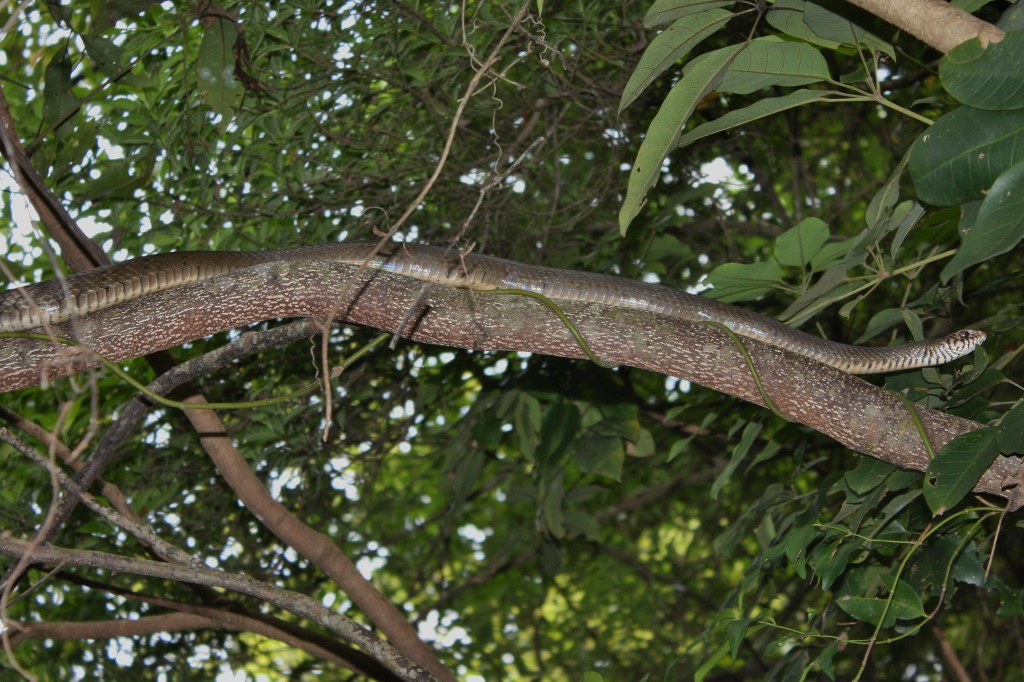
Many useful snakes are killed every year because people kill any snake on sight. Writing in Desh Rupantor, Almas Tahmid says about 70 per cent of snakes found in Bangladesh are non-venomous, and farmers' biggest mistake is confusing the harmless rat snake (dhaman) with the venomous common krait.
The rat snake (Ptyas mucosa) has no venom. It is usually light brown, yellowish brown or olive, with large eyes, a narrow head and a long, slim body. It is active by day, climbs trees and swims. It eats rats, shrews, frogs and insects and so protects crops; by the writer's estimate one rat snake can keep the rats down on about three bighas of land.
The common krait (Bungarus caeruleus) is deadly. It is glossy black or dark bluish with paired white bands from neck to tail, small eyes and a flattened head. It comes out at night, and its bite often leaves little pain or mark, but the venom is extremely potent.
The writer calls the common beliefs about the rat snake, that it has a thorn in its tail, sucks milk from cows or is venomous, baseless. No snake can suck milk, since its tongue is forked.
The advice: let a rat snake live; keep a safe distance from a krait and call an expert. Sleep under a mosquito net at night and keep the area around the house clear. For farmers, saving the rat snake means saving crops from rats.
Photo: Thomas Brown / Wikimedia Commons (CC BY 2.0)
Source: Desh Rupantor


Comments
(0)