
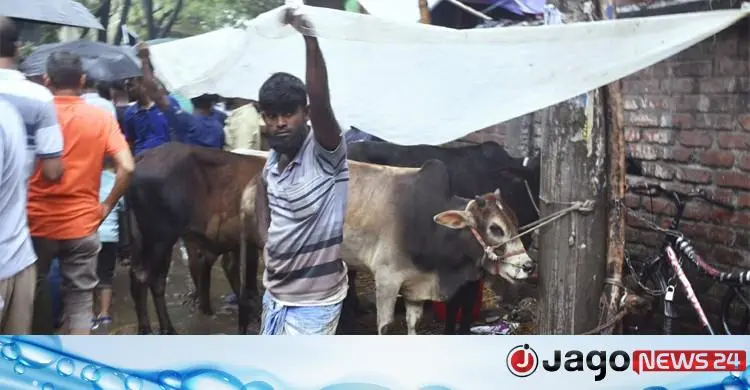
Trading is gradually picking up at the capital's cattle markets ahead of Eid-ul-Azha, but many buyers frown on hearing the prices. Most cows are being priced 20 to 30 percent higher than last year, with small and medium-sized cows rising comparatively more. Many feel this has made it hard for people on limited incomes to buy a sacrificial animal.
This was the picture at the cattle markets in Aftabnagar, Shahjahanpur and Kamalapur, where buyers and traders spoke to the reporter.
Although the markets have a festive air, the pressure of higher prices has dampened ordinary people's joy somewhat. Still, given the religious sentiment and the importance of the sacrifice, city dwellers are trying to buy animals within their means.
Small and medium cows in demand
Buyers crowd around small and medium cows more than large ones. Most families want to buy a cow within Tk 1.5 lakh, and some are disappointed not to find one they like within that budget.
Traders say many cows have yet to reach the markets. The closer Eid gets, the more animals will arrive in the capital, and the market may change somewhat. But because of high transport and fodder costs, buyers will have to pay more than last year.
A section of buyers, on the other hand, think there is not enough monitoring of the market this year, and many sellers are setting prices as they please. Haggling brings the price down a little, but in the end they still pay much more than last year.
What buyers say
Rezaul Karim, a private-sector employee living in Aftabnagar, said: "A cow I bought within Tk 1.2 lakh last year is being priced at Tk 1.5 lakh to Tk 1.6 lakh this year. Coming to the market, it feels like my budget has been thrown into disarray."
Sohel Rana, another buyer from the same area, said small cows were available for under Tk 1 lakh last year, but this year traders are asking more than Tk 1.1 lakh even for small ones, and haggling does not bring the price down much.
Mahbub Hossain, a bank official living in Shahjahanpur, said a cow that could be had within Tk 1.4 lakh last year is being priced above Tk 1.8 lakh this year. "The sacrifice is becoming very expensive for middle-class people this year," he said.
Farzana Yasmin, a homemaker from the same area, said her family had planned to buy a medium cow together. "But at the market I see every cow is priced much higher than before. It looks like we will have to raise our budget by another Tk 20,000 to Tk 30,000," she said.
Alamin Sheikh, a businessman living in Kamalapur, said sellers were asking higher prices because demand for small and medium cows was high. "People are looking for cows on a small budget, but even those cows are going out of reach," he said.
Sumaiya Akter, another buyer from the same area, said her budget was Tk 1.5 lakh, but it was hard to find a good cow within that now. "To buy one we like, it seems it will take around Tk 1.8 lakh. What can we do now? We'll go round the market and buy whatever cow we can get within our budget," she said.
Traders blame transport and feed
Traders blame the rise on higher transport costs and the cost of raising cattle. They say they had to buy cows at higher prices in the villages this year, and with truck fares and fodder prices up, they are forced to sell at higher prices.
Abul Kalam, a trader from Kushtia at the Kamalapur market, said a truck fare that was Tk 17,000 to Tk 18,000 last year now costs Tk 24,000 to Tk 25,000. "The cost of one truck alone has gone up by Tk 6,000 to Tk 7,000. Feed costs have risen too, so cow prices are a bit higher this year," he said.
Mizanur Rahman, another trader who brought cows from Chuadanga, said farmers had asked higher prices for their cows this year. "The prices of all feed, including straw, bran, wheat bran and maize, have gone up, and so have truck fares. If we sell cheap, there is no profit," he said.
Zakir Hossain, a trader from Sirajganj, said people think traders are making big profits. "But bringing cows to the market now costs a lot more. Truck fares, labour costs and market tolls have all pushed up expenses," he said.
He added that demand for small cows was higher this year because many people have limited budgets, which has pushed up small-cow prices as well. If no new cows arrive at the markets, prices may rise further, he said.
Source: Jagonews24. First published in Bengali on The Agro News.

Comments
(0)