
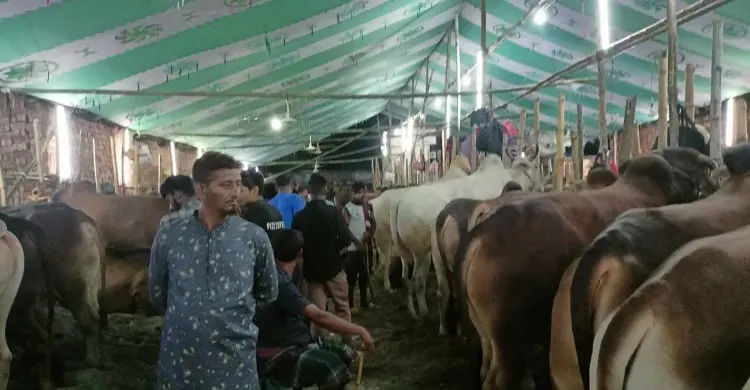
Trucks carrying sacrificial animals have been arriving for several days from across the country at the 19 cattle haats in Dhaka's two city corporations, and the haats are full of cattle and goats. Sales have not really started, but city residents are coming to the haats to look around, and some are bargaining. Many buy an animal if they like it, but their number is very small.
Cattle usually sell most on the day before Eid. Buyers hope prices will fall a little more on the night before Eid, while traders expect prices to rise.
Munnaf Bepari from Manikganj brought 56 medium-sized cattle to the haat four days ago and has sold only four. He is not selling the rest, expecting prices to rise.
"In Dhaka people have no space even to sleep," Munnaf Bepari told Jago News. "Where will they keep a cow? All the cattle will sell on chand raat, the night before Eid. Prices will go up. If they don't, I will take my goods back home. Even so, I will not give away cattle for the price of water."
Buyers expect a fall
Meanwhile, the number of visitors at the haat kept growing, though there were more people looking than buying. Buyers expect prices to fall.
Haji Mohammad Moinuddin came to Gabtoli haat from the extended Pallabi area of the city with his eldest son and his college-going grandchildren. He expects cattle prices to fall on chand raat.
"Traders are quoting high prices and are not letting their cattle go," he told Jago News. "For a cow worth Tk 1 lakh they ask Tk 1 lakh 50 to 60 thousand. Every time I see prices fall on the night before Eid. They fell last Eid too, and I believe they will fall this Eid as well. I looked at 12 or 13 cattle to get an idea. Cattle prices are very high this time."
Traders hold out
Shukchan Bepari from Mirpur, Kushtia, has brought 32 cattle to the Gabtoli haat this year. He lost an average of Tk 8 lakh at each of the last two Eids and hopes to make up for it this time. "I took a big loss at the last two qurbanis," he said. "Whatever happens, I will hold on to my cattle again this time. I will not sell for the price of water. But there are fewer cattle at the haat this year, so I hope prices will rise."
As a result, the buying and selling of qurbani cattle has all but stalled, though many who have space to keep cattle are buying after bargaining.
For now cattle are being looked over at the haat, and buyers leave after asking the price. Mizan Bepari of Mirpur has brought 40 cattle from Chuadanga to Gabtoli and has not sold a single one, hoping for a good price.
Raju Bepari, Montu Bepari and Delwar Bepari of Mirpur, who are cousins, have also come to Gabtoli. They brought 56 cattle, collected from village haats and different homes, and have not sold a single one, mainly in the hope of higher prices.
"Cattle sell on chand raat," Raju Bepari told Jago News. "Where will Dhaka's people keep cattle? There is not much buying and selling now. Buyers are coming to look at the cattle. They will look at the haat, go home and talk it over, and then buy. The cattle will sell in one night."
Meanwhile, sacrificial animals can already be seen in the city's alleys and in front of homes, and small seasonal traders are hurrying along the footpaths with herds of goats for sale.
Source: Jagonews24. First published in Bengali on The Agro News.

Comments
(0)