
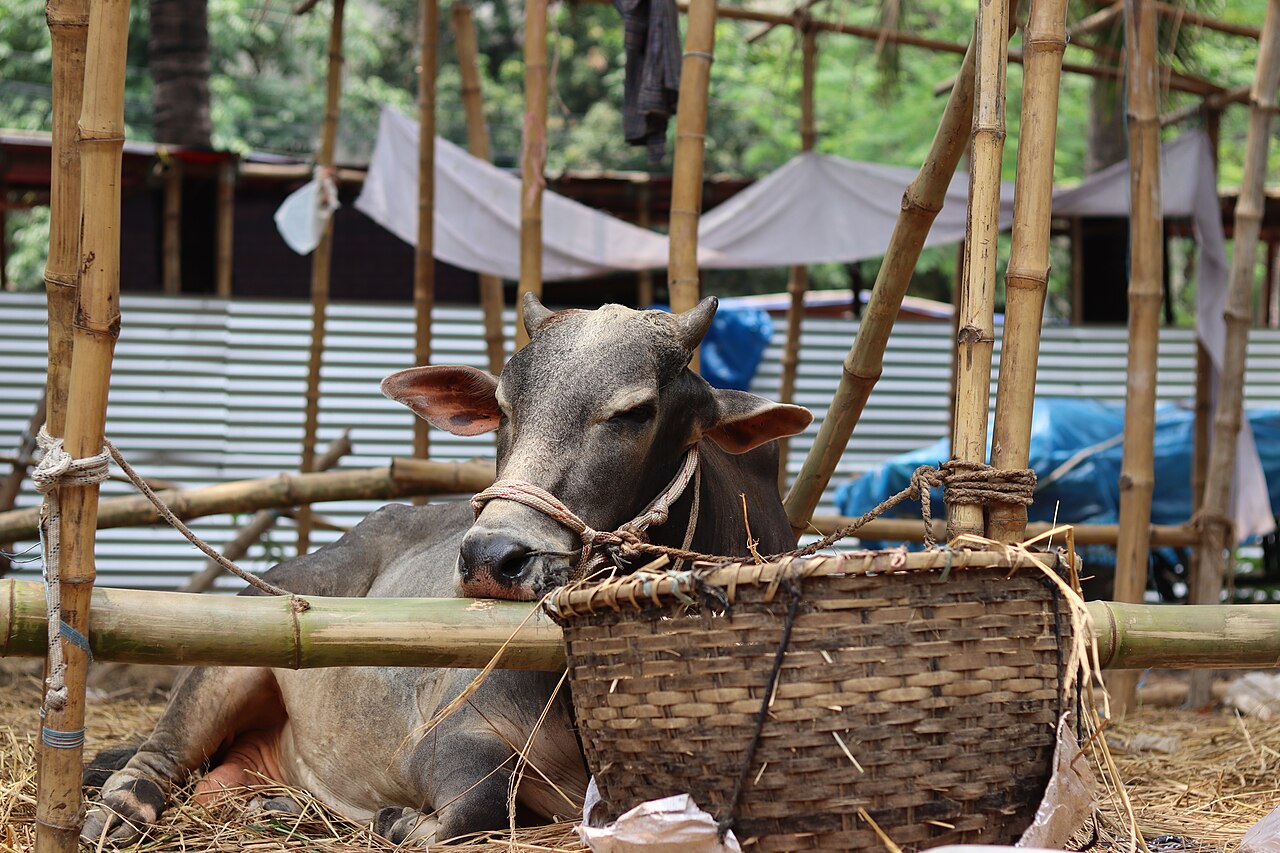
The administrator of Dhaka North City Corporation (DNCC), Shafiqul Islam Milton, said on Tuesday, 26 May 2026 that no complaints of extortion had been received from the sacrificial cattle markets in the Dhaka North and Dhaka South city corporation areas. He made the remark at midday while visiting the Gabtoli cattle market in the capital, in answer to a journalist's question, in the days before Eid-ul-Azha, the festival on which Muslims across Bangladesh buy and sacrifice animals. The visit came at the busiest point of the livestock-trading year, when tens of thousands of cattle and goats move into the city's markets and large sums of cash change hands over a few days.
What the administrator said at Gabtoli
Reporters at the market put to Milton an allegation that Tk 15,000 was being charged for each post, or khuti, used to tie up cattle at Gabtoli. He rejected it. "We investigated this matter and found no truth in it," he said. "No one is being charged more than the 5 per cent hasil." Hasil is the toll, or commission, that a market takes on each animal sold; the figure he cited, 5 per cent, is the ceiling the corporation says applies.
The question reflected a specific grievance that had circulated as the market filled, and the administrator's answer was that his office had checked it and that the charge did not stand up. He had reached Gabtoli after touring the market with Mir Shahe Alam, the State Minister for Local Government. The two walked through the stalls and spoke with the cattle traders, known as beparis, and with buyers who had come to choose an animal for the festival. Their visit, and the questions put to them, reflected a concern that returns to Dhaka's markets every year: whether buyers and sellers are made to pay more than the fixed rate.
The allegation and the official response
Complaints of chanda, or extortion, around the Eid cattle trade are an old refrain in Dhaka. Traders bringing animals into the city, and buyers leading them away, have long said that unofficial payments are sometimes demanded at market gates or on the roads, over and above the lawful toll. The specific claim raised at Gabtoli on 26 May, that Tk 15,000 was taken for every tying-post, was the kind of charge the administrator said his office had looked into and found to be untrue.
The Dhaka Metropolitan Police (DMP) Commissioner, Mosleh Uddin, who was present, invited anyone with evidence to come forward. "If there is any specific complaint of extortion, let us know and we will act immediately," he said. He added that the police were speaking to people at every DNCC market, the temporary ones and the permanent market at Gabtoli; that no incident of extortion had yet come to their notice; and that if a specific complaint were made, law-enforcement and other agencies were in place to act.
The assurances at Gabtoli echoed a message the authorities had given earlier in the month. On 6 May 2026, the State Minister for Local Government, Mir Shahe Alam, said that extortion centred on the sacrificial-animal trade would not be allowed and would be dealt with firmly, a statement reported by several newspapers that day. The administrator's and the police commissioner's words on 26 May were, in effect, the follow-up to that promise as the markets filled.
Eid-ul-Azha and the Qurbani trade
Eid-ul-Azha, the Feast of Sacrifice, is one of the two principal festivals of Islam. It falls on the 10th day of Dhu al-Hijjah, the last month of the Islamic lunar calendar, with the observance continuing for three further days known as the Tashreeq days; because the calendar is lunar, its date on the Gregorian calendar moves a little earlier each year. The festival marks the end of the annual Hajj pilgrimage and commemorates the prophet Ibrahim's willingness to sacrifice his son in obedience to God. In trading terms it is the larger of the two Eids, since it turns on the purchase of a live animal for each household that can afford one, rather than on clothes and food alone.
The central act of the festival, for those who can afford it, is the sacrifice of a permitted animal, a cow, buffalo, goat, sheep or camel, after the congregational Eid prayer. By custom the meat is divided into three parts, one kept by the household, one shared with relatives and neighbours, and one given to the poor. In Bangladesh the demand this creates is concentrated into a short window: most of the year's sacrificial animals are bought in the ten to twelve days before Eid, which is why the city's cattle markets swell so suddenly, and why the price of a single animal, and every charge attached to it, is watched so closely by ordinary families.
Gabtoli and Dhaka's sacrificial markets
Gabtoli, on the north-western edge of the capital, is home to Dhaka's long-established permanent cattle market, the only year-round market of its kind the city runs. For most of the year it handles a steady trade in cattle and goats; in the two to three weeks before Eid-ul-Azha it swells into one of the largest animal markets in the country, drawing beparis and animals from across Bangladesh.
Alongside the permanent market, the two city corporations set up temporary markets on open ground for the Eid season. For Eid-ul-Azha 2026 the number was settled only gradually. Reports in mid-April put it at 24 temporary markets, with the site at Aftabnagar still uncertain; by 19 April the figure had risen to 26, and in early May to 27 and even 28 as the corporations pressed ahead with tenders. By 20 May, reports counted 27 markets across the two corporations, with the leases completed for 19 of them; the market at Diabari, in the north, was reported to have drawn the highest bid. The temporary markets are set up on open grounds, playing fields and vacant plots in both city areas, filling in the week to ten days before Eid as the beparis arrive with their animals, and are dismantled soon after the festival.
One change stood out. According to the national news agency BSS, no market was set up at Sarulia this year, the site that the Dhaka South City Corporation usually runs as its permanent market, so that the city's permanent trade was concentrated at Gabtoli.
How the lease and hasil system works
Dhaka's cattle markets are run through a lease, or ijara. Each year the corporations invite tenders for the right to operate each market; the highest accepted bidder pays a lease fee to the corporation and then recovers it, and makes a profit, by collecting hasil from the sales inside the market. The hasil is therefore the lessee's main source of income, and the rate at which it is charged is watched closely by traders and buyers alike.
At the market, the lessee or the corporation's staff issue a slip, or receipt, recording each sale and the hasil paid on it; a buyer who keeps the slip has proof of what was taken. The corporations are expected to display the permitted rate so that buyers know what they owe. Disputes arise when the amount demanded, whether as hasil or as a separate 'entry' or 'parking' payment, exceeds what is written down; and it is these extra demands, rather than the lawful toll, that the word chanda usually describes.
That rate has been a subject of argument for years. In May 2025 it was reported that the per-animal hasil at the city's sacrificial markets would be reduced to 3 per cent. The administrator's statement on 26 May 2026 referred instead to a ceiling of 5 per cent, the figure he said no one was exceeding. Whatever the exact rate in force, the recurring worry is that lessees or their agents collect more than the fixed share.
When a market's lease is not awarded, or is cancelled, the corporation does not hand the market to a private operator but collects the hasil itself, a practice known as khas collection. The permanent Gabtoli market saw exactly this in 2025: its lease was cancelled and the market was run under khas collection, a decision that drew questions in the press at the time.
Earlier concerns about overcharging
The claim raised at Gabtoli did not come out of nowhere. In the weeks before Eid 2026, several reports alleged that tolls above the fixed share were being taken at some markets. On 21 May 2026, the daily Samakal reported that a market whose lease had been secured for about Tk 2.5 crore less than in a previous arrangement was collecting double the hasil. Such reports are allegations, carried by the newspapers and denied or unaddressed by those concerned; the administrator, for his part, said his inquiry into the Gabtoli tying-post claim had turned up nothing.
The open tender and the fixed hasil ceiling are the corporations' main stated safeguards against overcharging, on the reasoning that a market with a known operator and a posted rate can be monitored more easily than an unregulated gathering. But the pressure to recover a high lease bid is itself one reason the leased price, the posted rate and the amount actually taken are each watched through the Eid days.
Taken together, the State Minister's warning on 6 May, the overcharging reports of mid-May, and the administrator's and police commissioner's assurances on 26 May trace the authorities' running response to a problem they acknowledge is a perennial risk, even as they said they had found no proven case this time.
Dhaka North and Dhaka South City Corporations
The two bodies that run the markets, DNCC and DSCC, were created on 1 December 2011, when the former single Dhaka City Corporation was divided in two under an amendment to the city-corporation law passed on 29 November 2011. Dhaka North's jurisdiction was enlarged on 9 May 2016 to take in several outlying unions, bringing its area to about 197 square kilometres; at the 2022 census it had a population of 5,990,723 (a density of about 30,531 per square kilometre), organised into 54 general wards and 10 zones, with 18 reserved seats for women. Dhaka South, expanded in the same period to about 109 square kilometres, had a 2022 census population of 4,305,063 (a density of about 39,409 per square kilometre) across 75 wards.
Managing the Qurbani cattle market is one of the functions the corporations list for themselves, under religious welfare, alongside revenue work such as assessing and collecting holding tax, issuing and renewing trade licences, and managing municipal markets and other assets. Their wider duties run from urban planning, roads and transport to health, education, waste management, water supply in coordination with Dhaka WASA, and public security. In practice, at each Eid, this means the corporations choose the market sites, invite and award the tenders, fix the hasil ceiling, arrange policing and traffic management with the DMP, and organise the removal of waste after the animals are sacrificed. The administrator's visit to Gabtoli sat within that responsibility.
The livestock that fills the markets
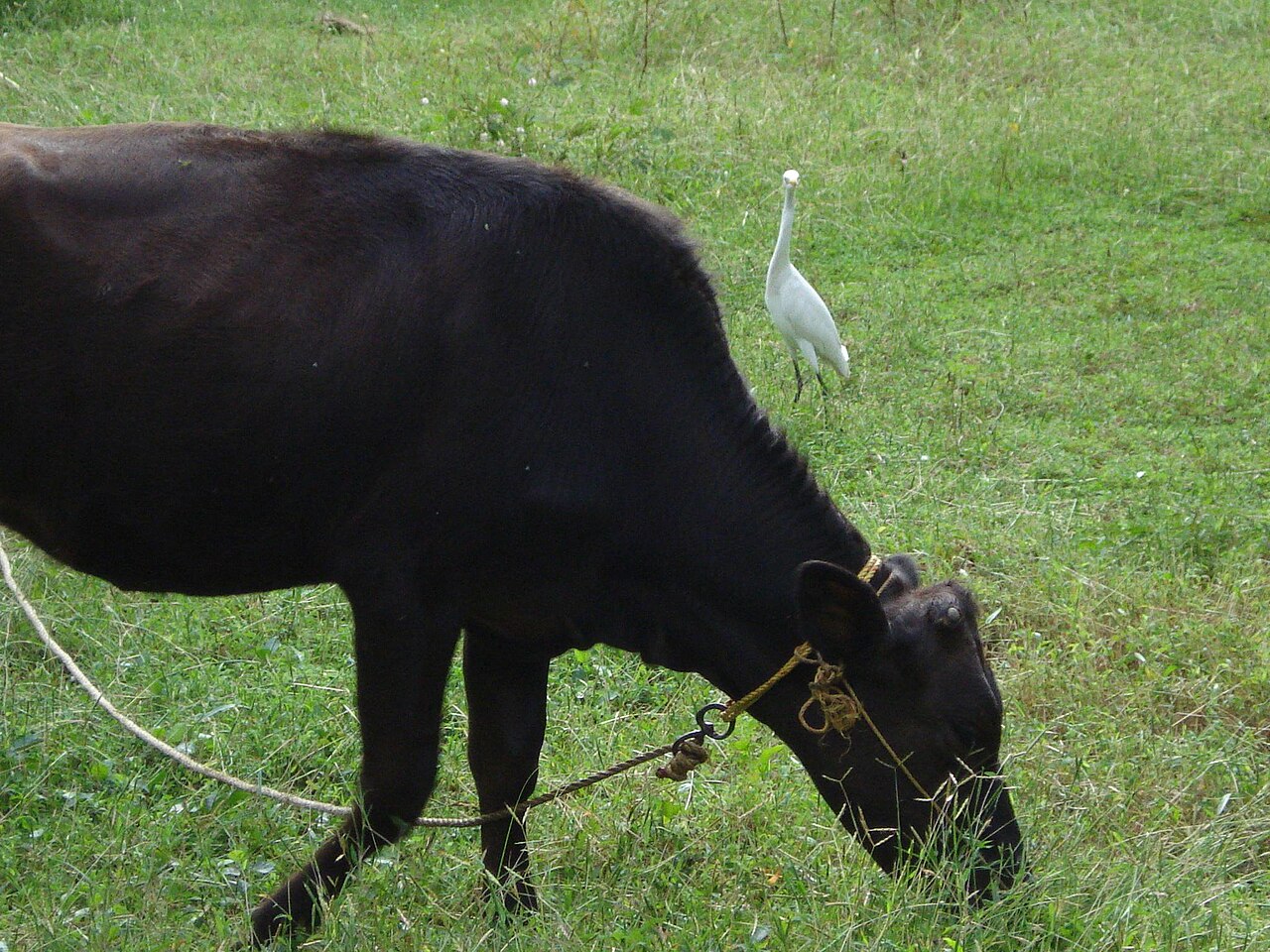
The animals that pass through the Eid markets come from a large national herd. Figures compiled for 2021 put Bangladesh's cattle at about 25.7 million, its buffalo at 0.83 million, its goats at 14.8 million and its sheep at 1.9 million, alongside some 118.7 million chickens and 34.1 million ducks. Animal husbandry contributes on the order of 2.9 per cent of national output, and livestock and dairy are an important part of the rural economy, while agriculture as a whole remains the country's largest employer. Most sacrificial animals are reared not on big ranches but on small farms and in households, and are moved to the cities in the final weeks before the festival.
Regional reports in 2026 gave a sense of the supply moving toward the markets. Across the eight districts of Rangpur division about 20.23 lakh animals were reported ready (5 May); Chattogram listed about 7.83 lakh (18 May), Pabna roughly 6.5 lakh (20 May), Shahjadpur in Sirajganj about 1.35 lakh (24 May), Jashore 1,17,997 (17 May), Satkhira about 1.2 lakh with a surplus of 18,000 (21 May), Chuadanga 2.02 lakh (12 May), Feni 90,000 (16 May), Narail 45,497 (19 May), Charfasson in Bhola about 25,000 (20 May) and Tala in Satkhira about 20,000 (22 May), among many district totals. Not every sign pointed up: Samakal reported on 4 May 2026 that the national cattle-and-goat count had fallen by about 6.5 lakh over two years. Animals reached the capital by road and, as Shomoyer Alo reported on 21 May 2026, by river.
Those district totals fed a national effort to meet the festival's demand from home-reared animals rather than imports, a goal the livestock sector has pursued for several years; some districts reported clear surpluses, such as the 18,000 animals over local need in Satkhira. The animals at the top of the market drew their own attention: on 25 May 2026, Prothom Alo reported a bull named Kala Manik listed at Tk 22 lakh in Dhaka, offered with a goat thrown in free, a glimpse of the market's high end even as most buyers looked for far more modest animals.
The farmers and the beparis
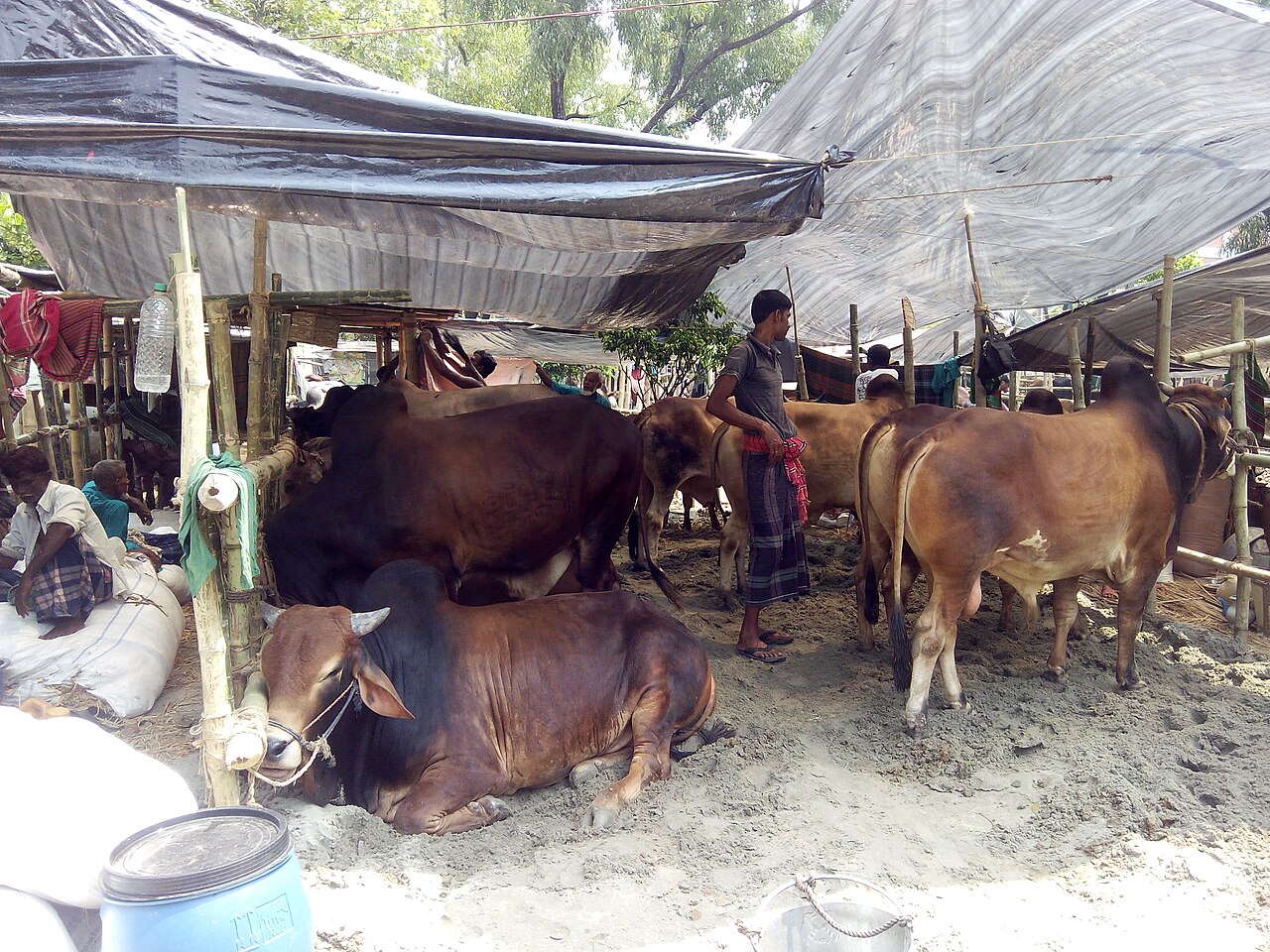
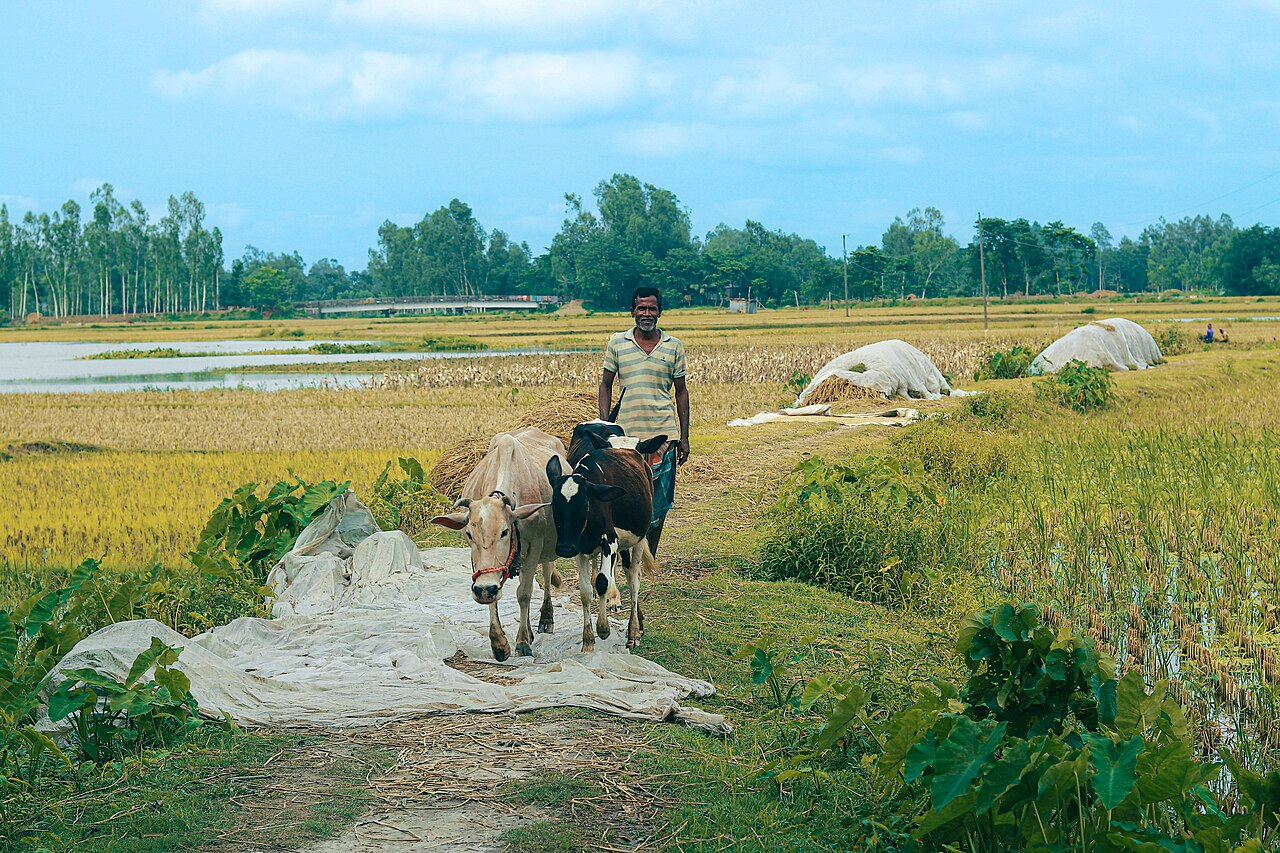
Most of the animals in the markets are the work of small keepers. In Bangladesh, sacrificial cattle and goats are reared chiefly on household farms and tiny holdings rather than on commercial ranches, often fattened over months specifically for the Eid sale, which for many rural families is one of the larger cash events of the year. The beparis, the traders who move the animals, buy in the villages and district markets and bring them to the cities by truck and, increasingly, by boat along the river routes, bearing the cost of transport, feed and minders for the days the animals stand in the market, and the risk that animals left unsold must be fed and carried back. The two-year fall of about 6.5 lakh in the national cattle-and-goat count that Samakal reported on 4 May 2026 is felt first by these small keepers and traders, for whom the price at the Eid market can decide a season's income.
Oversight as the markets filled
The toll is only one of the things the corporations and the police watch over in the Eid season. They set the boundaries of each market so that the trade does not spill onto the main roads and choke the capital's traffic; they require that approaches and exits be kept clear for the lorries carrying animals; and they post veterinary teams to examine the health of the animals offered for sale, since buyers want assurance that an animal is sound and free of disease. At the larger markets, banks and mobile-money operators are encouraged to set up booths so that buyers and sellers handling large amounts are not forced to rely on cash alone, a precaution against both theft and counterfeit notes. After the festival the corporations take on the other heavy task of the season, clearing the waste left by the sacrifice from streets and markets across the city.
The walk-through by the administrator and the State Minister, and the police commissioner's open invitation to report extortion, were part of this pre-Eid oversight. It was carried out in front of the beparis and buyers at Gabtoli, the very people whose complaints the authorities said they wanted to hear, and whose confidence in a fair price the markets depend on.
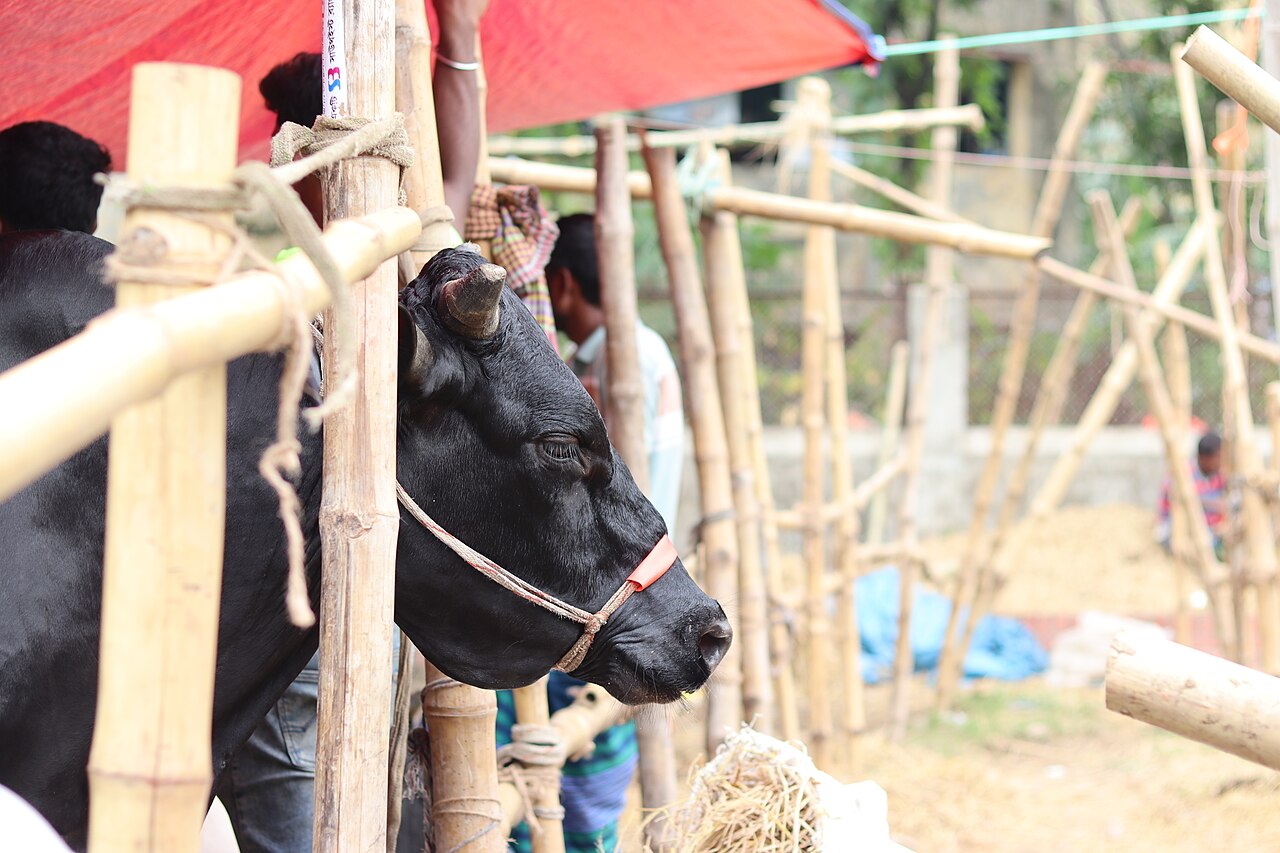
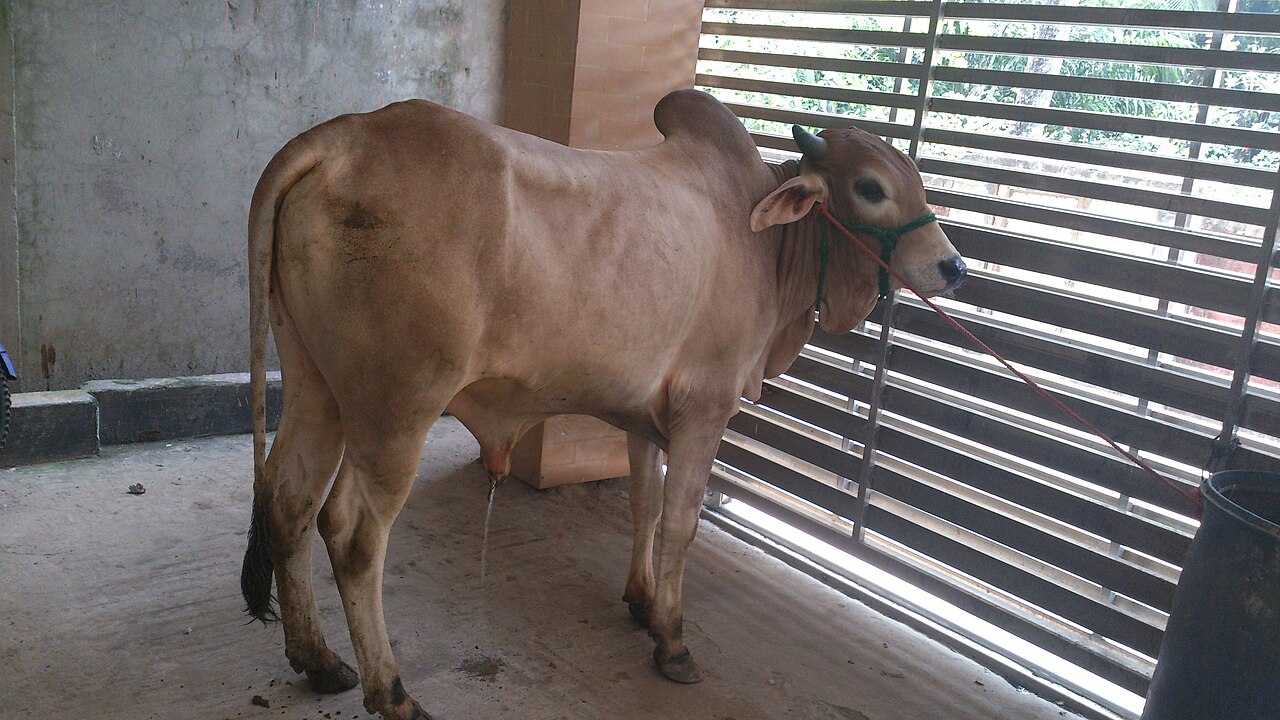
Photo: a cattle market during Eid al-Adha in Bangladesh, by Wasiul Bahar / Wikimedia Commons (CC BY-SA 4.0).
Sources: Jagonews24; RTV News; Bangladesh Sangbad Sangstha (BSS); The Daily Ittefaq; Prothom Alo; Samakal; Shomoyer Alo; Jugantor; Dainik Azadi; Wikipedia (Dhaka North City Corporation, Dhaka South City Corporation, Livestock in Bangladesh, Eid al-Adha).
Comments
(0)