
The capital's Qurbani cattle markets open on Wednesday, 6 July, for Eid-ul-Azha. Animals are already arriving from across the country, and fodder markets have become busy at the cattle markets too.
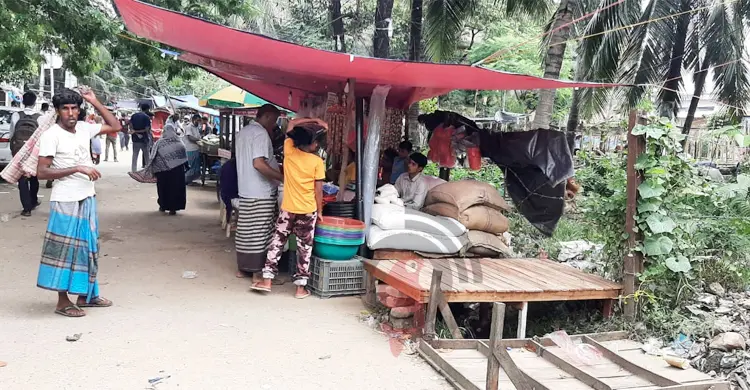
A visit to the Shahjahanpur, Meradia and Merul Badda cattle markets on Monday, 4 July, found makeshift fodder stalls set up around them. Some of these temporary sellers are from Dhaka and some have come from outside. Children, women and old people are all selling fodder and various items needed for Qurbani.
Although sales at the markets are officially due to begin on Wednesday, buyers have already started to come. There is no trading at the main markets yet, but many animals are being kept temporarily beside them. Qurbani animals can also be seen in neighbourhoods, where fodder stalls have also opened.
Seasonal trade
The temporary fodder sellers said they work in other jobs for the rest of the year but take up this business at Qurbani Eid, when a few days' work can earn good money. The trade runs from when animals start arriving at the markets until the second day of Qurbani.
A fodder market has been set up inside the bamboo market beside DIT Road. A seller there named Salam said he collects fodder from Sirajganj, Rangpur and other parts of the north. A small bundle of straw sells for Tk 20 at his stall; he buys them in the villages for Tk 8 to 10 and sells at this price because of transport and other costs.
Prices
Across the markets, depending on the market, wheat bran was selling at Tk 55 to 65 a kg, rice bran at Tk 60 to 65, broken rice at Tk 55 to 60, husk at Tk 32 to 35 and loose coarse salt at Tk 20 to 25. Green grass was selling at Tk 20 to 25 a bundle depending on type, and straw at Tk 15 to 20.
Jamal Mia sells green grass from a van at the Merul Badda market. He sells vegetables at other times but sells fodder during Eid. Grass is much more expensive this year than last year, he said.
Enamul Hossain, a fodder seller at the Shahjahanpur market, said all fodder costs considerably more than last year. Wheat bran that used to be Tk 40 to 45 a kg has risen by Tk 15 to 20 a kg. Khesari (grass pea) bran has gone up by Tk 20 to Tk 70, and all kinds of fodder have risen by Tk 10 to 20 a kg.
Nazer Hossain, who came to the cattle market from Sirajganj, said the temporary stalls charge even more than the higher prices in the regular market.
Alongside fodder, the markets are also selling hogla mats and khatias (wooden beds) for Qurbani. Mats sell for Tk 150 to 250 each depending on size, and khatias for Tk 200 to 500 each.
Source: Jagonews24. First published in Bengali on The Agro News.

Comments
(0)