
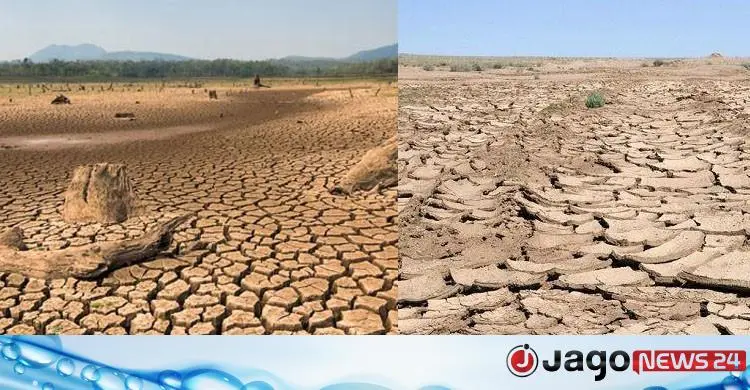
Desertification is now seen as one of the main environmental challenges. Extreme drought and climate change are rapidly turning dry regions into barren desert, and a third of the world's people live on these drylands. Experts warn that land degradation will bring food insecurity, poverty and large-scale displacement.
Desertification is the process by which fertile land loses its biodiversity and productivity and turns into desert. According to the United Nations, at least 40 per cent of the world's land is now affected. Rising global temperatures, deforestation, poorly planned farming and urbanisation are the main causes. A UN report says drought could affect 75 per cent of the world's population by 2050.
Food security at risk
Desertification is putting food security and sustainable farming at risk. As fertile land keeps degrading, biodiversity is lost and hunger and poverty rise. The UN says scarce resources can lead to social problems such as conflict and forced migration.
Ibrahim Thiaw, executive secretary of the United Nations Convention to Combat Desertification (UNCCD), said: "Land is the foundation of our lives. It feeds us, strengthens our economies and protects our environment."
The UN is stressing soil restoration and more sustainable farming. In West Africa, "half-moons" that are easy to build locally are being dug to hold more water. In Africa's Sahel, the Great Green Wall project is planting trees along some 8,000 kilometres, although a shortage of money has slowed it down.
Bangladesh warns of mass displacement
Experts say the crisis cannot be tackled without a coordinated global effort. In Bangladesh, 20 million people are at risk of displacement, a picture that emerged at a discussion on climate-driven migration at the UN climate conference COP27 in Sharm el-Sheikh, Egypt. Bangladesh's representative described internal migration caused by climate change and demanded that funding for adaptation be doubled.
"Today 650,000 people are displaced. Various estimates show the number will reach 20 million," the representative said, adding: "Beyond that, nearly twice as many are at risk of losing their usual homes."
The World Bank says salinity, sea-level rise and other effects of climate change will force 40 million people from their homes by 2050, and climate displacement is expected to exceed any other kind of internal displacement. Bangladesh's foreign ministry believes this displacement will put the world at risk, so responsibility must be shared, and world leaders must step forward now to share the burden of resettling climate refugees. If corrective action is not taken now, it said, this will become a security issue not only for Bangladesh but for the world.
Adaptation finance
Bangladesh says global finance still goes mainly to projects that cut carbon emissions, while it needs money to adapt. At the start of the COP, Bangladesh presented its National Adaptation Plan, which needs an average of $8.5 billion, or Tk 85,000 crore, a year until 2050. The promises made at the Copenhagen summit were not kept. Of the money that has come, about 80 per cent goes to cutting emissions, and more than 70 per cent is given as loans at market rates.
If climate finance keeps flowing this way, Bangladesh says, it could create a new debt burden for weak economies and developing countries. It argues strongly for a balanced split between adaptation and mitigation in line with the Paris Agreement, and for grant-based finance for adaptation. Among the demands raised on Bangladesh's behalf was finalising the steps needed to cut global carbon emissions by 45 per cent by 2030.
Early warning saves lives
World Meteorological Organization (WMO) Secretary-General Petteri Taalas said Cyclone Mocha, which swept over Myanmar and Bangladesh, showed how the most vulnerable communities are hit by weather, climate and water hazards. In the past, he said, both Myanmar and Bangladesh lost thousands and even hundreds of thousands of lives in such disasters, but thanks to early warning and disaster management such catastrophic death tolls are now history.
According to the WMO, tropical cyclones are the biggest cause of deaths and economic losses worldwide. Over the past half-century, it recorded more than 1,800 weather, climate and water disasters in Africa, with 733,585 deaths. The costliest, at $2.1 billion, was Cyclone Idai in 2019.
In the same period, the south-west Pacific was hit by about 1,500 disasters that killed 66,951 people and caused $185.8 billion in economic losses. Asia faced more than 3,600 disasters that took 984,263 lives and caused $1.4 trillion in losses, most of them from cyclones.
Source: Jagonews24. First published in Bengali on The Agro News.


Comments
(0)