
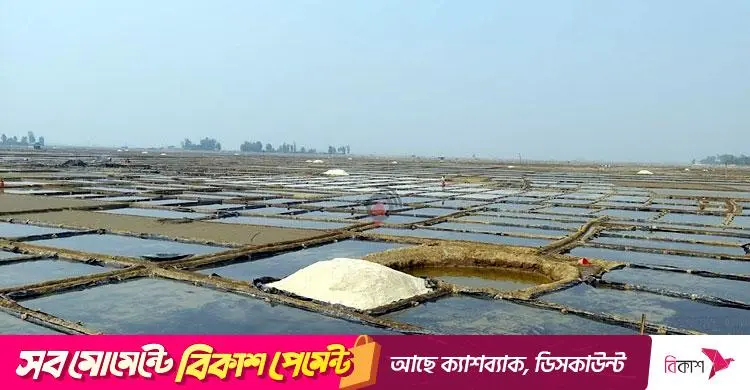
Salt is selling for about Tk 150 a maund less than it costs to produce. Farmers accuse mill owners of forming a syndicate to push prices down, some may stop production mid-season, and many are burying salt in pits to wait for prices to rise.
Shahjahan Monir (43), a farmer in Chowfaldandi, Cox's Bazar Sadar, made a profit last year and is growing salt on 9 kani (a kani being 40 decimals) this time, up from 6 kani last season. With the weather favourable since the start of the season, production has been good: by Monday (3 March) his 9 kani had produced about 1,000 maunds of salt.
Yet he is deeply frustrated, because salt is selling for Tk 150-160 less than its production cost. For the past week salt has been selling in the field at Tk 320-325 a maund, while transport and middlemen add another Tk 100-110 a maund. Producing a maund costs Tk 360-380. While packaged salt costs Tk 40-45 a kg, salt from the fields fetches Tk 6 a kg. So, far from recovering the higher land lease, labour and other costs, Shahjahan expects to have to borrow to pay off his workers.
It is not only him. The same picture applies to every salt farmer in the fields at Pokkhali and Gomatoli in Eidgaon, Chakaria, Pekua, Moheshkhali, Banshkhali, Anwara, Teknaf, and Bharuakhali and Khurushkul in Sadar.
Farmers blame a syndicate
Riduanul Haque, a salt farmer at Gomatoli in Eidgaon, said prices have been lower than last season since the start of this one, and remain so. It is hard to get Tk 220 for a maund, meaning a loss of around Tk 160 to 180 a maund, while production costs about Tk 360-380 a maund. If this continues to the end, farmers will be ruined.
Another farmer, Saif Uddin, said mill owners had formed a syndicate and pushed prices down, and there is no way to sell outside it. Salt from Pokkhali and Gomatoli is sent by cargo boat along the river to the Islampur salt industrial area. Those farming 10 kani this season will lose Tk 3 to 3.5 lakh by the end of it. So far 100 to 110 maunds a kani have been produced in the Pokkhali-Gomatoli-Chowfaldandi fields and around, where salt is grown on 6,000 acres.
According to the Bangladesh Small and Cottage Industries Corporation (BSCIC), salt is being farmed on 68,500 acres this season in Cox's Bazar Sadar, Kutubdia, Moheshkhali, Pekua, Chakaria, Eidgaon and Teknaf, and in parts of Banshkhali, Anwara and Patiya upazilas in Chattogram. By 1 March, 632,000 tonnes had been produced. This year's production target is 2,610,000 tonnes, the same as the country's annual demand. Salt from the fields is selling for an average of Tk 225.
Higher leases and costs
According to sources, farmers in the island upazilas of Kutubdia and Moheshkhali start producing before the season begins, so they stay ahead of other parts of the district. Salt is grown on 6,750 acres in Kutubdia and 17,000 acres in Moheshkhali. Because of early farming, annual field leases in Kutubdia are always higher: Tk 30,000-40,000 in Cox's Bazar Sadar, Eidgaon and elsewhere, but Tk 50,000 in Kutubdia. After good prices last season, the lagiyat (a six-month lease) for salt fields on the district's mainland coast rose to Tk 40,000-50,000 this season, and to about Tk 70,000-80,000 in Kutubdia. The cost of laying polythene in the fields, transporting salt and paying labourers has also risen from last year. As a result, farmers are spending Tk 350-380 to produce each maund. Unless they get Tk 450-500 a maund as they did last year, they will lose interest in salt farming, and 80 percent of farmers, who borrowed at high interest to farm salt, will be ruined.
Farmers allege that the syndicate pushed prices down so that they would stop producing salt, creating a shortage in the country that would allow salt to be imported. That, they say, would amount to destroying the country's self-sufficient salt industry. And with no government warehouses to store salt when prices are poor, they are storing it in pits in the old way, to be dug up and sold if prices rise.
Salt stored in pits
Shahab Uddin, president of the Moheshkhali Salt Farmers' Unity Struggle Council, said many farmers have lost heart at not getting a fair price. Many are stopping production, and those who carry on are storing their salt in pits.
Md Idris Ali, field inspector of BSCIC's salt development project, said farmers are having to sell at a loss. Deeply frustrated, many have stopped production, while others carry on because they have no choice. Most, however, are storing salt in pits instead of selling. At present lakhs of tonnes of salt are stored in at least several thousand pits in Teknaf, Moheshkhali, Kutubdia, Pekua, Eidgaon and Chakaria, each holding 200 to 1,000 maunds depending on size.
According to Idris Ali, salt stored in a warehouse dries out and loses weight, but salt kept in a pit does not dry out and stays safe. Even storms, rain or waterlogging do not spoil it. The salt inside the pits is wrapped in polythene and the mouth of each pit is covered with earth.
Protests and demands
On 18 January, Industries Adviser Adilur Rahman visited the salt fields of Cox's Bazar, inspected production and spoke to farmers. He then met the district administration, salt farmers, mill owners and BSCIC officials. At the meeting, Md Mizanur Rahman Chowdhury, convener of the Cox's Bazar Salt Farmers and Traders Struggle Council, said a kilogram of packaged salt costs Tk 40 to 50 in the market, and no one seemed to be looking into why prices differ so much between field and market. With still no decision on prices, the council protested on the Cox's Bazar-Chattogram highway at noon on 26 February, dumping salt on the road to demand a fair price for Cox's Bazar salt.
The protesters say Cox's Bazar and Chattogram are the country's only domestic salt-producing centres. About 95 percent of the salt needed is produced in Teknaf, Cox's Bazar Sadar, Eidgaon, Moheshkhali, Kutubdia, Pekua and Chakaria upazilas of Cox's Bazar, and the remaining 5 percent in Banshkhali and Patiya of Chattogram. Last season, with favourable weather, 222,000 tonnes remained in stock after demand was met. This season, too, the weather has been favourable and production is going well. On about 68,000 acres, the domestic salt industry supports the income of 10 lakh people, including 65,000 farmers.
They allege that salt mill owners have formed a syndicate with the ill intent of destroying the domestic salt industry and are manoeuvring, under the name of industrial salt, to control various ministries and agencies and get LCs approved for salt imports.
HM Hamidur Rahman Azad, a Kutubdia resident, central assistant secretary general of Bangladesh Jamaat-e-Islami and a former member of parliament, has called for a fair price for salt to be set to save the industry. Drawing the attention of the adviser to the industries ministry to the need to fix field-level prices to save the country's only self-sufficient salt industry, he said salt produced in Cox's Bazar district meets the needs of the country's 18 crore people and its industries.
Md Zafar Iqbal Bhuiyan, deputy general manager of BSCIC's Cox's Bazar salt industry development project, said that because they are not getting a fair price, farmers are reluctant to produce salt even though the weather is normal. The reasons for the fall in price are being investigated.
Source: Jagonews24. First published in Bengali on The Agro News.

Comments
(0)