
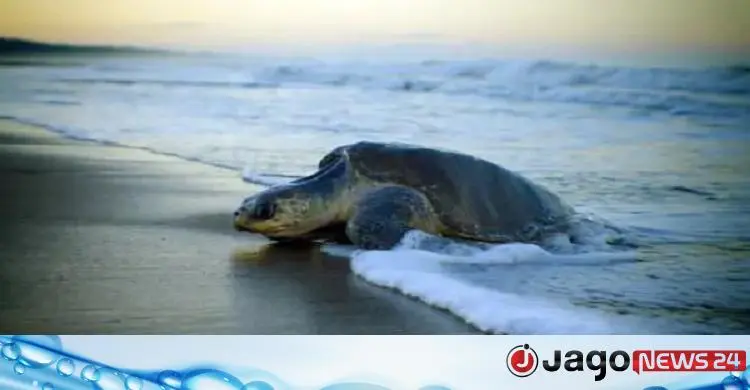
Olive ridley sea turtles return to the beaches where they hatched to lay their eggs. But on the way back to the sands of Cox's Bazar, death traps await them. Human activity had already made the beach hostile, and now the sea is no longer safe either. Compared with a decade and a half ago, fewer mother turtles now come to the Cox's Bazar beach, and fewer eggs are laid.
Olive ridleys no longer arrive in groups on Bangladesh's "dangerous" beaches, so the "arribada", known as a remarkable natural event, is no longer seen. Before two months of this year were out, 95 dead olive ridley turtles had been found on the beach, a matter of concern for experts.
Caught in nets, flippers cut
Preliminary investigations found the turtles died after being caught in nets and having their flippers (the limbs they swim with), necks and other parts cut. Experts warn that the number of olive ridleys coming ashore to nest will fall further if excessive trawling, the large number of fishing trawlers close to the coast, nets tangling round necks and flippers, fishermen cutting off flippers instead of freeing trapped turtles, unplanned tourism on the beach, and excess light and noise continue.
The olive ridley nesting season runs from November to the last week of March, and mother turtles come ashore around the full moon or new moon. In this peak season, between January and 27 February, members of the Bangladesh Oceanographic Research Institute (BORI) found 95 dead olive ridleys. They washed up along the Cox's Bazar Marine Drive from Sonar Para in Ukhiya upazila to Teknaf beach, at Hajampara and Baharchhara in Teknaf, on Inani beach and on the Sonadia coast in Moheshkhali upazila.
Tariqul Islam, a senior scientific officer at BORI, said mother turtles lay the most eggs in February. All the dead turtles found were olive ridleys, and all were carrying eggs. Most had nets wrapped round their bodies and net ropes caught on their flippers; many had cut flippers and cut marks and wounds on their necks. They wash ashore 7 to 10 days after dying, by which time most bodies are bloated and rotting. They have been buried.
Professor Dr Tauhida Rashid, director general of BORI, said the country has no laboratory able to carry out forensic examinations on turtles. Initial observation suggests, however, that the turtles died because of discarded pieces of net (ghost nets) and flippers caught in fishing nets.
Dr Mohammad Muslem Uddin, chairman of the Department of Oceanography at the University of Chittagong, said fishermen cut off turtles' flippers to save their nets and time when turtles get caught, and that is why the turtles are dying. Eighty percent of the dead turtles had nets wrapped round their bodies. Large jellyfish, which turtles feed on, have also been found on the beach, and there were probably many turtles and jellyfish in the fishing areas, he said.
Deaths rising every year
The Department of Environment is concerned at the rising number of turtle deaths each year: the turtles carry eggs, yet their bodies bear injuries. Dead turtles are washing up not only on the Sonar Para coast but also at Pechar Dwip. Local people blame fishermen, trawling vessels, large trawlers and illegal nets, and say turtles are also killed when struck by large trawlers and trawling vessels.
Nobi Hossain, a local young man, has worked for four years to protect turtles and conserve eggs on the Sonar Para coast. He says mother turtles are dying one after another when they come ashore to nest. "I found about 20 dead turtles in one week and buried them on my own initiative. If they are left lying, they smell and are harmful to small children nearby. My effort is for people to become aware of protecting turtles and the environment," he said.
Officials of the Department of Environment are also worried. Researchers say there is no alternative to enforcing the law and raising awareness among fishermen. Md Abdul Kaium, a researcher at the Radiant Research and Education Centre, said about 60 to 70 dead turtles had washed ashore in the past two months, most often around Sonadia Island, Cox's Bazar, the Teknaf peninsula and St Martin's Island.
He said turtles get caught in nets at sea or are badly injured by trawlers during the nesting period, and often die from bleeding or injuries even when the nets are cut away. Last year, more than 200 dead turtles were recovered. Government restrictions, mobile courts and public awareness are therefore urgent, he said.
Coastal fishermen and communities must be helped to understand that the survival of sea turtles keeps biodiversity in balance, he added. It reduces the number of jellyfish, increases fish production and benefits fishermen in the long run. If environmental activists, researchers and everyone involved work together to raise awareness, the situation can change for the better.
Hatcheries planned on Sonadia
Khandaker Mahmud Pasha, deputy director of the Department of Environment's Cox's Bazar office, said sea turtles are important for the balance of the sea and nature, so everyone's awareness and participation are essential to conserve them. Monitoring showed turtle deaths in 2025 were nearly three times those in 2024, and BORI's research also indicates the number of dead turtles is rising year by year. This is undoubtedly alarming and a cause of deep concern, he said.
The department's Cox's Bazar office said a conservation project is under way on Sonadia Island, with plans to set up hatcheries in the 2026-27 fiscal year. A guard is being recruited. Hatcheries will be built at at least two sites in Dakshinpara, Paschimpara and Purbapara, where eggs can be kept safe and hatched. Officials hope coordinated efforts, strict monitoring and greater public awareness will bring positive change in turtle conservation.
Source: Jagonews24. First published in Bengali on The Agro News.

Comments
(0)