
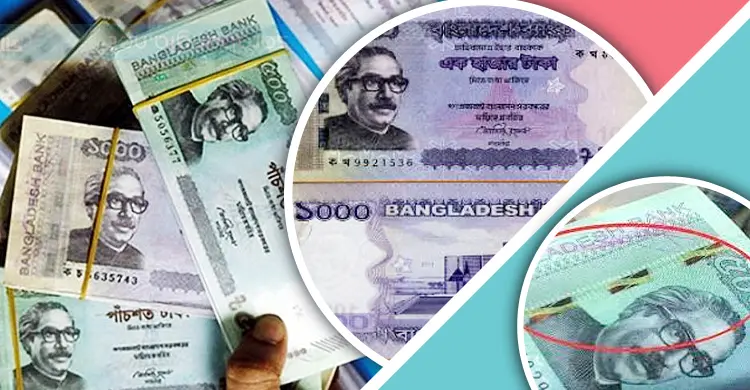
Various gangs are active in spreading counterfeit money with sacrificial animal markets as their target. They openly advertise fake notes for sale on Facebook pages and even offer home delivery. The gangs work through agents who push the notes into the market. Once notes made at almost no cost are released into circulation, the gangs pocket large sums.
Law enforcers have found several counterfeit money gangs ahead of Eid. They say they are also ready to stop fake notes spreading at the markets, with note-detection machines and full security arrangements at the markets.
Intelligence sources say fake notes worth lakhs of taka have already been released targeting Eid-ul-Azha, and more than 50 gangs are active in the capital to release more. They are forging notes from Tk 100 to Tk 1,000. Law enforcers have recovered nearly three-quarters of a crore taka in fake notes this year.
Markets in the capital have already been set up and trading has begun, with traders bringing animals from districts across the country. Crores of taka will change hands at the markets every day, which is why the gangs are trying to supply fake notes there.
Law enforcers say the fake notes are being made very skilfully and could spread much more widely at the slightest carelessness. Police will set up several booths at every cattle market to stop counterfeit money.
Recent arrests
On the night of 19 June, RAB-3 arrested three people, including a gang leader, with Tk 2 lakh in fake notes in the Uttarkhan police station area of the capital. The gang aimed to spread fake notes at cattle markets during Eid. The leader, Md Mehedi Hasan, knew Photoshop and graphics work and learnt how to make fake money by watching YouTube. With the help of Shahzada and Tushar, who were also arrested, he began making fake notes and selling them through Facebook. They made four deliveries, including consignments of Tk 5-6 lakh, and spent only Tk 2,000 to make Tk 1 lakh in fake notes.
On 21 June, RAB arrested two people with Tk 3 lakh 38 thousand in fake notes in South Manda, Mugda, in the capital. The money had been made to supply to cattle markets. The gang planned to make a huge quantity of fake notes, but RAB foiled the plan first.
On 23 June, RAB-1 arrested a member of a gang that slipped fake notes among real money in the Gazipur Metropolitan Sadar police station area. The gang had long used social media and other online platforms to buy and sell fake money, drawing in buyers with online adverts and videos. It exchanged money through mobile banking and sent fake notes to retail sellers by courier, and even slipped fake notes into bundles of real money.
Several police and RAB operations show that the gangs used to print mainly Tk 500 and Tk 1,000 notes, but because people are more careful with these, they are now also forging Tk 50, Tk 100 and Tk 200 notes. The notes are spread both offline and online, and there are cases of supply by courier. The gangs sell Tk 1 lakh in fake notes for Tk 10,000 to Tk 20,000.
According to the Dhaka Metropolitan Police (DMP), 12,759 fake notes with a face value of Tk 75,88,410 were recovered in the five months from January to May this year, along with a large amount of equipment for making them. All cases related to fake notes in this period are under investigation. Besides taka, the gangs are also making fake foreign currency: in April the DMP's Detective Branch (DB) seized Tk 12 lakh worth of fake rupees.
Central bank orders note-detection machines at markets
The central bank has instructed that note-detection machines be used at every cattle market in the capital. On 21 June, Bangladesh Bank's Currency Management Department sent the instruction to the managing directors and chief executives of all scheduled banks. It says counterfeit note detection booths must be set up at 10 markets of the south city corporation and 9 markets of the north city corporation in the capital, and at other approved sacrificial animal markets across the country, down to upazila headquarters. Banks will provide the service free to animal traders from the day markets open until the night before Eid.
In districts outside Dhaka where Bangladesh Bank has offices, regional offices must be instructed to give the necessary support in the same way at markets approved by the relevant city corporation or municipality, led by the local Bangladesh Bank office. In districts without a Bangladesh Bank office, Sonali Bank branches have been given responsibility for assigning duties to different banks at markets approved by city corporations, municipalities, police stations or upazilas.
Asked about fake note detection at the Gabtoli market, Jashim Uddin Molla, deputy commissioner (DC) of the DMP's Mirpur division, told Jagonews that note-detection machines have been installed at the market, where anyone can check whether a note is real or fake. A police control room will also be open round the clock at Gabtoli.
He asked traders, buyers, sellers and others to seek police help in any untoward incident, and said immediate police help is also available by calling the national emergency service 999.
Md Faruk Hossain, DC of the DMP's media and public relations division, told Jagonews that fake note dealers become active ahead of any big festival. At these festivals they sell twice what they cannot sell in the rest of the year, and every year they start preparing about a month before Eid, working day and night to make fake notes.
"They sell the fake notes to wholesalers, who sell them on to retailers at a higher price, and the retailers release them into the market in various ways. But just as gang members are active ahead of Eid-ul-Azha, members of every DMP police station and every DB unit are also working to catch them. Several groups have already been brought to book. There will also be machines at the cattle markets to detect fake notes, where real and fake can be identified," he said.
Commander Khandaker Al Moin, director of RAB's Legal and Media Wing, told Jagonews that RAB has stepped up security around markets in the capital and across the country. Cash changes hands at the markets, and RAB will help protect the temporary booths of various banks. Drugging gangs and ointment gangs are active at markets, and security measures have been taken to prevent such incidents. Watchtowers and temporary camps have been set up at the capital's big markets.
Mohammad Harun Or Rashid, additional commissioner (detective) of the DMP, told Jagonews that DB detectives are working in the field to prevent fake notes targeting Eid. Members of several gangs have been arrested before, and those on bail are also under watch.
He asked people to inform the DB of any information about fake notes, and said anyone wanting to make a large transaction before Eid should seek police help. The DMP's intelligence-gathering division, the DB and plainclothes police are working on market security, preventing fake money and stopping muggers and all other crime.
How to spot a fake note
- On every note, including Tk 100, Tk 500 and Tk 1,000, the design on the front and back, the text in the middle, the denomination and seven parallel straight lines are printed in raised form, so the note feels slightly rough to the touch.
- On the right side of the note there are small raised circular marks, three on the Tk 100 note, four on the Tk 500 and five on the Tk 1,000, which feel raised to the touch. This feature cannot be added to fake notes.
- The watermark on fake notes is blurred and of poor quality. Real notes have a clear watermark of a "tiger's head" and the Bangladesh Bank monogram, which can be seen against the light on close inspection.
- Notes of every denomination have a security thread bearing the Bangladesh Bank logo, with the denomination and the logo printed at four places on the thread. The thread is very strong and so firmly fixed to the paper that it cannot be lifted by scratching with a nail or by twisting. Counterfeiters cannot insert the thread this precisely.
- On Tk 100, Tk 500 and Tk 1,000 notes, the denomination written in English numerals at the top right corner is printed in colour-changing ink. On Tk 100 and Tk 1,000 notes the figure turns from golden to green when the note is moved slowly; similarly, the 500 turns from reddish to greenish. The ink on fake notes may shine, but it does not change colour.
- Every note carries the portrait of Bangabandhu, the Bangladesh Bank monogram and the denomination as a watermark. The monogram and denomination look brighter than the portrait. Fake notes lack these features.
Fake notes can easily be checked with a magnifying glass: seen through one, a fake note shows only a single line.
Source: Jagonews24. First published in Bengali on The Agro News.


Comments
(0)