
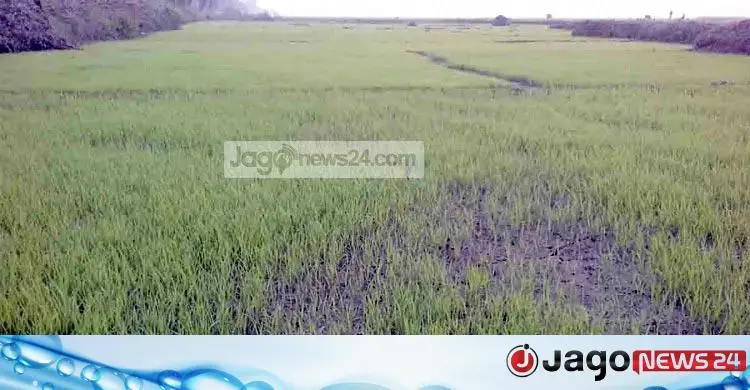
Bulu Mia, a farmer in Bhandarpur village of Badalgachhi in Naogaon, has been preparing seedbeds for the IRRI-boro season. He has already made seedbeds on three bighas of land, but almost all of them have turned red. If the dense fog gets worse, he said, there will be no way to save the seedbeds.
Almost every crop, including IRRI and boro rice, mustard, wheat, maize, onion and garlic, is suffering from the excessive cold.
Throughout the past week, temperatures in Naogaon stayed between 6 and 10 degrees Celsius. On 7 January, the season's lowest temperature of 6.7 degrees Celsius was recorded at Badalgachhi in Naogaon.
In its monthly forecast on 1 January, the Meteorological Department said several cold waves could sweep the country in January and temperatures could drop to 4 degrees Celsius.
Agricultural experts say it is not only boro: when low temperatures and fog persist for a long time, diseases spread quickly in almost all rabi crops, reducing yields and threatening quality.
Advice to protect seedbeds
Humayra Mondal, deputy director of the Department of Agricultural Extension (DAE) in Naogaon, said: "We are advising farmers everywhere to cover seedbeds with polythene and keep them submerged in water at night to protect them from dense fog and cold waves. Farmers are also being advised not to transplant IRRI-boro during this intense cold. If the cold continues, the damage will grow, and boro cultivation may be somewhat delayed."
Naogaon district has a target of growing IRRI-boro on 192,380 hectares this year, for which seedbeds have been prepared on 8,350 hectares.
The Agromet Lab of the Bangladesh Rice Research Institute (BRRI) has issued a warning that the extreme cold is raising the risk of seedling blight and thrips attacks in seedbeds.
BRRI chief scientific officer Dr Niaz Md Farhat Rahman said it is essential to keep 3 to 5 centimetres of water in seedbeds, which keeps the soil temperature under control, while balanced fertiliser management can keep seedlings healthy.
A nationwide concern
It is not only one district: dense fog and continuous cold are causing unease in farming across the country, including the northern region. The cold is more intense this year than in other years nationwide, raising the risk to crops.
According to the DAE, the target this season is 2.48 lakh hectares of boro seedbeds, of which seedbeds have been prepared on about 70 percent.
Against a target of 4.67 lakh hectares of potatoes, planting has been completed on about 87 percent. But the current weather has raised the risk of late blight in potatoes, and the DAE has issued a precautionary advisory to reduce the disease.
Farmers in Bogura, one of the country's main potato-growing districts, fear heavy losses. Enamul Hoque, a farmer in Sherpur upazila of the district, said: "I have grown potatoes on two bighas this time. For several weeks the sun has barely appeared, and this is affecting potato production. Disease has started. I am spraying regularly and costs are rising. I am worried about what will happen if this continues."
Experts say late blight appears in potatoes if the sun is not seen for three days in a row, and the disease can kill potato plants quickly. Signs of cold injury have also reportedly appeared in potato fields in many areas.
Vegetables and mustard also hit
Winter vegetables and mustard have also been affected. Mohiuddin, a farmer in Akkelpur, Joypurhat, said bean plants are not holding their clusters. Each cluster has produced 4 to 5 beans, compared with 15 to 20 in other years.
There are also fears of lower mustard output. In Ullapara, Sirajganj, many fields were seen with more weeds than mustard. In the same area, bees cannot come out because of the intense cold and dense fog, disrupting honey production.
Abu Noman Faruk Ahmed, a professor in the plant pathology department of Sher-e-Bangla Agricultural University, said such weather is not at all favourable for crops. Without sunlight, crops fall ill easily. Most rabi crops are now at an important formation stage, and an attack at this time could sharply reduce yields.
Md Obaidur Rahman Mondal, director of the DAE's field services wing, said farmers are being given regular advice in the field and the situation is being closely monitored.
DAE director general S M Sohrab Uddin said that if the weather causes major crop damage, overall measures to make up for it are being considered. There is always provision for incentives for affected farmers, he said.
Source: Jagonews24. First published in Bengali on The Agro News.

Comments
(0)