
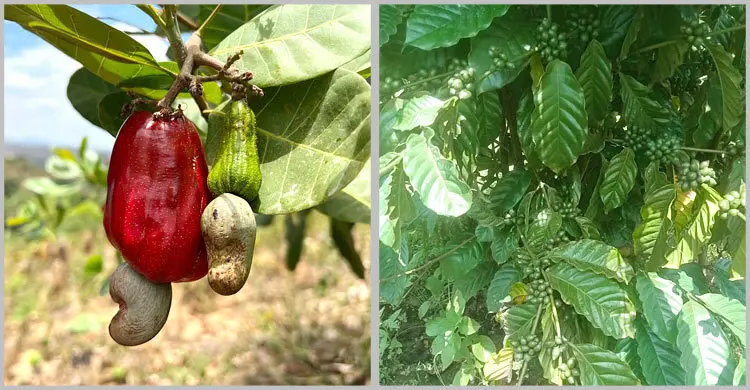
The government is drawing up new plans around coffee and cashew nut. The soil of the country's hill region is suitable for both crops, and using that soil and climate, 25 lakh saplings of the two have been planted under a government project. Some trees are already bearing. Among the project's main aims are to meet domestic demand within a few years, save foreign currency, earn from exports and create jobs.
Under the project titled "Cashew Nut and Coffee Research, Development and Extension", about 10 to 15 per cent of the saplings planted in the three hill districts of Rangamati, Khagrachhari and Bandarban have died. The Implementation Monitoring and Evaluation Division (IMED) has ordered them to be replaced quickly. The Department of Agricultural Extension (DAE) is implementing the project from January 2021 to December 2025.
The project's overall aim is sustainable improvement in farmers' incomes, employment and socio-economic conditions through expanding coffee and cashew cultivation, raising production, and processing and marketing, in 25 upazilas of the three hill districts and other suitable areas.
The DAE said the goals include raising production by 50 per cent by developing and extending varieties and management technology, expanding the growing area from 2,000 hectares to 6,000 hectares, meeting domestic demand and raising foreign earnings through exports, developing the skills of 49,500 farmers in the project area, creating jobs, and helping reduce poverty and improve nutrition.
IMED's instructions
The consultancy firm Creative Consultants International Limited is carrying out intensive monitoring of the project, which the Ministry of Agriculture is implementing through the DAE. A review of the firm's first draft report submitted to IMED found that saplings planted in the hills were dying. IMED has issued further instructions besides replacing them: the report must show whether the dead saplings are being replaced, and must state the implementation status of the project's various components in all the areas selected for intensive monitoring.
The report must also give audit information in the format IMED prescribes, identify the lack of coordination between the project's two implementing agencies, the DAE and the Bangladesh Agricultural Research Institute (BARI), and correct the discrepancies in the project's allocation, spending and progress figures in various places.
Asked about the IMED report, project director Md Shahidul Islam told Jagonews24: "We have already planted 25 lakh coffee and cashew saplings, but 10 to 15 per cent have died for various reasons. When we plant saplings of different trees at home, not all of them survive either; some die. In the same way, some coffee and cashew saplings in the hills have died. But we are replacing them."
Asked why the saplings are dying, he said: "Coffee and cashew saplings have to be carried by hand from one hill to another; that is one reason. The saplings are usually planted in the monsoon, and in the rains they are often lost for various reasons. But replacing saplings is an ongoing process."
On yields, he said: "Right now the harvest is small. Look, when we plant a mango sapling, it does not bear fruit at once; it takes time. But we hope to get full yields in the next two years. We will get coffee and cashew from these trees for 40–50 years."
Area under cultivation
The project's work began in June 2021. At the start, cashew was grown on 1,800 hectares in the country; through the project it is now grown on about 4,200 hectares. Coffee cultivation has grown from 65 hectares to 1,800 hectares. Most of this expansion has been in the three hill districts of Rangamati, Bandarban and Khagrachhari, where cashew and coffee are now grown on land once used for jhum cultivation. With prices of the produce rising, people in the hills are becoming interested in growing them.
The DAE said saplings are being replaced wherever they die. Coffee and cashew trees one to two years old are yielding a small crop, and full yields of both will come within the next two years. The trees will live and bear fruit for 40 to 50 years. One tree yields 10 to 15 kg of cashew nuts or three to four kg of coffee a year.
Consumer demand for cashew nuts in the country is rising day by day, and the cashew market is now worth about Tk 700 crore. On average 2,500 to 3,000 tonnes of processed cashew nuts are imported every year. Demand for coffee in the country is about 2,000 tonnes, and over the past decade demand has grown by about 56 per cent on average. About Tk 600 crore worth of coffee is sold in the country each year. Demand for both products has been rising over the past five years. When the coffee trees reach full yield, the country's demand will be met, the report says.
Creating jobs
The expansion of cashew and coffee farming and the setting up of processing factories have created jobs. Large industrial groups are setting up processing factories in the country's economic zones. Companies such as BSRM and Kazi Group are building processing factories for export at a cost of about Tk 250 crore, which will create jobs for about 1,200 people.
About 2,000 workers are employed in the existing processing factories, a significant number of them women.
Raising export earnings
One of the project's main aims is to earn foreign currency through exports while meeting domestic demand with home-grown cashew and coffee. Work is under way to bring two lakh hectares of uncultivated land in the hill region under cashew and coffee. If this can be achieved, the country could meet its own demand and export one billion dollars' worth.
New entrepreneurs
The expansion of cashew and coffee growing is creating new entrepreneurs. The country now has 22 cashew processing factories, all set up privately, which is making it easier to market home-grown cashew nuts. Domestically grown coffee is also being used in processing factories around the country. The project has produced new growers and entrepreneurs.
The world currently produces 35 lakh tonnes of cashew nuts, 12 lakh tonnes of it in the West African countries of Ivory Coast, Nigeria, Ghana and Benin. But these countries cannot process their cashews; the African countries process only 10 per cent. Vietnam processes their cashews and earns four billion dollars a year.
The global cashew market is worth 9.8 billion dollars, of which Vietnam alone exports four billion dollars. The rest is exported from India and some West African countries. The big markets for cashew are the United States and Europe. Like Vietnam, Bangladesh could also earn and save foreign currency, directly and indirectly, from coffee and cashew.
Source: Jagonews24. First published in Bengali on The Agro News.
Comments
(0)