
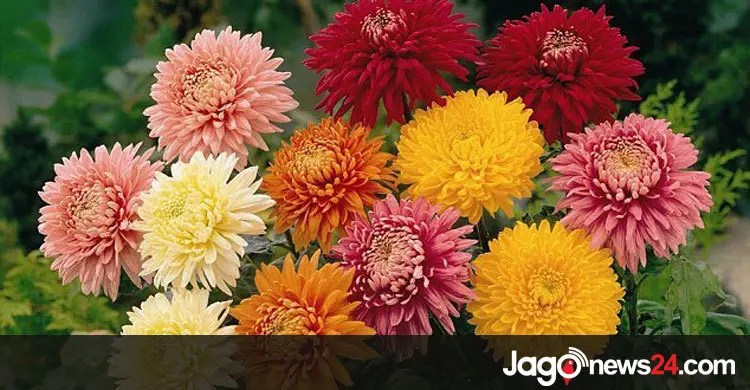
The chrysanthemum (chandramallika) is one of the most popular seasonal winter flowers. It is also called chrysanthemum because it blooms around Christmas. Its original homes are Japan and China. It comes in many shades and colours, and so is also called the "queen of autumn". It can be grown in the yard, on the veranda and on the roof.
Climate: chrysanthemums grow well in relatively cool weather and sunny places. In Bangladesh winter is the right season to grow them.
Soil: well-drained loam and sandy soil rich in organic matter suits chrysanthemums. The soil pH should be 6.0 to 7.0.
Raising and planting seedlings
Seedlings can be raised from seed, suckers and cuttings. Cuttings are taken from mid-July. Stems 8 to 10cm long, cut at a slant from strong one-year-old branches, will root when set in a bed or bucket. Around February, when flowering is over, the plants are cut back to 15 to 20cm above the soil. After some time suckers emerge from the base of the cut stems. When they are 5 to 7cm long, they are separated from the mother plant and planted in a shaded seedbed or pot. From May to July the seedlings must be protected from rain and strong sun.
Planting: before final planting in the field or pot, moving the seedlings to separate beds or pots can improve their flowering. The right time to plant in the field or pot is October to November. Depending on the variety, plant at a spacing of 30 x 25.
Fertiliser
Chrysanthemums take up large amounts of nutrients from the soil, so they respond very well to soil with organic and chemical nutrients. Per hectare, apply 10 tonnes of rotted cow dung or compost, 400kg of urea, 275kg of TSP, 300kg of muriate of potash, 165kg of gypsum and 12kg of boric acid and zinc oxide. Mix the rotted dung or compost into the soil 10 to 15 days before planting the suckers, and the other fertilisers except urea 7 to 10 days before. Apply half the urea 25 to 30 days after planting the suckers and the other half 45 to 50 days after planting, around the base of the plant but a little away from it. After top-dressing, mix the fertiliser into the soil and irrigate.
Care of buds, water and support
Buds: keep beds and pots free of weeds. About a month after planting, pinch off the tips so the plants become bushy rather than tall. If young plants flower early, remove the flowers at once. For large flowers, disbud: keep the middle bud and cut off the two side buds. For medium-sized flowers, remove the middle bud.
Irrigation: plant seedlings in the afternoon and press down the soil around the base, then water lightly. The plants cannot tolerate too much water, so water them in a way that does not leave it standing at the base for long. Regular, measured watering every day before and after planting is essential.
Staking: chrysanthemum flowers are usually large compared with the stems, so drive a strong stick from the base of the plant up to the bud to stop the flowers drooping. It is best to put the stick in once, at planting. Choose bamboo sticks to suit the height of the variety and set them a little away from the base of the seedling.
Pests, disease and harvest
Sucking insects suck sap from leaves and flowers, leaving spots; flowers and even whole plants may dry up. To control them, mix 2ml of malathion in 1 litre of water and spray every 7 to 10 days.
Aphids, both young and adult, suck sap from new shoots and flowers, seriously harming growth and yield. They can be controlled with Novacron (0.1%) or Rogor (1%).
Powdery mildew turns the leaves grey, with a white powder on top. It can be controlled by spraying 0.5ml of Tilt 250EC or 2g of Thiovit per litre of water every 7 to 10 days.
Harvest: yield varies with the variety, but each plant gives an average of 30 to 40 flowers a year. When the outer petals are fully open and the inner ones begin to open, cut the flowers with long stalks using a sharp knife early in the morning or in the afternoon.
Source: Jagonews24. First published in Bengali on The Agro News.
Comments
(0)