
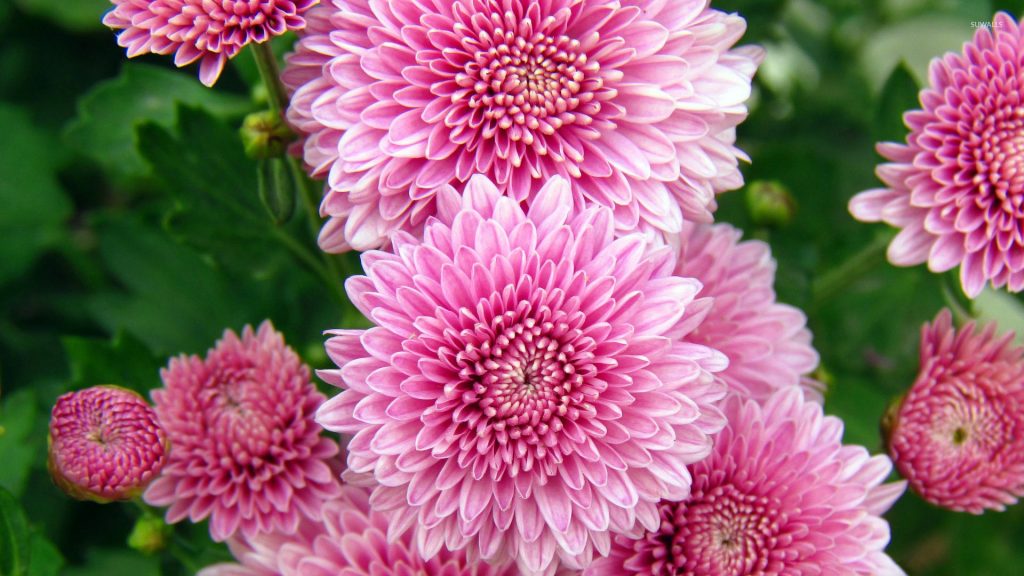
Varieties: the Bangladesh Agricultural Research Institute (BARI) has developed two chrysanthemum varieties, BARI Chandramallika-1 and BARI Chandramallika-2.
Chrysanthemums prefer relatively cool weather and sunny places. In Bangladesh, winter is the best time to grow them. Well-drained loam and sandy soils rich in organic matter are suitable, and a soil pH of 6.0-7.0 is desirable.
Raising seedlings
Chrysanthemum plants can be raised from seed, suckers or stem cuttings. Plants from seed do not give good flowers and take a long time to bloom, whereas cuttings or suckers do not have this problem. In Bangladesh, plants are usually raised from stem cuttings, starting from mid-July. Cuttings 8-10 cm long, cut at a slant from fresh, sturdy one-year-old stems, will root when set in a bed or bucket. Around February, when flowering is over, the plants are cut back to 15-20 cm above the ground. After a while suckers emerge from the base of the cut stems. When they are 5-7 cm long they are separated from the mother plant and planted in a shaded nursery bed or pot. From May to July, seedlings must be protected from rain and strong sun.
Before final planting in the field or a pot, seedlings can be moved to a separate bed or pot to improve their fitness for flowering. The right time to plant in the field or pots is October-November. Chrysanthemums should be planted at a spacing of 30 x 25, depending on the variety.
Fertiliser
Chrysanthemums absorb large amounts of nutrients from the soil, so they respond very well to soil with organic and chemical nutrients. For good yields, fertiliser must be applied in balanced doses. Per hectare, apply 10 tonnes of rotted cow dung or compost, 400 kg urea, 275 kg TSP, 300 kg muriate of potash, 165 kg gypsum, and 12 kg boric acid and zinc oxide. Mix rotted dung or compost into the soil 10-15 days before planting suckers, and the other fertilisers except urea 7-10 days before. Apply half the urea 25-30 days after planting the suckers and the other half 45-50 days after planting, around the base of the plant at a little distance. After top-dressing, mix the fertiliser into the soil and irrigate.
Care, watering and staking
Beds and pots should be kept free of weeds. About a month after planting, pinch out the tips so the plants become bushy rather than tall. If young plants flower early, remove the flowers at once. For large flowers, disbud: keep the central bud and cut off the two side buds. For medium-sized flowers, remove the central bud.
Plant seedlings in the afternoon and firm the soil around the base, then water lightly. Chrysanthemums never tolerate too much water, so water in such a way that it does not stand at the base for long. Regular daily watering in the right amount is essential before and after planting.
Chrysanthemum flowers are usually large relative to the branches, so a strong stick should be set from the base of the plant up to the bud to keep the flower from drooping. It is best to set the stick once at planting time, a little away from the base, using a bamboo stick matched to the height of the variety. Setting it right at the base, or after the plant has grown, can damage the roots, and wounds on the roots can let pathogens in and cause disease.
Pests
Thrips are tiny, ash-coloured insects that cannot be seen with the naked eye. They suck sap from leaves and flowers, leaving spots; leaves and flowers dry up, and in heavy attacks the whole plant withers. To control them, mix 2 ml of malathion in 1 litre of water and spray every 7-10 days.
Aphids are the main pest of the flower. They are dark green, purple or black. Both young and adult aphids suck sap from new shoots and flowers, seriously harming growth and yield. They can be controlled with Novacron (0.1%) or Rogor (1%).
Source: Staff Correspondent. First published in Bengali on The Agro News.
Comments
(0)