
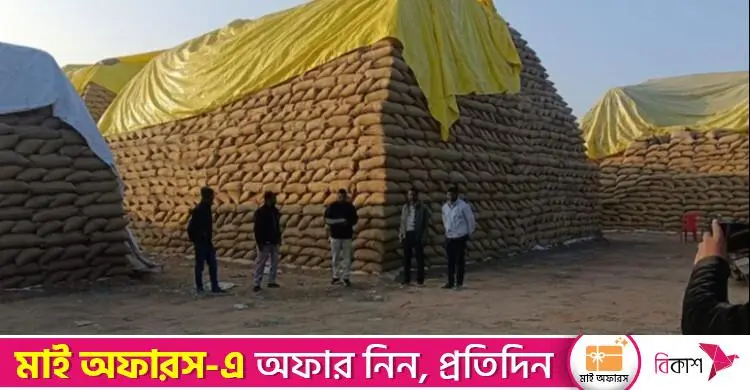
Allegations of major irregularities have arisen around government paddy procurement and storage in Chhattisgarh, known as "India's rice bowl". According to official records, thousands of quintals of paddy are written off every year in various districts of the state as losses from "drying, insects and birds". But analysis of the figures shows the scale of these losses is not normal and instead points to organised corruption.
The clearest picture comes from Mahasamund district, where 81,620 quintals of paddy were shown as lost in official accounts in just 10 months. By that calculation, it is about 11 quintals an hour, or 272 quintals a day – equal to a truckload of paddy vanishing every hour.
The losses occurred at five procurement centres – Mahasamund, Bagbahara, Pithora, Basna and Saraipali. At each, about three and a half per cent of the total paddy bought was shown as "lost".
Officials call it "technical"
Mahasamund district marketing officer Ashutosh Kosariya told the Indian broadcaster NDTV that the matter is mainly "technical". He said paddy from the 2024–25 season was stored for about 11 months, longer than usual, so it lost weight as its moisture fell. "Across the state, an average of three and a half per cent of paddy is lost to drying. In Mahasamund it is 3.57 per cent," he said.
Dipesh Pandey, in charge of the Bagbahara centre, said paddy arriving in the rainy season has up to 17 per cent moisture, which falls to 9 to 10 per cent by the time it is dispatched. Some natural decay in that period is inevitable, and then termites, insects and birds appear. In the monsoon a lot of paddy falls to the ground, which cannot be collected and mixes with the mud, he said.
However, under a directive issued on 12 September by Chhattisgarh's food and consumer protection department, a shortfall of 1 per cent brings a show-cause notice, 1 to 2 per cent a departmental inquiry, and more than 2 per cent can lead to dismissal and even an FIR.
In practice, shortfalls of more than 3 per cent are being passed off as "normal".
Earlier cases
Earlier, when about 26,000 quintals of paddy disappeared in Kawardha district, rats and insects were blamed at first, but an investigation found evidence of fake bills, fake worker lists and tampered CCTV footage. The centre head was dismissed.
A similar picture has emerged in Jashpur district, where a shortfall of about 20,586 quintals of paddy was found in the 2024–25 kharif season, with a market value of about Rs 6.38 crore. About five thousand sacks also went missing, bringing the total loss to Rs 6.55 crore.
The state government has proudly announced that since 14 November 2025 it has bought about 93.12 lakh tonnes of paddy and deposited Rs 20,753 crore in the accounts of about 16.95 lakh farmers. But the question is how much of this huge quantity of paddy actually reaches mills, ration shops and consumers.
Chhattisgarh's food and civil supplies minister Dayaldas Baghel declined to comment.
Analysts say that if rats account for seven crore in one district, insects for six crore in another, and a truckload of paddy vanishes every hour somewhere else, it can no longer be called natural loss. In this way, they say, "India's rice bowl" is slowly becoming a bottomless vessel into which paddy goes in and money flows out, with no accountability.
The report is based on NDTV.
Source: Jagonews24. First published in Bengali on The Agro News.
Comments
(0)