
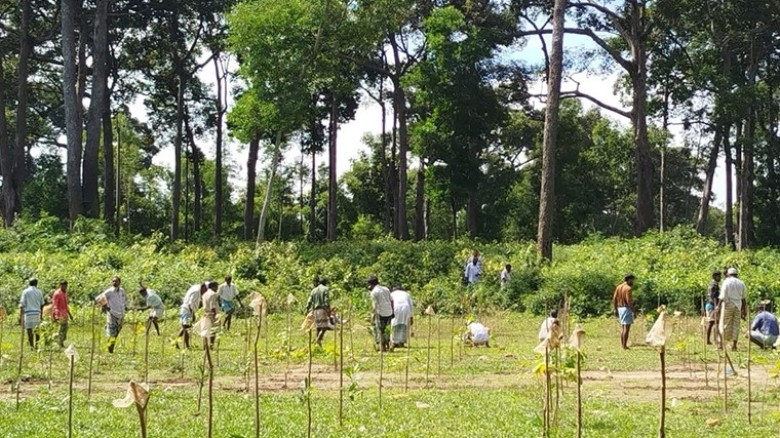
About 55,123 acres of forest land in the Chattogram forest region, which covers Chattogram, Cox's Bazar and Bandarban, are now in the hands of encroachers. Figures from the Chattogram Conservator of Forests show that of the region's 855,968 acres of forest, 605,305 acres (70.72 percent) are reserved forest and 110,707 acres are protected forest.
District by district, 33,620 of Chattogram's 370,091 acres of forest are occupied. In Cox's Bazar's two forest divisions, 19,862 of 211,854 acres are occupied, and in the three divisions of Bandarban and Lama, 1,602 of 272,027 acres.
Forest researchers say encroachment, unchecked felling, the spread of hill farming and construction are shrinking wildlife habitat and thinning out native plant species. Barking deer, sambar, hoolock gibbons, capped langurs, pangolins, slow lorises, fishing cats, king cobras, Burmese pythons and yellow tortoises are among the animals now at risk. The IUCN's 2016 count found 268 critically endangered Asian elephants in the country.
Staff are short too. Across the region's 71 ranges and 170 beats, 1,184 people fill 2,284 posts, leaving 1,100 vacant. Of 802 forest guard posts, 230 are empty and 572 guards are at work, so each guard on average watches over 1,497 acres.
Mihir Kumar Doe, Conservator of Forests for the Chattogram region, said some 55,123 acres in the three districts remain under illegal occupation, though about 83.66 percent of all forest land is reserved or protected. Hazarikhil Wildlife Sanctuary, Medhakachhapia, the Sangu-Matamuhuri reserve, Dhoapalong-Hemchhari National Park and Jahajpura-Shilkhali hold rare trees, bamboo and wildlife, he said, which is why these forests must be protected.
Ecotourism built around the region's hill forests, waterfalls, rivers and sea is also growing. Those involved fear that unless the occupied land is recovered, the forests' biodiversity and the tourism that depends on it will both suffer.
The report is by Krishi Shomoy's Chattogram correspondent.
Source: Krishi Shomoy
Comments
(0)