
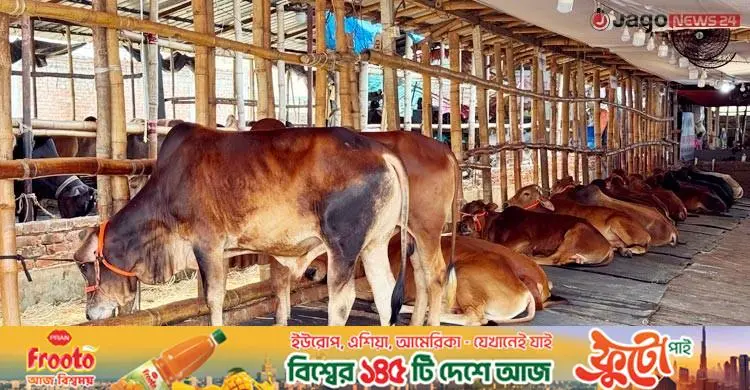
With Eid-ul-Azha approaching, there is a festive mood at the cattle markets and farms of Chattogram. Keen buyers are visiting agro farms in and around the city every day.
Some go with their families to look at cattle, others book the animal they like in advance. At some farms children and adults alike are excited; at others people are busy taking photos on their phones to share on social media.
Farms in the Oxygen, Bhatiari, Sagarika, Bibirhat, Hill View and Katalganj areas of the city now see visitors from morning to night.
Farm owners report steady footfall
Alhaj Mohammad Monjurul Alam, owner of Messrs Haji Marufa Agro Farm at Quaish in the Oxygen area, told Jagonews24 that buyers were coming to his farm day and night. "Many buy cattle and take them home, while some buy and leave them at the farm. The farm has been fairly crowded for the past few days," he said.
At Shah Chorondwipi Agro Dairy Farm, also at Quaish, several families had come with their children to see the cattle. Some were taking photos with the animals, others asking about prices and weights.
Nurul Alam Sawdagar, owner of Shah Amanat Agro Farm, said countless people come every day to see the cattle and many book the ones they like in advance. "This year demand is highest for medium-sized, well-conditioned cattle," he said.
He said people were less interested in very large cattle than before, and most buyers were looking for cows between Tk 2 lakh and Tk 4 lakh.
Fewer Indian cattle this year
Farmers said that until a few years ago local farmers suffered because Indian cattle came in across the border. Cheap Indian cattle meant local cattle did not fetch a fair price. This year, with far fewer Indian cattle coming in, local farmers are somewhat relieved.
Ataur Rahman, a farmer in the Hill View area, said, "If extra cattle do not come in from outside the district, we will get good prices. Every year cattle come in from various districts, as well as from India and Myanmar, and local farmers suffer."
Nurul Absar, owner of Sarm Agro, said, "Raising large cattle costs a lot, and feed prices have also risen. But buyers now want small and medium cattle, so this year I have prepared cattle accordingly."
Buyers cut their budgets
Prospective buyers across the city said many were planning their sacrifice on a smaller budget this year.
Nurul Absar, a resident of Baklia, said, "Our two brothers' families sacrifice together. Household costs have risen a lot this year, so we are thinking of taking a small cow. We went to the farm with the family, looked at the cattle and paid an advance."
Shahidul Islam of the Bahaddarhat area said, "Last year I sacrificed a large cow. This year a reasonable one will do. Everything costs more now."
Traders say buyers are coming to the market with more careful calculations than before, and many are keen to buy straight from farms instead of going to the markets.
District livestock officer Dr Alamgir said the number of animals fit for sacrifice in Chattogram this year could exceed demand, and surplus animals would also come into the city from the upazilas. "Indian cattle used to have a big influence. Now local farmers have moved far ahead," he said.
He said monitoring of farms had been stepped up to ensure healthy and safe animals, and veterinary medical teams would also work at the markets.
Jahangir Alam, estate officer of Chattogram City Corporation, said supply was good this year and regular monitoring was being carried out to prevent artificial fattening. "We hope buyers will be able to buy animals at tolerable prices," he said.
Online sales grow
As in the past few years, sacrificial animals are also being sold on social media and online platforms, with many farmers showing their cattle on Facebook pages and YouTube videos.
Farmers say that if online sales grow, pressure on the markets will ease and transport and security risks will fall somewhat. Interest in booking cattle online is growing especially among expatriate families and busy city dwellers.
Traders and farmers fear, however, that heavy rain or a transport crisis at the last minute could affect the market, since Chattogram's market depends largely on cattle transported from districts across the country.
Farmers, traders and livestock officials said no major shortage of sacrificial animals is expected this year. Local farms have enough cattle and goats ready, and large numbers of cattle will also come to Chattogram from districts in the north and south-west.
The biggest change this year is in buyers' preferences. High inflation, rising household costs and economic pressure are pushing most people towards small and medium cattle instead of large ones, and farmers have prepared relatively more medium cattle with that demand in mind. Those involved expect no major crisis in the market; with ample supply, rising demand for medium cattle and active participation by local farmers, prices are expected to stay relatively stable.
Source: Jagonews24. First published in Bengali on The Agro News.

Comments
(0)