
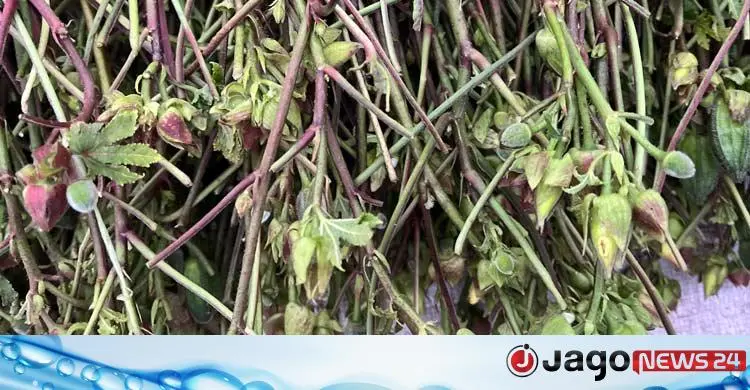
Demand for latakasturi plants has risen markedly in Chapainawabganj. The plants and their seeds are fetching much higher prices in local markets than before, and because the plants are selling at high prices, many farmers in the area are becoming interested in growing latakasturi.
The plant's scientific name is Abelmoschus moschatus. In Bangladesh it is known as latakasturi, also called kalakasturi, and it is grown commercially in various countries. It grows in forests and scrubland, but its use in Bangladesh is comparatively very low.
Many growers in Chapainawabganj now cultivate latakasturi regularly to support their families. Because it can be grown at low cost and the profit is relatively high, it is becoming a promising cash crop for farmers. With proper care and marketing, latakasturi cultivation could play an important role in the region's economy in future.
Sold by the kilo at Kansat jaggery market
At around 6am on 23 January, several growers were seen selling latakasturi plants beside the district's Kansat jaggery market. The vines were selling at Tk 200 to Tk 250 a kg, and the buyers were mainly sugarcane growers.
Sugarcane growers said the plants are used to remove dirt and froth while jaggery is being made.
Mojibur Rahman, a latakasturi grower from the Abbas Bazar area, said he had grown the crop on one bigha of land. He has already sold Tk 50,000 worth and hopes to sell at least another Tk 30,000 worth.
Sugarcane grower Atikur Rahman Swajan said latakasturi is used to clean cane juice during jaggery making. Because it is so effective at clearing the dirt and froth as the juice is boiled, demand for it in jaggery making is growing day by day.
How it cleans the juice
Dr Md Yasin Ali, deputy director of the Department of Agricultural Extension (DAE) in Chapainawabganj, said purifying cane juice is a very important step in making jaggery. When the juice extracted from the cane is boiled, dirt, fibre, dust and froth float to the top. If this is not removed, the jaggery turns dark and its taste and quality may suffer. To solve this problem, sugarcane growers and jaggery makers have long used latakasturi plants.
He said that when a set amount of latakasturi is added to the juice as it boils, the dirt and froth clump together and rise to the surface easily. Once that is removed, the juice becomes clear and the jaggery comes out bright in colour and of better quality. As it is a natural ingredient, latakasturi does not harm the taste or quality of the jaggery; rather, it makes the jaggery more hygienic and more marketable.
Source: Jagonews24. First published in Bengali on The Agro News.

Comments
(0)