
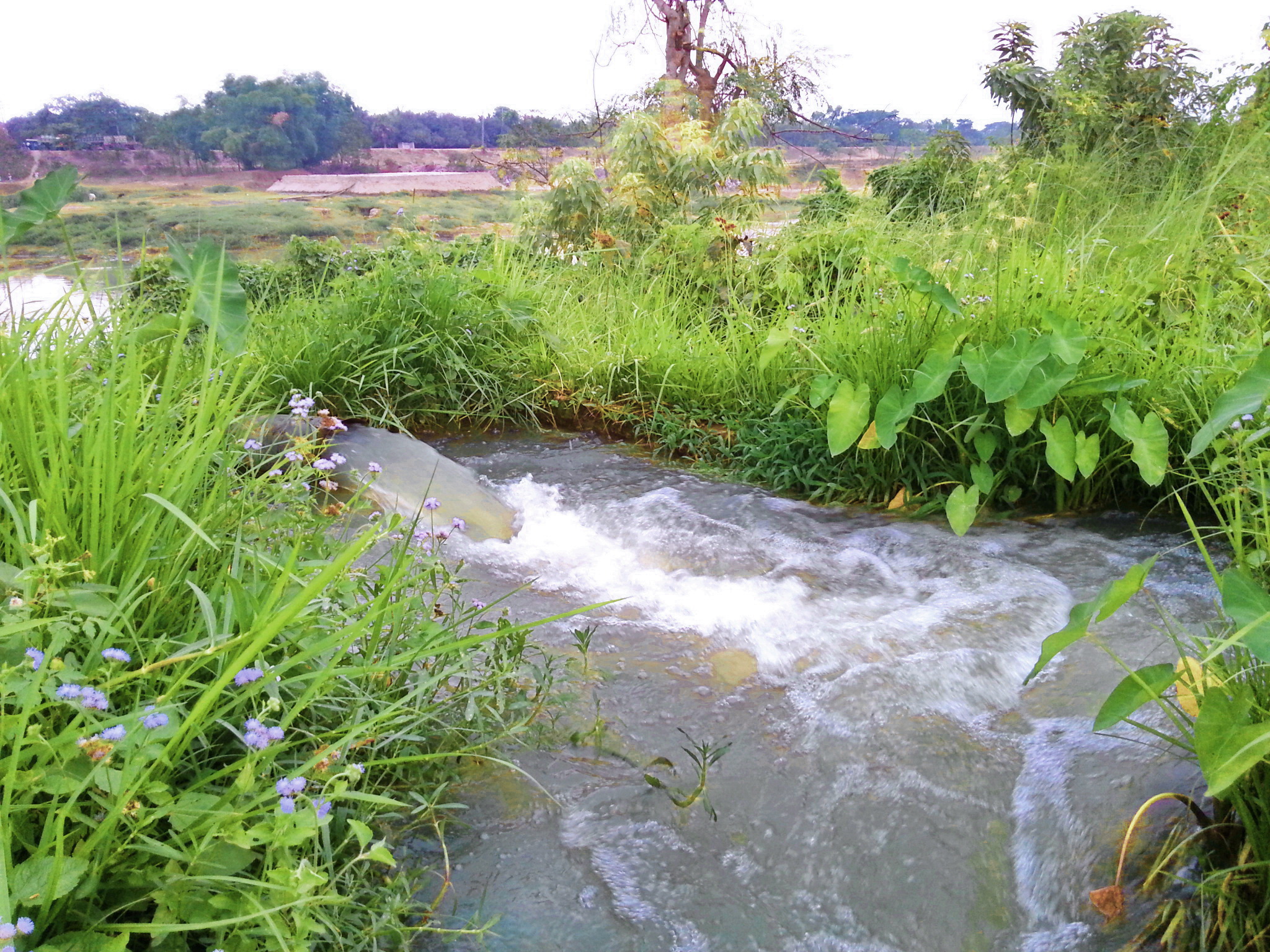
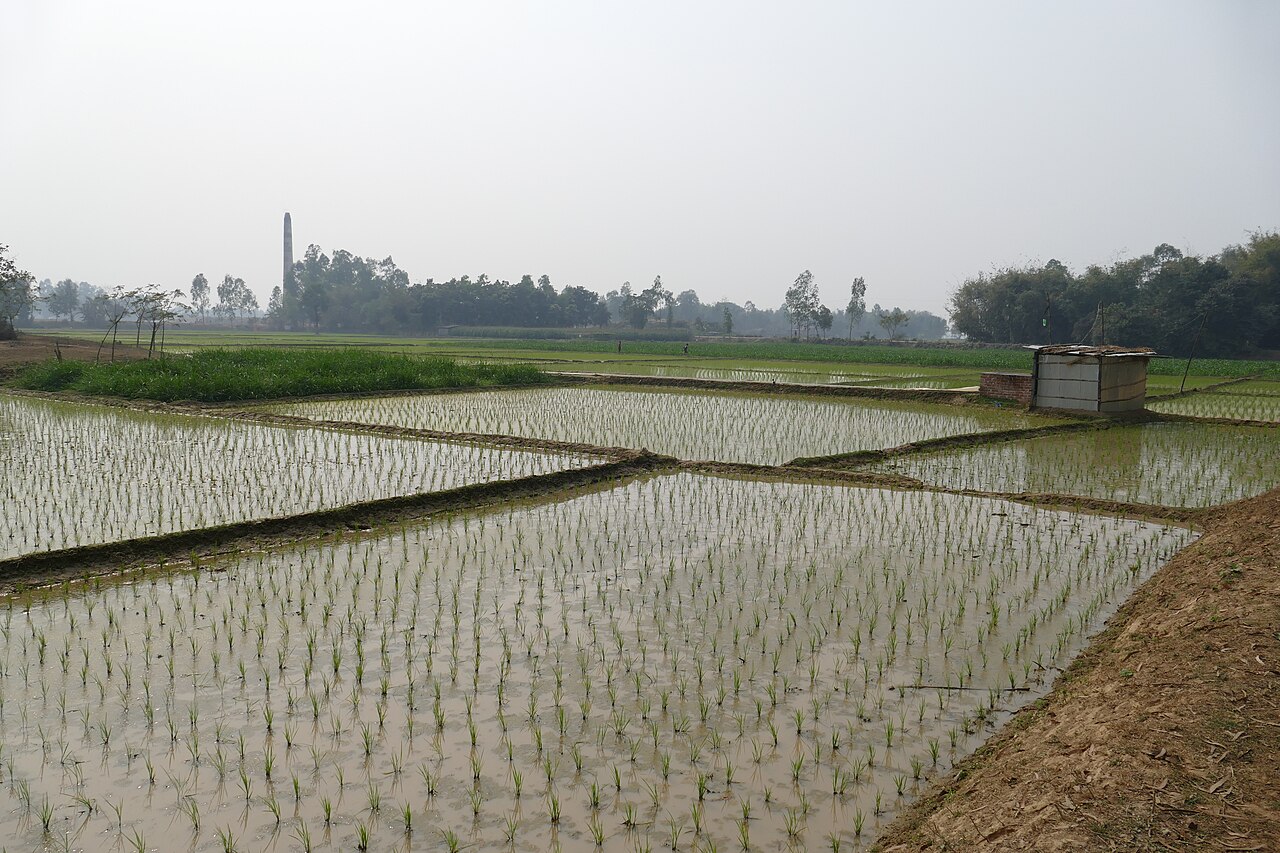
Farmers in the west field of Nandanpur, in Shajahanpur union of Chapainawabganj Sadar upazila, said in early April 2026 that an organised gang was removing transformers and lifting irrigation pumps from their land at night. According to a Jagonews24 report published on 5 April 2026, at least 50 pumps and transformers had been stolen from that one field in the previous three months, and ten motors were taken in a single night on 30 March. The thefts came in the middle of the boro season, when the paddy needs water at regular intervals, and the farmers said that unless the thefts stopped, the crop on about 200 bighas would dry up and be lost.
The farmers were already coping with a shortage of diesel and with higher prices for farm inputs. Local people complained that, despite repeated thefts, there was not enough security, and that complaints to the rural electricity office and to the police station had brought no remedy. A senior police officer in the district rejected that account, saying no one had filed a complaint at the station and that goods had been recovered where complaints had been received.
What the farmers reported
Latifur Hamman, a farmer in Shajahanpur union, told Jagonews24 that at least five of his motors and one transformer had been stolen in the previous year. "How much money can you keep spending to buy them again and again? On top of that there is a fuel crisis. We are not getting oil, and there is a diesel shortage too," he said.
Jahangir Alam, a farmer in the Hakim area, said his own motor had been stolen two days before he spoke. Within four days, he said, one motor each belonging to Khalil, Nasir, Matiur Rahman, Matin and Rashid, and three belonging to Mofiz Ali, had also been taken.
Farmers said the diesel shortage on one side and the rising price of farm inputs on the other were already making them spend more to grow a crop, and they still faced the risk of not getting a fair price for the harvest. The theft of water motors and transformers, they said, had added a new fear on top of these.
A day earlier, on 4 April 2026, the online outlet Bangla Stream had published its own report from the same field. Its correspondent wrote that locks on the pump houses were being cut almost every day and that keeping watch at night had not stopped the gang. Farmers told Bangla Stream that they were borrowing, including from NGOs, to buy new equipment and get irrigation running again, and that some were thinking of growing other crops in future. Bangla Stream also reported that farmers alleged that staff of the rural electricity cooperative had a hand in the transformer thefts, and that farmers had announced a reward of one lakh taka for help in catching the thieves. That allegation was the farmers' own; neither report carried any finding that it was true. Bangla Stream's count of the thefts was higher than Jagonews24's; this report follows the Jagonews24 figures.
What the officials said
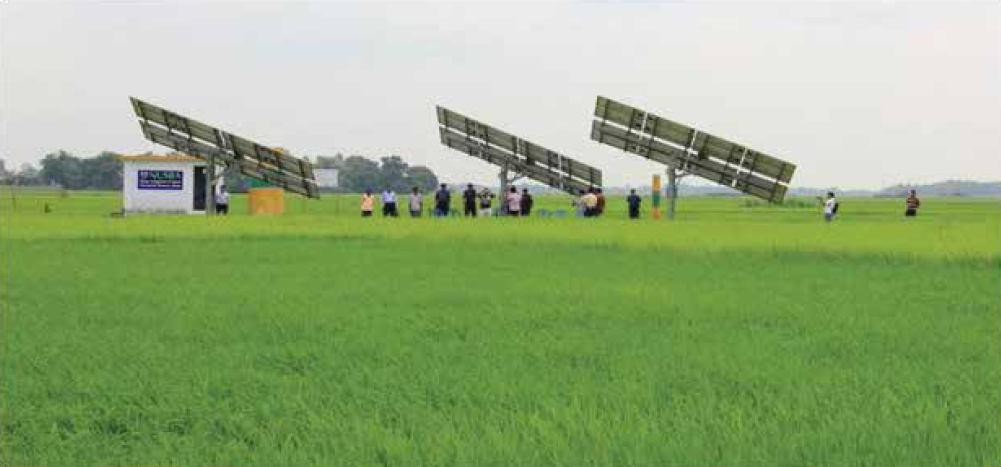
Sunain Bin Zaman, the Chapainawabganj Sadar upazila agriculture officer, said crops in the char areas needed extra irrigation and could not be grown without water on time. He expressed concern about the thefts and said solar panels or dug wells (patkuya) could be added in future as an alternative source of irrigation.
Howlader Md Fazlur Rahman, general manager of the Chapainawabganj Palli Bidyut Samity, the rural electricity cooperative that supplies the area, said regular meetings and campaigns were being held to raise awareness among farmers and local people to prevent theft. He said strict action would be taken if anyone from his own office was found to be involved.
ANM Wasim Firoz, additional superintendent of police in Chapainawabganj district, denied the farmers' complaint. He said no one had filed a complaint at the police station, that police had worked on the complaints they had received and recovered many goods, including motors, and, as Bangla Stream quoted him, that legal action would be taken when complaints were made.
A diesel shortage at the same time
The thefts in Nandanpur came during a wider fuel crisis. BBC Bangla reported on 4 April 2026 that a fuel crisis arising from the war involving Iran had begun to affect Bangladesh, from ride-sharing in the cities to farms and goods transport in the countryside. Many places were not getting diesel for irrigation pumps although the boro crop urgently needed water. The government said there was no risk of a diesel shortage, that about 61,000 tonnes of diesel had reached Chittagong port on 3 and 4 April, and the energy division's spokesman said there would be no fuel crisis in April. To cope with the situation the government had shortened office hours to 9 am to 4 pm and decided to cut public spending on fuel, power and gas by 30 percent. Researchers quoted by the BBC said recent rain had eased the pressure on farmers, but warned that the crisis could deepen when the crop's demand for water rose further.
The Daily Star's Bengali edition reported on 29 March 2026 from several districts. In Gopalganj, a farmer said he was buying diesel at Tk 150 a litre and could neither water his paddy nor sow jute. The district office of the Department of Agricultural Extension (DAE) said boro had been planted on 82,593 hectares in Gopalganj that season, of which 25,654 hectares were watered by diesel-run machines. In Barisal, an official of the Bangladesh Agricultural Development Corporation (BADC) said electric irrigation was running normally while diesel pumps were in trouble: each of 70 pumps needed about 12 litres of diesel but was getting about 2 litres.
In Barisal at least, electric pumps kept running while diesel ones struggled. The reports from Nandanpur describe a field irrigated by electric motors fed through transformers, which is exactly the equipment the farmers said was being stolen.
Irrigation in the Rajshahi agricultural region
Chapainawabganj belongs to the DAE's Rajshahi agricultural region, which also covers Rajshahi, Natore and Naogaon. Citing DAE data, the newspaper Protidiner Kagoj reported on 26 March 2026 that the boro target for the region that season was about 3.52 lakh hectares. About 21 percent of the region's irrigated land depended on diesel pumps. The region had 11,535 deep tubewells, 315 of them diesel-run; 1,10,449 shallow tubewells, of which 88,268 ran on diesel; and 8,647 low-lift pumps, of which 7,458 ran on diesel. A farmer on the Diarmanik char in neighbouring Godagari upazila said the price of diesel had risen from Tk 102 to Tk 120 a litre in four days. An additional director at the DAE's Rajshahi divisional office said at the time that no complaints of a diesel shortage or overpricing had reached them.
Across the country, minor irrigation is the backbone of the dry-season crop. A BADC survey for the 2021-22 irrigation season counted 17,12,515 irrigation machines of various types and capacities in use, of which 12,45,758 ran on diesel: 804 deep tubewells, 10,60,525 shallow tubewells and 1,84,429 power pumps, according to an article by a retired BADC member director for minor irrigation, published in Bonik Barta in November 2024.
Banglapedia describes the main machines. A deep tubewell is generally 60 to 90 metres deep, with a 20 to 30 horsepower engine, and uses a turbine pump that can work where the groundwater lies beyond the reach of suction. A shallow tubewell is usually less than 30 metres deep, with a 4 to 8 horsepower engine, and is used intensively in every part of Bangladesh. A low-lift pump draws water from rivers, canals and other surface sources.
Rural electricity is supplied through the Palli Bidyut Samitys, consumer cooperatives organised by the Rural Electrification Board. According to Banglapedia, the board was set up under a government ordinance of 1977 and began work in 1978. By 2011, electricity from the rural programme was running 2,40,542 irrigation pumps, up from 86,766 in 2000.
Why boro paddy cannot wait for water
Boro is the dry-season rice crop of Bangladesh and is almost entirely irrigated. In the article cited above, the former BADC official wrote that boro transplanting continues until the end of January and harvesting until mid-May, so the heaviest demand for irrigation falls between mid-January and mid-April. Early April, when the Nandanpur thefts were reported, sits at the end of that peak.
The International Rice Research Institute (IRRI) explains in its Rice Knowledge Bank that around 1,300 to 1,500 millimetres of water is a typical requirement for irrigated rice in Asia, and that on average about 1,432 litres of water go into producing one kilogram of rice in an irrigated lowland system. Rice, IRRI says, is extremely sensitive to water shortage, above all at flowering: drought at that stage causes spikelet sterility and so fewer grains. Its guidance is to keep about 5 centimetres of water in the field from heading to the end of flowering. Even under alternate wetting and drying, a water-saving method, IRRI advises keeping the field flooded from one week before to one week after flowering.
Farmers interviewed by BBC Bangla elsewhere in the country made the same point in their own words: in Akhaura, a farmer said this was the time when the grain forms, and that without continuous irrigation the crop could be badly damaged.
The national stakes are large. In its grain and feed update released in December 2025, the United States Department of Agriculture (USDA) expected the boro area to remain unchanged in the 2025-26 marketing year and forecast boro production at 2.05 crore tonnes, the first crop of a marketing year in which total rice output was forecast at 3.76 crore tonnes, The Daily Star reported on 28 December 2025.
Chapainawabganj Sadar and Shajahanpur union
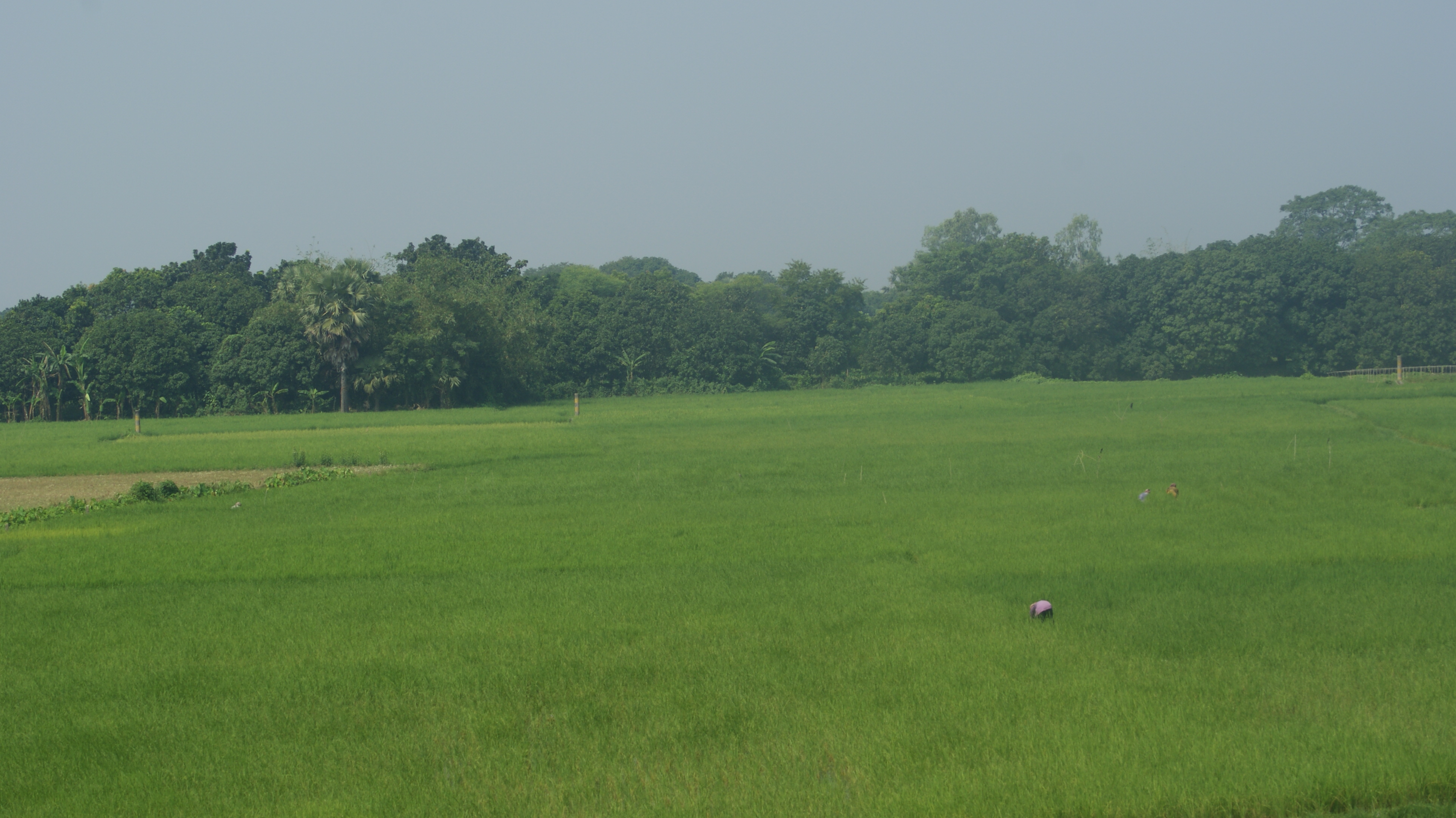
Chapainawabganj district, in Rajshahi division, covers 1,702.55 square kilometres along the border with West Bengal in India, according to Banglapedia. The district is made up of Barind tract, diara and char lands, and its main rivers are the Padma, the Mahananda and the Pagla. Until 1947 Nawabganj was a thana of Maldah district; it became a subdivision of Rajshahi district after partition and a district in 1984.
Sadar upazila covers 451.78 square kilometres and has 14 unions, among them Char Anupnagar and Char Bagdanga. Shajahanpur union covers 7,511 acres; the 2011 population census counted 10,291 men and 11,729 women there. Banglapedia lists paddy, black gram, wheat, sugarcane, betel leaf, onion, garlic and vegetables as the upazila's main crops, and mango, jackfruit, litchi and papaya as its main fruits. Agriculture was the main source of income for 44.97 percent of households, and 59.62 percent of households were recorded as landless.
The Barind tract to the east of the Mahananda is Bangladesh's largest Pleistocene terrace. Banglapedia notes that the region receives comparatively little rain, averaging about 1,971 millimetres a year, mostly during the monsoon, and that it has been designated drought-prone, which makes dry-season crops dependent on pumped water.
An old problem in the fields
Thefts of irrigation transformers were not new. In an article published on 1 August 2023, Prothom Alo wrote that transformers are stolen mainly for their valuable copper coils: the gangs take the coil and leave the rest. The paper wrote that when a transformer is stolen, the customer pays half the cost of a new one and the Palli Bidyut the other half, and if it is stolen a second time the customer pays the whole cost. In April 2022, during the irrigation season, Prothom Alo had checked information from 12 upazilas and found at least 419 transformers stolen in 12 months, worth about Tk 2.5 crore.
The same article recorded that in September 2022 the Rapid Action Battalion (RAB) detained two people in Gomastapur upazila of Chapainawabganj with stolen agricultural transformer parts, including three transformer covers and 45 kilograms of copper wire. It noted that victims often suspected dishonest insiders of the electricity offices, but that no proof of this had been found: none of those caught with stolen goods or held as suspects up to then had been linked to the Palli Bidyut. A general manager of the Meherpur Palli Bidyut Samity told the paper that most of those involved were professional thieves.
The problem has continued since. Samakal reported on 20 September 2025 that, according to the Tangail Palli Bidyut Samity, 230 transformers were stolen in that district between June 2024 and July 2025, worth about Tk 2 crore, and that farmers there kept watch over transformers at night.
Some answers have come from the fields themselves. Prothom Alo described a device built by a student of the Chittagong University of Engineering and Technology (CUET) after three transformers serving his father's low-lift pump were stolen: when a sensor picks up vibration on the transformer, the device automatically calls a saved phone number. It cost five to six thousand taka to make.
What the law says
The Electricity Act 2018 (Act No. 7 of 2018), which replaced the Electricity Act 1910, treats such thefts as serious offences. Section 35 says that a person who, with dishonest intent, steals, removes, destroys or deliberately damages electrical equipment or line materials, such as poles, parts of towers, conductors, transformers and electric wire, commits an offence punishable with imprisonment of not less than two and not more than five years and a fine of not less than Tk 50,000 and not more than Tk 5 lakh.
Section 36 makes it an offence to keep such stolen equipment while having reasonable grounds to believe it was stolen, punishable with up to two years in prison, a fine of up to Tk 50,000, or both. Section 43 says that an employee of a government or private body engaged in generating, transmitting or distributing electricity who commits, or is directly or indirectly involved in, an offence under the Act faces the same punishment, and that an employee who knows of an offence and does not act to prevent it or inform superiors within a reasonable time is deemed to have abetted it.
Solar pumps and dug wells
The alternatives the upazila agriculture officer mentioned were already being discussed before the 2026 crisis. In the November 2024 article in Bonik Barta, the former BADC member director wrote that from January to April Bangladesh receives about 11 to 12 hours of sunlight a day, more than eight hours of it strong enough for solar photovoltaic power. Citing BADC, he put the cost of converting the country's diesel irrigation machines to solar power at about Tk 90,000 crore, and argued that most farmers, being marginal, small or medium, could not make that investment without government support.
A dug well, or patkuya, is a wide, shallow well that stores water close to the surface. The Barind Multipurpose Development Authority (BMDA) has built solar-powered dug wells in Rajshahi district. Samakal reported on 8 November 2025 that under a project taken up in the 2018-19 financial year, BMDA built 20 such wells in Bagha, Charghat, Puthia and Paba upazilas at a cost of Tk 2.6 crore, or Tk 13 lakh each, and that BMDA said each could irrigate 5.5 hectares. The same report quoted farmers in some places who complained that the water did not reach ordinary farmers, while BMDA's assistant engineer for the area said a farmers' committee had been formed and no farmer had complained to them about it.
Photo: Mohammed Tawsif Salam / Wikimedia Commons (CC BY-SA 3.0)
Sources: Jagonews24, Bangla Stream, BBC Bangla, The Daily Star Bangla, Protidiner Kagoj, Bonik Barta, The Daily Star, International Rice Research Institute (IRRI), Banglapedia, Prothom Alo, Samakal, Electricity Act 2018 (Legislative and Parliamentary Affairs Division)
Comments
(0)