
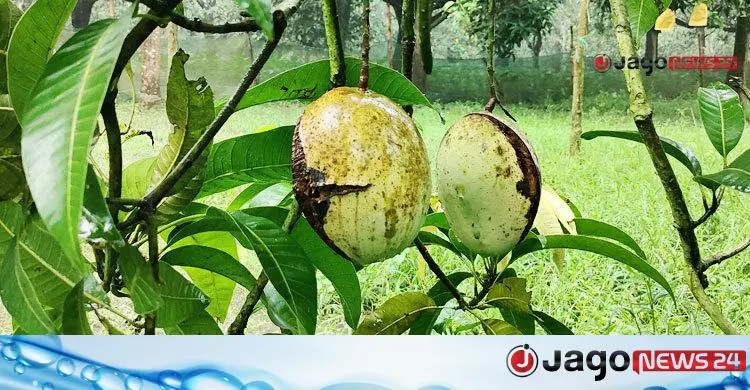
The GI-recognised Fazli mango of Chapainawabganj, known as the capital of mangoes, was once a symbol of the region's pride and heritage. Now growing it has become a worry for small farmers. A severe attack of fruit flies is making mangoes on the trees rot and drop, cutting yields and raising costs. Growers and others in the trade estimate that fruit flies have destroyed Fazli mangoes worth about Tk 100 crore this season.
Four of the district's mango varieties have already been recognised as geographical indication (GI) products: Fazli, Ashwina, Langra and Khirsapat. Yet despite the GI recognition, small growers are not seeing the profits they hoped for from these traditional mangoes.
A visit to Fazli orchards across the district found the fruit badly damaged by fruit flies. Once attacked, mangoes on the trees rot and fall, so growers are losing both output and money.
Pheromone traps and their cost
Growers are using various methods to control the pest, chief among them the pheromone trap, which is being set up in orchards to stop the fruit fly spreading. Each trap costs about Tk 250, and many growers use several, adding to their costs.
A pheromone trap is a modern, environment-friendly way of controlling harmful insects. A special pheromone lure (a chemical with an artificial scent) is usually placed inside a small plastic bucket or container. Holes are made on two sides and the trap is hung from a mango branch with string.
The pheromone imitates the natural scent released by female insects. Drawn by the scent, the harmful male insects come to the container and are trapped or die once inside. This reduces the number of males and disrupts breeding, so later attacks are kept largely under control.
Growers complain, however, that even after spending so much on pheromone traps they cannot fully control the fruit fly. Production costs are rising while yields are falling.
Old trees, high costs, low prices
Growers say Fazli is costly to produce but does not fetch the price they need. Most Fazli trees are old, and hardly any new Fazli orchards have been planted in the past decade. Farmers still produce the fruit by tending trees handed down through generations. Because Fazli trees grow very large, they need extra labour and money: growers must climb them to spray pesticide and apply more fertiliser. Disease and pest control costs more than for other varieties, and spraying from high in big trees wastes more pesticide and raises labour costs.
Growers say that although the GI-recognised Fazli has a proud heritage, they get no benefit from it in the field. With high costs and relatively low market prices, they are counting losses instead of profits, because the pest attack begins once the fruit sets, and now the fruit fly is ruining the whole crop.
Shibganj upazila produces the most mangoes in Chapainawabganj district and grows Fazli on a large scale. Ujjal Hossain, a grower in Shyampur union of Shibganj, has Fazli mangoes on 5 bighas this season, and this is the time to sell them.
But after several days of heavy rain, fruit flies attacked his orchard, and he says about 50 per cent of his mangoes have been ruined. Pheromone traps and other measures have not given the results he hoped for, and he is worried whether he will even recover his costs.
"We expected a good harvest this year. But after several spells of rain and the change in weather, fruit fly attacks increased. Even with pheromone traps, pesticides and other methods we cannot save the mangoes. Many in the orchard have been ruined. If this goes on, it will be hard to make a profit from Fazli."
Rafiqul Islam, a grower in Kansat union, said families like his had made their living from Fazli for years, and the mango carries the heritage of the area. But growing it now brings many problems. The trees are old and big, so tending them costs more; growers must climb to spray pesticide and use more fertiliser, which makes production far costlier than for other varieties. He too said a good harvest had been expected this year, but fruit fly attacks rose after several spells of rain and changing weather, and pheromone traps, pesticides and other methods had failed to save the fruit.
Shahidul Islam, a grower in Shyampur union of Shibganj, said he had watched Fazli being grown since childhood and had long grown it himself. The variety was once in great demand, and good Fazli sold for Tk 5,000 a maund. Now the same mango sells for Tk 900 to Tk 1,000 a maund.
Because prices do not cover costs, he said, he was forced to cut down five large Fazli trees in his orchard last year, and this year he has decided to sell six more. If this continues, it will be hard to keep Fazli trees in future.
Mojibur Rahman has been buying mangoes at Kansat market for 10 years and sending them to Chattogram and other parts of the country. He said heavy rain had left the Fazli in very poor shape. Good-quality fruit is now selling for Tk 1,500 to Tk 1,600 a maund. Fruit fly attacks bore holes in the mangoes and rot the flesh inside, making them hard to sell, so demand for Fazli is falling day by day.
Poor-quality fruit bags
Ismail Khan Shamim, general secretary of the Shibganj Mango Producer Co-operative Society in Chapainawabganj, said Fazli was once the most widely grown mango variety in the district, but many growers are gradually abandoning it because of various problems.
He said Fazli suffers more from pests and diseases, and fruit flies in particular are causing heavy damage now. In many orchards 40 to 50 per cent of the mangoes are being ruined by fruit flies. Growers are trying various methods but not getting the results they want, so many are losing interest in Fazli. The estimated value of these mangoes is about Tk 100 crore.
Shamim said fruit bags can largely prevent fruit fly attacks, but for several years most imported fruit bags have been of poor quality. Anyone can bring them in and sell them, and agriculturists do not effectively monitor their quality. As a result, growers are not getting the expected results even after using the bags, and they are the biggest losers.
Nayan Mia, the Shibganj upazila agriculture officer, said fruit flies often attack Fazli orchards, but orchards where growers spray regularly against the pest have fewer problems.
He said growers are being advised to plant late-season varieties instead of Fazli. There is currently no compensation scheme for affected growers, and the agriculture department has no specific figures on how many orchards have been hit.
Md Abdul Halim, additional deputy director (crops) of the Department of Agricultural Extension (DAE) in Chapainawabganj, said fruit fly attacks are nothing new; the pest has damaged mangoes for a long time. It attacks fruit generally, but the damage is greater in Fazli. Growers are being advised to use pheromone traps and encouraged to use more fruit bags.
Asked why fruit flies were not controlled even where fruit bags were used, he said there was a shortage of fruit bags this season, so many growers used poor-quality ones, which caused the problem. He said the department trains growers on these matters all the time.
Researchers urge care in buying bags
Dr Md Sharaf Uddin, acting chief scientific officer of the Regional Horticulture Research Station in Chapainawabganj, told Jagonews24 that there is no alternative to fruit bags for keeping the quality of all mangoes, not just Fazli. Bagging reduces insect attack, keeps the fruit's natural colour and taste, and fetches a better market price.
He said growers in Chapainawabganj and other regions now use fruit bags widely, and they play an important part in producing high-quality, export-grade mangoes. But the supply of poor-quality bags has risen in recent years, and many growers using them are not getting the expected benefit and are instead losing money.
Good fruit bags protect mangoes from disease and harmful insects, he said, but poor ones often fail to, leading to spots, rot and other problems on the fruit. Growers must therefore be careful when buying them.
He said the fruit fly is one of the most harmful mango pests. It lays its eggs by piercing the skin of the fruit, which then spoils. Growers are being advised to use pheromone traps, which attract and control the males and also reduce the use of chemical pesticides.
He added that climate change and excessive rain had increased fruit fly infestation this season, with Fazli growers hit hardest. To cut losses, farmers are being advised to take up late-season varieties, and emphasis is also being placed on caring for orchards with modern technology and proper management.
The report puts the area under mango in Chapainawabganj this season at 37,000, without giving a unit. The production target is 458,000 tonnes, with a market value of about Tk 5,000 crore.
Source: Jagonews24. First published in Bengali on The Agro News.

Comments
(0)