
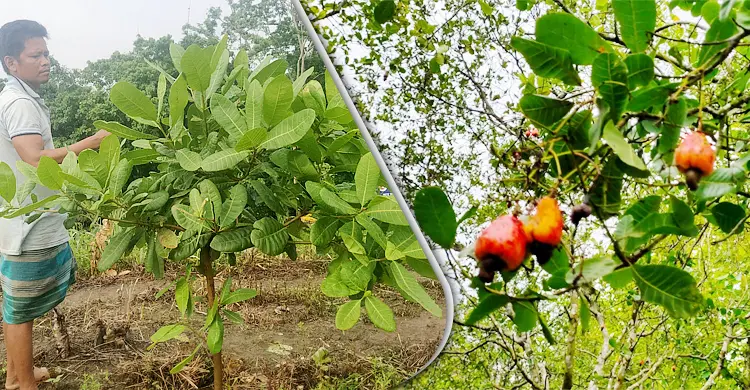
Demand for cashew nuts on the international market is high and growing day by day. As commercial agriculture takes shape in Bangladesh, cashew has great potential to carry that commercialisation forward. Cashew trees were first planted in the hill areas alongside agricultural rehabilitation work to check soil erosion and landslides. Now, because the tree grows fast, is environmentally friendly and profitable, programmes have been taken up to plant it on fallow hill and flat land.
Cashew is a tropical fruit and can be grown all over Bangladesh; the country's climate is quite favourable for it. Cashew is called a naturally nutritious fruit. At present old varieties are grown in Bangladesh, which yield little and bear late. Recently some improved varieties have been developed in India, Vietnam and Sri Lanka that yield four to five times more and bear heavily on small trees.
Conditions the crop needs
Cashew grows best at temperatures of 25°C to 27°C, with annual rainfall of 1,000 mm to 2,000 mm, at an altitude of 500 to 1,000 metres above sea level, and on flood-free acidic sandy or sandy loam soil. By these measures, the hill regions have plenty of land suitable for cashew. In the hills there is usually no rain from November to about April-May, so the land stays dry for five to six months, and there is little scope for irrigation.
Severe drought and hot winds prevail in March-April, yet cashew still yields quite well. The hills also have low-priced land and a hard-working labour force. Land is the basic element of farming, without which agriculture is impossible, and it is difficult to find low-priced land for cashew on the plains.
Bandarban leads
Bandarban has 8.69 lakh cashew trees on 1,797 hectares. Within Bandarban, Thanchi upazila has the highest yield and accounts for 50 per cent of the total cultivation, followed by Ruma, Rowangchhari and Sadar.
Citing the Agriculture Information Service (AIS).
Source: Jagonews24. First published in Bengali on The Agro News.

Comments
(0)