
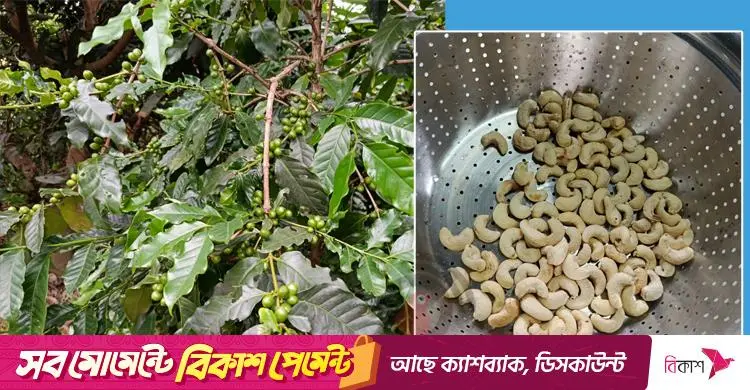
Kishanghar Agro, a cashew-processing enterprise, operates at the horticulture centre in hill-ringed Bandarban. Some 15–20 women work there, most of them from hill communities. This small enterprise has given neglected hill women a different life. Farmers who once practised jhum cultivation are now promising cashew and coffee growers, and a wind of change is reaching the national economy too.
In Bandarban, the hills are trying to move from traditional farming into modern agriculture. The seeds of this effort are being supplied by the Cashew Nut and Coffee Research, Development and Extension Project running in the hills.
Room to grow
Project director Shahidul Islam toured the hills to show how farmers are taking an interest in cashew and coffee, and he wants to take this cultivation much further. "Cultivation in the hills can be increased many times beyond what is possible now," he said. "My project began in June 2021 and is running in 66 upazilas of 19 districts. When it started, cashew was grown on 2,200 hectares in the country. As a result of the project it is now grown on about 4,200 hectares."
"Over the same period, coffee cultivation rose from just 65 hectares in 2021 to 1,800 hectares. Most of this expansion has been in the three hill districts of Rangamati, Bandarban and Khagrachhari."
He added: "Ninety-eight per cent of the land in the hills is still uncultivated, and coffee and cashew can be grown on almost all of it. Within a few years at least one lakh hectares in the hills could be under cashew and another one lakh hectares under coffee."
The project director said cultivation would bring not only production but also the socio-economic development of hill people, exports and much more. "Cashew needs almost no care. Once you plant the tree, it is done. It can be stored at home for months and fetches a good price. Coffee is the same. Few crops are of such high value."
A coffee farmer there said he gets Tk 200 for a kilogram of cashew and Tk 400 to 600 for coffee beans, whereas a kilogram of mango in the hills may fetch only Tk 40. That is why hill farmers are drawn to coffee and cashew.
The project is also training these farmers, and they receive saplings free of charge.
M M Shah Newaz, deputy director of the Department of Agricultural Extension (DAE) in Bandarban, told Jago News: "Given the terrain and climate of the Chittagong Hill Tracts and other hilly areas of the country, there is great scope for growing crops such as coffee and cashew. That is why poor and marginal farmers are being involved in growing them through the project."
Processors and markets
Coffee and cashew could have a strongly positive effect on the whole economy because they are important export products with global demand. Their production could become a tool for tackling climate-change problems, meeting nutrition needs, creating jobs and, through exports, achieving the Sustainable Development Goals (SDGs). Processing them at home has also opened the prospect of more agribusiness and more investment in agriculture.
The expansion of cashew and coffee is creating new entrepreneurs. Cashew has been grown in the hills since the 1960s, but processing machinery was not readily available, so farmers were not encouraged to grow it commercially. Because it is profitable, 22 nut-processing enterprises have been set up in the country in the past few years, 15 of them in regular production, with capacity to process 10–12 thousand tonnes. Big corporate groups are also entering the business.
Tariqul Islam, managing director of one of them, Kishanghar Agro, told Jago News: "We work from cashew cultivation right through to processing. We started with 120 farmers, and now 950 farmers are producing nuts."
He said: "There is huge demand for cashew in the country, most of which is still imported. There is also a big export market abroad. If our cultivation grows further, there will be a large supply of nuts in future. We hope we can go into exports as well."
Consumer demand for cashew in the country is rising day by day. The domestic cashew market is now worth about Tk 700 crore, of which local production accounts for only Tk 100 crore. The remaining Tk 600 crore worth of nuts must be imported, which means 2,500 to 3,000 tonnes of cashew are imported a year, and that figure rises every year.
Demand for coffee in the country is about 2,000 tonnes. Over the past decade demand has grown by about 56 per cent on average, and about Tk 600 crore worth of coffee is sold domestically each year. Consumer demand for both products has been rising over the past five years.
There is also huge demand for these two farm products on the world market. Besides meeting domestic demand, they could earn a great deal of foreign currency through exports.
Big groups invest
Work towards this goal has been under way since the start of the coffee-cashew project, which aims to bring two lakh hectares of uncultivated land in the hill region under cashew and coffee. If this is achieved, the cashew and coffee produced could meet domestic demand and allow exports worth one billion dollars.
Large industrial groups are setting up coffee and cashew processing factories in the country's economic zones. Companies such as Pran, BSRM and Kazi Group are setting up processing plants for export at a cost of about Tk 300 crore, creating jobs for about 1,500 people.
Arabica and Robusta coffee are being grown in the country's hills, and these private companies aim to earn heavily by exporting them.
Source: Jagonews24. First published in Bengali on The Agro News.


Comments
(0)