
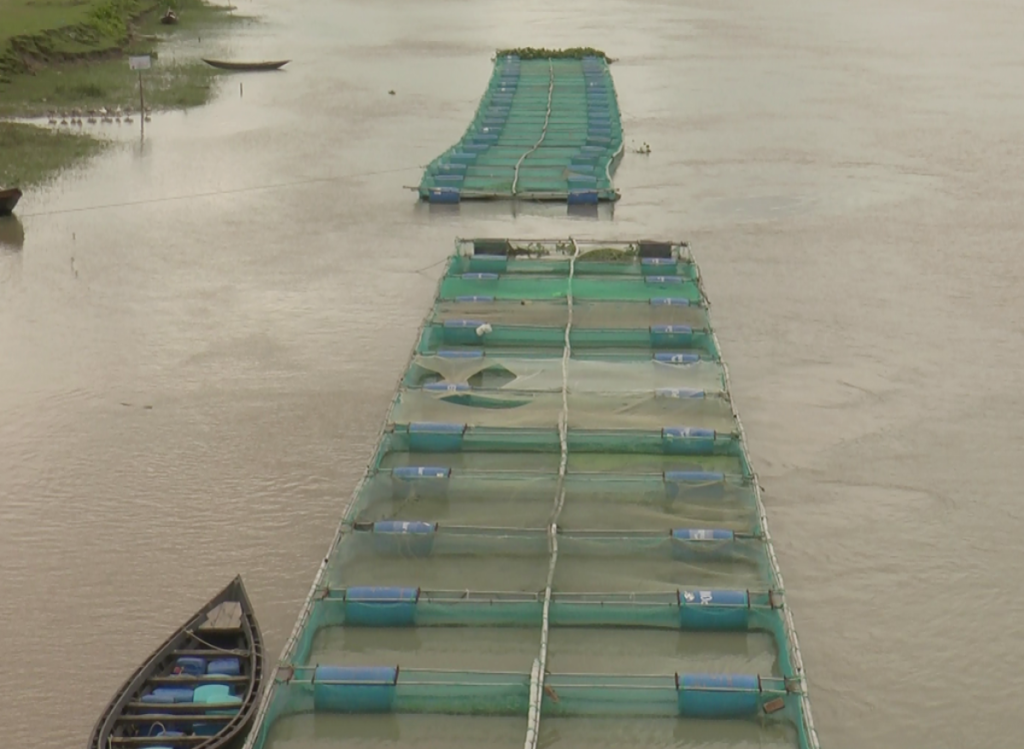
Although cage fish farming has taken a new form in Bangladesh only recently, it has a long history in world aquaculture. It began on China's Yangtze river about 750 years ago, and thanks to technological advances it has become steadily more popular in modern times. Cage fish farming is the technology of producing fish commercially at high density by placing cages of suitable size in various water bodies under controlled conditions.
Beginnings in Bangladesh
Although attempts at cage fish farming were made at various times in the past, it is the cage farming on the Dakatia river in Chandpur district, modelled on Thai technology, that has recently attracted everyone's attention. The pioneer of this effort is Md Bellal Hossain, owner of Farid Fibre and Weaving Limited, a net and yarn factory in the BSCIC industrial estate in Cumilla. Starting in 2002, within just six years monosex tilapia were being farmed in about 450 cages on the Dakatia river in Chandpur and 500 cages on the Rahmatkhali channel of the Meghna in Lakshmipur district, producing 700 tonnes of exportable tilapia a year. Because commercially successful cage farming in Bangladesh began on the Dakatia, the management and production model used there is called the "Dakatia model".
The materials needed to build floating cages are now available in Bangladesh.
Cage size
The net used for the cages must be one that harmful animals such as crabs, monitor lizards and turtles cannot cut. Two sizes of net are usually made for Dakatia-model cages: 20 ft x 10 ft x 6 ft and 10 ft x 10 ft x 6 ft. A mesh of 3/4 inch to 1 1/4 inch is best, allowing clean river water to flow through the cage constantly.
Building and placing the frames
To build the frames, a rectangular 20 ft x 10 ft frame is first made from 1-inch GI pipe, and another 10 ft pipe is welded across the middle. One 20 ft x 10 ft cage can then be fitted directly to a frame, or, if needed, two 10 ft x 10 ft cages. Three drums are placed between every two frames and the frames are set out in rows. The cages are firmly fixed at a chosen spot in the river with the necessary number of anchors, and a separate net is then set on each frame.
Stocking density
Stocking density is decided by considering the water current, mesh size, water depth, the size of fish expected, feed quality and investment capacity. Depending on the species, up to 30 to 40 monosex tilapia fry can be stocked per cubic metre. At stocking, the fry must be big enough not to escape through the mesh: at least 25-30 grams.
Supplementary feed
For commercial cage farming in flowing water there is no alternative to floating feed. Many feed mills have now been set up privately to make fish feed commercially, and various companies produce floating pellet feed.
From stocking until marketing, the feeding rate should be kept between 8 per cent and 3 per cent of body weight. Supplementary feed must continue until the fish weigh 300-500 grams. Experience with factory-made floating feed shows that at most 1.5 kg of feed is needed to produce a fish of 750-1,000 grams from stocking to market.
Grading the fish
For the expected production, the fish in the cages should usually be graded for the first time three weeks after stocking, though the timing can vary by variety. Keeping an eye on the day's temperature, grading should be done in the morning or late afternoon. When the river is flowing strongly, the water in the cages changes quickly, and this is the best time to grade. Before marketing, the fish should be graded two or three times as needed.
Fixed costs of 50 cages at current prices
- Stitched nets: 50 at Tk 3,500 each, Tk 175,000
- Empty drums or barrels: 153 at Tk 1,450 each, Tk 221,850
- 1-inch GI pipe: 3,600 ft at Tk 80, Tk 288,000
- Iron frame joints: 350 at Tk 100, Tk 35,000
- Anchors: 12 (20 kg each) at Tk 2,400, Tk 28,800
- Anchor rope: 5 coils at Tk 5,000, Tk 25,000
- Bamboo: 100 at Tk 200, Tk 20,000
- Nylon thread and rope: Tk 5,000
Production cost of one crop in 50 cages
- Fish fry: 60,000 at Tk 2, Tk 120,000
- Fish feed: 24,500 kg at Tk 28, Tk 686,000
- Labour: 3 workers for six months (18 labour-months) at Tk 3,000, Tk 54,000
- Total: Tk 860,000
Production and profit (monosex tilapia)
- Minimum production per cage per crop: 350 kg
- In 50 cages (350 x 50): 17,500 kg
- Wholesale price per kg: Tk 100
- Total sales: Tk 1,750,000
- Net profit (1,750,000 - 860,000): Tk 890,000, not counting the one-off fixed installation costs
Conclusion
Bangladesh has plenty of suitable rivers, and fish production can be increased by farming in cages all year round. Tilapia is in great demand both at home and abroad. People living along the riverbanks, especially poor fishing communities, make their living only by catching wild fish from the rivers. By organising these fishers, fish production can be increased, and by keeping them off the rivers at certain times of year, especially during the breeding season of the rivers' native species, natural fish stocks can be increased and various species saved from destruction. Like other Asian countries, Bangladesh can earn a great deal of foreign currency by exporting quality cage-farmed tilapia. To enter the international tilapia market, policymakers, exporters and everyone concerned must come forward.
Source: Online Desk. First published in Bengali on The Agro News.
Comments
(0)