

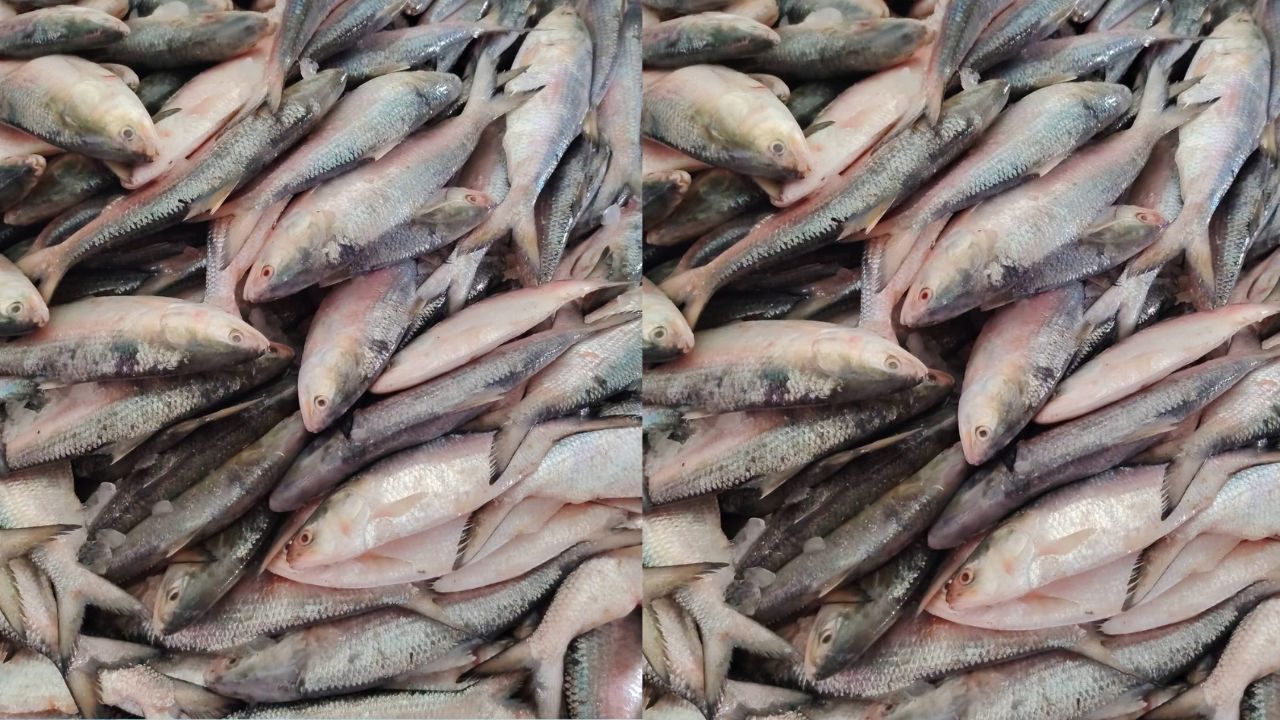
Hilsa supplies have picked up at Chandpur's landing ghats near the end of the season, with prices down Tk 200-300 a kilogram in two weeks. Local traders said 700-800 maunds of hilsa landed at the Boro Station fish landing centre on Wednesday, 23 September; a one-kilogram fish still costs about Tk 2,300, and it is mainly the small fish that have become cheaper. But behind the relief, Bangla Tribune's Jamal Uddin reports, the production figures are worrying.
According to the Department of Fisheries, hilsa output fell from a record of more than 571,000 tonnes in 2022-23 to about 529,000 tonnes in 2023-24 and about 500,000 tonnes in 2024-25 — a drop of about 71,000 tonnes, or more than 12 percent, in two years, including about 5.5 percent in the last year alone.
The fall is steepest at sea. The marine catch was about 322,000 tonnes in 2021-22 and about 251,000 tonnes in 2024-25, some 22 percent lower in three years, while the inland catch has not fallen much. Government figures show that small mechanised sea-fishing boats increased by about 51 percent between 2010-11 and 2019-20 without a matching rise in the catch, so researchers see overfishing, or 'fishing pressure', as a likely major cause.
The fish are getting smaller too. Research by the Bangladesh Fisheries Research Institute puts the average length of hilsa caught at 14.65 inches in 2022-23 and 13.39 inches in 2025-26. In preliminary observations at nine fishing ports from 1 to 15 September, the institute found eggs in 9-25 percent of hilsa landed, against 45-49 percent at this time in earlier years — not a final national figure, but one that raises questions about the number of large breeding fish.
Researchers point to the catching of jatka (juvenile hilsa) and brood fish, banned fine-mesh nets, silting and changing river flows, industrial and plastic pollution, erratic rainfall and climate change, and say the boundaries of old sanctuaries need reassessing because rivers and hilsa routes have shifted over two decades. Meanwhile, of 1,739.50 tonnes of Indian hilsa imports permitted, 535 tonnes had come through Benapole by 23 September; imports stopped after 103 no-objection certificates were cancelled on 22 September.
Shobe Barat Sarkar, general secretary of the Chandpur Fish Traders' Cooperative Society, called the lower catch an early sign of crisis and blamed reckless jatka fishing for the shortage of big hilsa. Dr Anisur Rahman, a former chief scientific officer of the institute, said there were some signs of a crisis but the situation had "not yet fully reached that stage"; if the trend continues for a few more years, it will be cause for concern.
Hilsa fishing, transport, storage, marketing and sale will be banned nationwide for 22 days from 8 to 29 October to protect spawning brood fish. Anisur Rahman said the ban must be properly enforced and that the state of the stock can be judged more surely after observing spawning in that period. Experts add that a 22-day drive alone will not solve the problem without stopping jatka fishing and illegal nets, alternative livelihoods for fishermen, and scientific control of fishing capacity at sea.
Photo: Jotiii / Wikimedia Commons (CC BY-SA 4.0)
Source: Bangla Tribune
Comments
(0)