
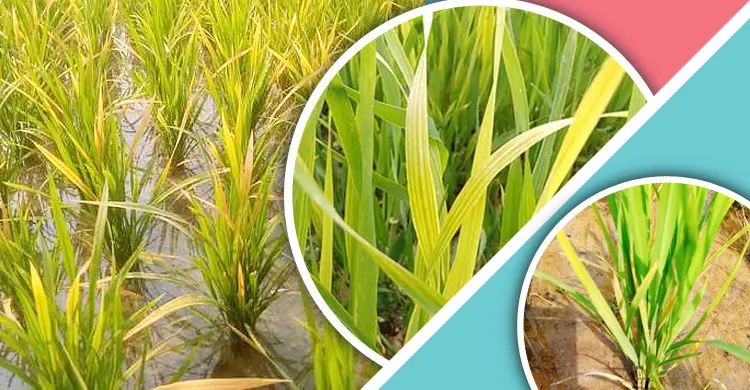
Leaves of various rice varieties are turning yellow in parts of transplanted aman fields, as seen recently during field visits in the Rangpur region. This has caused some worry among farmers.
Sources at the Bangladesh Rice Research Institute (BRRI) said rice leaves can turn yellow for various reasons. The right cause must be identified and effective action taken now to solve the problem through proper management. BRRI's advice is set out below.
Nitrogen deficiency
If the leaves turn yellow across the whole field rather than in scattered patches, and tillering is low, nitrogen is lacking. At first the older leaves show yellowing, but after a few days all the leaves turn yellow.
Remedy: For less fertile land, medium-duration varieties (120-145 days) and a yield potential of 5-6 tonnes per hectare, the urea dose is usually 24kg (per 33 decimals). If the water in the field is low (2-3 inches), urea should be top-dressed in three equal instalments according to the plant's growth stage. If the field is waterlogged, 100g of urea mixed in 10 litres of water should be sprayed on 5 decimals of land.
Sulphur deficiency
At first, young leaves across the field show light green or light yellow discoloration, which later appears on the lower leaves too. Notably, most plants in low-lying parts of the field become somewhat stunted.
When fields become waterlogged after heavy rain or floods, sulphur turns into sulphide instead of sulphate, which plants cannot take up.
Remedy: If the water in the field is low (2-3 inches), apply 6-8kg of gypsum (per 33 decimals). If the field is waterlogged, 60g of Thiodit mixed in 10 litres of water should be sprayed on 5 decimals of land.
Zinc deficiency
Young rice leaves turn white along the midrib near the base, later becoming bronzed or rust-spotted brown and then orange. Tillering is low and plants are stunted in scattered patches. When fields become waterlogged after heavy rain or floods, soil pH rises and plants cannot take up zinc.
Remedy: If the water in the field is low (2-3 inches), applying zinc sulphate at one kg (per 33 decimals) gradually brings the plants back to normal. If the field is waterlogged, 20g of zinc sulphate (mono) mixed in 10 litres of water should be sprayed on 5 decimals of land.
Bacterial leaf blight
The disease appears when too much urea has been applied and leaves are wounded by rubbing against each other in stormy wind or after storms and rain. At first yellowish marks appear at the tips or edges of leaves. They then spread down from the top and inwards from both edges, and the leaves later look like straw.
Remedy: Spraying 60g of muriate of potash (MoP), 60g of Thiovit and 20g of zinc sulphate (mono) mixed in 10 litres of water on 5 decimals of land controls the disease within a short time (7 to 10 days), and new green leaves emerge.
Source: Jagonews24. First published in Bengali on The Agro News.


Comments
(0)