
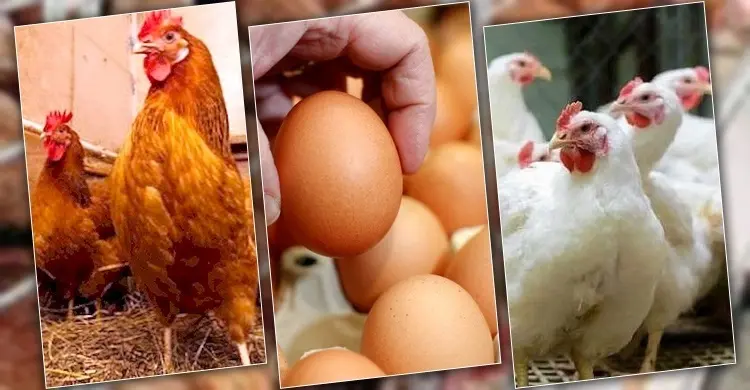
Egg and broiler chicken prices in the domestic market rose suddenly because of a gap between demand and supply. Higher international prices for feed raw materials, the sharp fall of the taka against the dollar, excessive shipping costs for imports and load-shedding have greatly increased the cost of producing eggs and chicken meat, and so prices of eggs and chicken, the biggest source of protein in the open market, shot up. The Bangladesh Poultry Industries Central Council (BPICC), the poultry industry's central body, believes a class of opportunistic middlemen seeking to profit is also behind the unwanted rise. The organisation also expressed concern and regret over consumers' hardship.
A BPICC press release on Friday, 19 August, said that to avoid such situations in future, a strong monitoring system should be built jointly by the Department of Livestock Services and BPICC, and long-term plans to protect grassroots farmers should be drawn up and properly implemented.
How prices rose and fell
BPICC said a report on the causes of the sudden price rise, presented at its emergency meeting on 16 August, found that on 6 August the wholesale price of chicken was Tk 136 a kg, a brown egg Tk 9.10 and a white egg Tk 8.70. But from the day after the announcement of the new higher prices of diesel, petrol, octane and kerosene took effect (the release gives this as 7 October), a transport crisis involving buses, trucks and pickups broke out across the country. Many owners kept their vehicles off the road, while others charged extra fares. Because rural grassroots farmers supply 85 to 90 per cent of eggs and chicken, the disruption to supply cut deliveries to Dhaka and other district and divisional cities, and prices rose.
On 13 and 14 August, manipulation by middlemen pushed egg and chicken prices in the open market to their peak. At wholesale, a brown egg rose to Tk 10.90 and broiler chicken to Tk 170-175 a kg. According to TCB data, at retail an egg rose to Tk 13.75 and broiler chicken to Tk 200 a kg. Ordinary farmers had no hand in this sudden rise, BPICC said. Once transport gradually returned to normal, egg and chicken prices began to fall again from 15 August.
Most recently on Thursday, the wholesale price of broiler chicken fell by about Tk 40-45 to Tk 130-135 a kg, brown eggs fell by Tk 130 to Tk 960 per 100 (Tk 9.60 each) and white eggs by Tk 140 to Tk 950 per 100 (Tk 9.50 each).
Farmers at a loss, middlemen in profit
In the release, BPICC president Masiur Rahman said it now costs a farmer Tk 140 to 145 to produce one kilogram of broiler chicken and at least Tk 9.50 to produce an egg. The abnormal rise in feed raw material prices on the international market, the sharp fall of the taka against the dollar, excessive shipping costs and load-shedding have raised the cost of producing eggs and chicken by 30 to 40 per cent. The worrying thing, he said, is that while farmers count losses, middlemen are making unfair profits, so both farmers and consumers are deprived of what they should get.
He said that before 6 August farmers sold broilers at an average of Tk 128-131 a kg, a loss of Tk 12-14 a kg, while middlemen made a profit of Tk 27-32 a kg.
He added that middlemen will always exist in the market, but their profit must be reasonable. If marginal farmers do not get fair prices, the production system will collapse. The government must therefore take short- and long-term plans to protect them. The government's long-term plans have mainly prioritised the dairy and fisheries sectors, although poultry contributes 40-50 per cent of the protein supply, he said.
Kazi Zahin Hasan, president of the Breeders Association of Bangladesh (BAB), said the poultry supply side was weakening because many farmers had left the trade for fear of losses. Weekly production of day-old white broiler chicks, which was over 1 crore 80 lakh in January-February, has now fallen to 1 crore 30-35 lakh.
Zahin Hasan said broiler chicks sold at an average of Tk 16.65 and layer chicks at Tk 20.74 in May; broiler chicks at Tk 8.07 and layer chicks at Tk 13 in June; broiler chicks at Tk 18.71 and layer chicks at Tk 13.95 in July; and so far in August broiler chicks at an average of Tk 28.06 and layer chicks at Tk 31.53, against an average production cost of Tk 140-145. So even though breeder farms are selling chicks at a loss, farmers are not keen to buy them, which he called worrying.
Feed costs and the way ahead
Shamsul Arefin Khaled, president of the Feed Industries Association Bangladesh (FIAB), said that just as the impact of the Covid pandemic was starting to ease, the Ukraine-Russia war began and prices of feed raw materials shot up at home and abroad. Since most essential feed ingredients, including maize and soybean, are imported, higher raw material prices, shipping costs and the dearer dollar mean production costs cannot be reined in.
He said the same situation prevails worldwide, not only in Bangladesh, and food-exporting countries are from time to time restricting exports. So the country must focus on increasing its own food production and keep farmers and growers alive, even with subsidies.
BPICC president Masiur Rahman also said people's trust in and reliance on poultry have grown because the sector supplies quality animal protein at a comparatively low price. The industry is trying to cut production costs so eggs and chicken can reach consumers more cheaply. The government is helping sincerely, but that help must increase, he said.
He said nothing should be done that creates panic among farmers and suppliers. "We are all going through a time of crisis. When raw material prices fall and the dollar rate returns to normal, the situation will normalise by itself. Everyone's sincere cooperation, including the government's, is needed to face the crisis," he said.
Source: Jagonews24. First published in Bengali on The Agro News.

Comments
(0)