
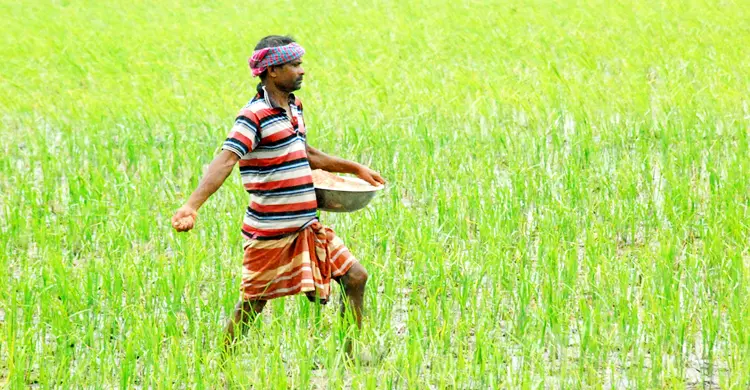
Farmers grow both short- and long-duration rice varieties in the boro season. The Agricultural Information Service (AIS) has set out the correct fertiliser management for them.
Long-duration varieties
For long-duration varieties, with a life of more than 150 days, the dose per bigha (33 decimals) is urea 40 kg, TSP or DAP 13 kg, MOP 22 kg, gypsum 15 kg and zinc (monohydrate) 1.5 kg.
Apply all the TSP, MOP, gypsum and zinc to the soil at final land preparation. Take care to apply zinc and TSP separately rather than mixing them.
Split the urea into three equal parts: the first at final land preparation, the second 20-25 days after transplanting, when tillers appear in the hills, and the last 5-7 days before panicle initiation.
Short-duration varieties
For short-duration varieties, with a life of less than 150 days, the dose per bigha is urea 35 kg, TSP 12 kg, MOP 20 kg, gypsum or sulphur 15 kg and zinc 1.5 kg.
Again, apply all the TSP, MOP, gypsum and zinc at final land preparation, keeping zinc and TSP separate.
Split the urea into three equal parts: the first 15-20 days after transplanting, the second 30-35 days after transplanting and the last 5-7 days before panicle initiation.
Saving fertiliser
The agency says that if DAP is used, a third less urea is needed; DAP is profitable and environmentally friendly. Cutting the paddy 10-12 inches above the base at harvest and working the straw into the soil cuts the potash needed by a third.
Using organic fertiliser together with chemical fertiliser makes the chemical fertiliser more effective and gives a good yield. Apply 700-800 kg of organic fertiliser per bigha at least once a year.
Source: Jagonews24. First published in Bengali on The Agro News.

Comments
(0)