
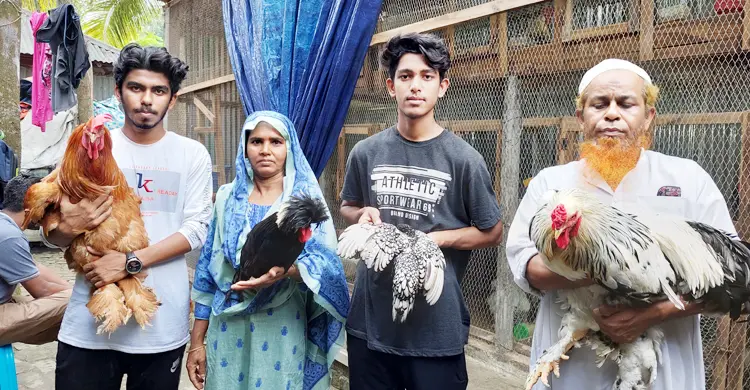
Sajjadul Islam Apon, 20, was born and raised in Gabtali, Bogura. His father, Md Abdul Kaium Tarafdar, runs a stationery business and his mother, Mst Swapna Begum, is a homemaker. A bright student, Apon passed his secondary exams from Bogura Zilla School in 2017 with GPA 5.
He passed his higher secondary exams from Bogura Government College in 2019 with distinction and is now a second-year English undergraduate at Gaibandha Government College. He is the elder of two brothers.
Alongside his studies, Apon runs an online chicken business. He started with a Facebook page, 'Shokher Murgiwala', and now earns about Tk 50,000 to Tk 60,000 a month selling chickens online, which pays for his studies and helps his family.
How it began
Apon lived in a student mess from 2019. When the coronavirus pandemic began, the mess closed and he came home. He already kept some pigeons and pet birds, and says he had always liked animals and birds. During the lockdown he looked after them while continuing his studies.
Because he kept birds and pigeons, he was a member of related Facebook groups. One day he saw some foreign chickens on Facebook and liked them a lot, though he did not even know their name. The group told him they were Silkie chickens.
"It really is one of the world's beautiful chickens and popular in many countries," Apon said. "Then I started collecting information about Silkies. Many people posted them for sale in Facebook groups, and at first I asked different sellers for prices to get an idea."
Taking a risk
"I really wanted to get some chickens but I had no money, so I could not buy any," he said. "Then I asked my mother for Tk 1,000 to buy some chicks, and she gave it to me without a second thought."
With little money and no experience of paying online, he feared being cheated, so he looked for a seller in or near Bogura. One day he saw a post by Ataus Samad Rahul of Bogura, went to his house and bought two one-month-old Silkie chicks for Tk 1,000.
Rearing the birds
The seller guided him on how to rear the chicks, which took about five months to grow. At six months they began to lay. He kept two pairs of the chicks for himself and sold the rest online; from the two birds he raised 10 chicks, which later began laying too.
"Then I wanted to collect more new fancy breeds, but I had no space. I kept them in pigeon or bird cages," Apon said. "There was a small raised room inside our house, and I thought I could build a chicken house there. My hens were still laying, so I hatched and sold chicks, saved some money and built nine small cages on three shelves with net and wood. My younger brother and I built them ourselves. Then I slowly started buying new breeds."
Early opposition
Apon faced plenty of obstacles at first. His father could not accept it at all and told him: "You are a Zilla School student selling chickens, what is this? You are doing honours in English and rearing and selling chickens. Is that right?"
"One day I was coming home past my father's shop after delivering chickens," Apon said. "He asked where I had been, and I said I had sent some chicks to Dhaka. He joked, 'Did they pay, or did you just send them?' I said they had paid by bKash. He did not believe me until he checked my bKash balance, and then he believed that chicks really sell online. After that he said nothing, only, 'Do what you are doing, but make sure your studies go well.'"
New breeds
After Silkies, Apon began rearing Brahmas, then collected Bantam, Cochin, Fighter and some other laying breeds. From then on he never looked back. His chicks sold well online, and with the income he bought feed, medicine and more new breeds, until his small farm was full.
"Around 2021 my father liked seeing my big Brahma chickens very much, and from then he slowly started supporting me," Apon said. "He wanted to help me with money, but I did not take a single taka; I bought more chickens with my own money from selling chicks."
With the small farm full, his father took the initiative to build a new 20ft by 10ft farm inside their house, with three-tier shelves of three cages each as before, giving 18 cages in all. The new farm cost Tk 60,000.
The farm today
Apon's farm now has more than 100 chickens of 16 to 18 breeds, including Brahma, Silkie, Cochin, Bantam, Polish Cap, Frizzle, Phoenix, Yokohama, Onagadori, Malaysian Serama, Sebright, White Faced Spanish, Rosecomb, Sumatra and Fighter. Some adult pairs sell for Tk 4,000 to Tk 30,000.
The farm has the Malaysian Serama, the world's smallest chicken, and the American Brahma, the world's largest, and both breed regularly. The farm produces 10 to 15 eggs a day and 50 to 60 chicks a week, earning Apon Tk 50,000 to Tk 60,000 a month.
He has so far delivered chicks and adult birds to 55 districts, usually by bus. Many young entrepreneurs from around the country visit the farm every day and buy chicks or adult birds there.
Awards and plans
Apon has won two awards as a successful farmer and young entrepreneur at Department of Livestock Services exhibitions at upazila and district level. He wants to set up a bigger farm of foreign fancy chickens, and has already given jobs to three unemployed young men of his age.
His advice to young entrepreneurs: "If anyone wants to rear these chickens, I will help them with all the information for free. You can even start with two local chicks and see whether you can rear them properly, then collect fancy chickens. Some people think they will buy chickens worth a lakh at once and become entrepreneurs; instead of taking that risk, start with two to four birds and you will get good results. I want the young people of our country not to sit idle but to start work in whatever they are good at. Obstacles will come, and you have to face them to reach the top."
Source: Jagonews24. First published in Bengali on The Agro News.
Comments
(0)