
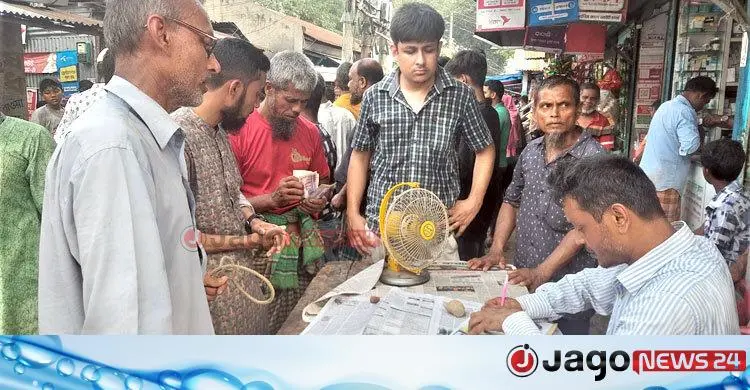
Business worth crores of taka is under way at Bogura's cattle markets ahead of Eid-ul-Azha, with trade picking up at more than 50 large and small markets in the district. But amid the rush, 'toll terror' has become a new ordeal for buyers and sellers, with allegations at almost every big market in the district that extra tolls (hasil) are being collected on each cow and goat in disregard of government-set rates.
Under government policy, the rates of toll at cattle markets are fixed. Local Government Division instructions set a fixed amount for cattle, buffalo and other large animals and a lower rate for goats and sheep. But traders and buyers allege that in practice these rates are being largely ignored at Bogura's markets.
Charges at Sabgram
At the Sabgram market in Bogura Sadar upazila on the afternoon of 23 May, Tk 1,000 was being taken from the buyer and Tk 200 from the seller for each cow sold, up to Tk 1,200 in all for a single cow. Traders said this is several hundred taka more than the government rate. For goats, up to Tk 500 was being collected from the buyer and Tk 100 from the seller.
Mokchhedul Islam, who is in charge of collecting the toll, said: "We are taking it the way we were told to. The lessee can say why more is being collected."
Sagar, a cattle toll collector, said: "We take what the lessee has fixed. There is a commission on every memo. We are only collectors; there is no scope to go beyond instructions."
Sabgram market lessee Abdul Kaiyum Sarkar said: "I leased the market for Tk 1 crore 5 lakh 3 thousand. On top of that I have to pay 15 per cent VAT, 10 per cent income tax and 10 per cent security deposit. Market conditions are not very good either, and there is a risk of loss. So it is not possible to take toll at the government rate."
Asked why the toll amount is not written on receipts, he said: "If someone asks, we write it; if not, we don't."
In most cases, however, the toll amount was not being written on receipts, only the animal's price and the name, making it hard to keep proof of overcharging.
Reza of the Dhawapara area of Sadar bought a goat for Tk 12,500 and paid Tk 500 in toll. "Tk 500 toll for a goat is in no way normal. We are forced to pay it," he said angrily.
Chhaiful Islam, who came to sell goats, said: "Earlier they took it only from the buyer. Now they take it from the seller too. There is no way to leave the market after selling a cow or goat without paying."
Same picture at Mohasthan and elsewhere
The picture is the same at the Mohasthan market, where up to about Tk 1,400 per cow is allegedly being taken from buyers and sellers. Several traders said a fixed sum is charged whatever the price of the cow.
A farmer who came to sell cattle at Mohasthan said: "Many cattle are sold. Even so, if you don't pay the toll they behave badly. If you protest, they make trouble."
At the markets, several people were seen surrounding buyers together to collect money on entry. There are also complaints that anyone who questions it faces delays in getting a receipt, trouble over loading and unloading animals, or raised voices.
Similar complaints have been made about the Sabgram, Ghoradhap and Joy Bangla markets in the town, Bhabanipur market in Sherpur, Talora and Dhaper Hat in Dupchanchia, Bhatra market in Nandigram, Malancha market in Kahalu and several cattle markets in Gabtoli.
Traders say a 'toll syndicate' has effectively become active at the markets ahead of Eid. Farmers complain that the pressure of extra tolls ends up affecting animal prices, so ordinary buyers pay more while genuine farmers' profits shrink.
This year the local administration has set the toll at Tk 800 for large cattle and Tk 600 for small cattle, to be collected from the buyer. But the lessees' people are ignoring that instruction and collecting Tk 1,400 per cow from buyers and sellers together, and Tk 700 for goats.
The Mohasthan market in Shibganj upazila is one of Bogura's biggest, drawing traders, dealers and buyers from different parts of the country, who buy cattle there and supply them to markets in big cities including Dhaka, Chattogram, Sylhet and Feni.
Mizan Sarkar of the Sutrapur area, who came to buy a cow for the sacrifice, said: "I bought a bull for Tk 1,15,000 and had to pay Tk 1,200 in toll. The seller, Shamim Hossain of Tengra village in Sadar upazila, also had to pay Tk 200."
Lessee and UNO respond
Mohasthan market lessee Ashraful Islam said that all year round the market collects Tk 750 from the buyer and Tk 100 from the seller, and toll is being collected at a slightly higher rate for Eid. Admitting that toll is taken from sellers, he said: "At every market toll is collected from both buyer and seller. Others are doing it, so am I."
Shibganj Upazila Nirbahi Officer (UNO) Ziaur Rahman said tolls have been fixed at Tk 800 and Tk 600 for cattle and Tk 250 for goats or sheep. "There is no scope to collect more than the fixed rate. We will take action against the lessee," he said.
But buyers and sellers say that despite many complaints, visible monitoring by the administration on the ground is very limited, and mobile courts or monitoring teams are rarely seen at the markets.
The deputy commissioner and the upazila nirbahi officers concerned could not be reached despite repeated calls to their official mobile numbers about market monitoring and excess tolls.
Almost all the district's markets are now full of livestock, with animals priced from Tk 50,000 up to Tk 10 lakh. As Eid draws closer, sales are rising, and so are the complaints of excess tolls.
Buyers and sellers say this 'toll terror' will not stop unless the administration keeps strict watch, the toll amount is made compulsory on receipts and the official rate list is publicly displayed.
Source: Jagonews24. First published in Bengali on The Agro News.
Comments
(0)