
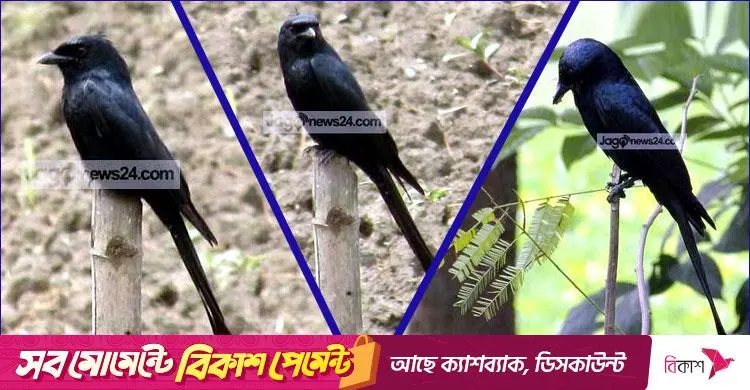
Green fields, golden paddy and shady village thickets: there is hardly a corner of Bengal where a certain brave bird is not seen. It has no colourful plumage, no peacock's tail and no sweet voice like a parrot's. But with a single sharp call it can stop even a fierce bird of prey in its tracks. The bird is the finge. Small as it is, its courage, intelligence and skill have earned it a unique place in nature.
In English the finge is called the black drongo; its scientific name is Dicrurus macrocercus. It is usually blackish, though some have a bluish sheen or a touch of brown. Its long forked tail, sharp eyes and upright posture make it easy to identify. Its greatest trait is that it is not timid. The finge is a brave guardian of nature that can fearlessly chase off birds of prey bigger and fiercer than itself. A small drongo is often seen chasing vultures, hawks, kites or ravens, as if guarding the fields were part of its job.
According to Bangladeshi birdwatchers, the finge is one of the native birds that bravely confront birds of prey and try to protect other birds. Farmers and nature lovers in rural Bengal therefore know it as a brave and useful bird.
A friend to farmers
The drongo's contribution to farming is no less. By eating insects it satisfies its own hunger and protects crop fields, vegetable gardens and trees. Harmful insects such as leaf pests, grasshoppers and the red bugs that attack trees are all part of its favourite diet. Farmers therefore regard it as a friend in need. The small bird is important for poison-free farming and for keeping nature in balance.
It is not only brave but clever. According to zoologists, the drongo can imitate other birds' calls and often does so as a hunting trick. To lure an insect it calls like another bird and then seizes its prey. Scientists call this crafty imitation "clever mimicry". Such deceptive intelligence in an ordinary bird is truly remarkable.
Breeding and decline
The drongo can be seen at any time of year, but spring is its breeding season. Males then call often, dance and build sturdy nests in bushes to attract females. They nest in coconut and jackfruit trees or bamboo clumps. The nest is small but secure and clean. The female usually lays two to four eggs, and both parents incubate them and raise the chicks.
Today, however, urbanisation, towering mobile phone masts, tree felling, excessive pesticide use in farming and spreading settlements are reducing the numbers of the drongo and many other native birds. Their calls, their spread wings and even the stories of their courage seem to be confined to the pages of books.
Protecting the drongo therefore means protecting nature. It is not just a bird but a symbol of courage and of self-defence in a crisis, a small, strong warrior of nature. In the city's Zia Udyan and Suhrawardy Udyan, on small-town school fields, in the open fields behind villages or on riverbanks, some people are still startled to hear its sharp "chyanch" call, as if the little bird were reawakening the courage we have lost.
Nature teaches us much, and the drongo is a lively example of that lesson: a silent symbol of courage, intelligence and selfless help in Bengal's skies, fields and minds.
Source: Jagonews24. First published in Bengali on The Agro News.

Comments
(0)