
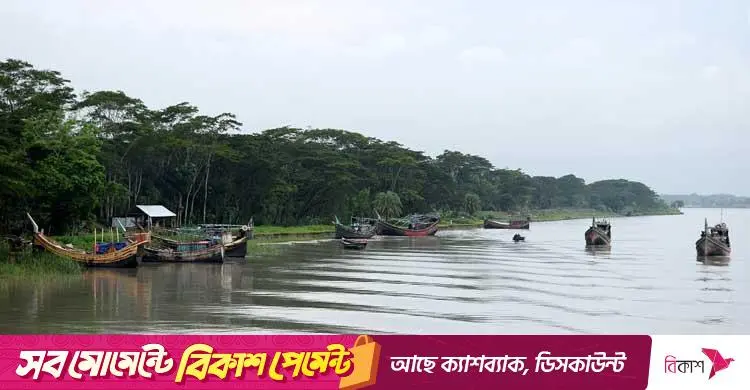
Green trees line both banks, birds sing in their branches, and between them the river plays and murmurs, a sound that fills the mind with peace. For these reasons, travellers are no strangers here. This is the Bishkhali, a river of southern Bengal that cuts through a landscape of rare beauty. Since ancient times it has helped civilisation and trade flourish for a large population and linked villages to towns. Yet the story of how this lovely river got its name is full of sorrow.
The Bishkhali flows through Jhalakathi and Barguna districts in south-western Bangladesh. It rises from the Sugandha river near Jhalakathi town, passes Rajapur and Kanthalia, and enters Barguna. Skirting Bamna-Betagi and Sadar upazilas of Barguna, it reaches the Baleshwar-Haringhata estuary 13 km downstream in Patharghata upazila and flows into the Bay of Bengal. The river is 105 km long with an average width of 760 metres and a winding course. The Bangladesh Water Development Board lists it as "south-western region river no. 60".
The Bishkhali is very fast-flowing and wider downstream than upstream. Water flows in it all year round, and boats and vessels large and small use it. Its flow rises above normal in the monsoon, and tides are a constant feature.
Three stories of the name
It is said that boats once often sank in storms and the Bishkhali's rough waves near the mouth of the Amua canal in Kanthalia upazila, so boatmen were reluctant to ferry people across from there. Still, many pressed the boatmen to take them over. Under heavy pressure, one boatman took his own life rather than make the crossing. A saying grew up locally: "Bishkhaili to pari dili na" (you took poison, yet you did not cross). The name Bishkhali came from that "bishkhaili".
Another story about the name is told in the Kanthalia-Bamna area. According to local people, around the beginning of 1799 there was a taluk (estate) in Bamna. One of its holders in 1800 was Shafiz Uddin Chowdhury of Dupasha village in Barishal. With the help of Chinese people he started a salt business and set up a small salt factory at the northern end of Bamna upazila. Later, as events turned out, he took poison in his mouth, jumped into the river and died. Hundreds of people came to see the man who had taken poison, and the story spread everywhere. From "bishkhaili" came the name Bishkhali.
Because the Bishkhali meets the sea, its water was once very salty, so salty that people could not put it in their mouths. It is said that Chinibibi, sister of the dervish Neyamat Shah, one day went down into the river, put the water in her mouth and swallowed it, saying: "I have swallowed the poison of the water." From then on the water became less salty, and the river's name changed from "bish khai" (eating poison) to "bish khali", meaning free of poison.
Beauty, hilsa and erosion
Bishkhali is a short name, yet it holds great depth and shapes the lives of the people along it. The river keeps flowing, carrying an undying ballad of joy and sorrow, laughter and tears. Although accounts of its naming differ, it is bound up with a mixed sense of history, civilisation and culture.
There are chars and islands at various places along the Bishkhali, and their beauty draws visitors from across the country. Steamers and launches once ran along the river on the Barguna, Jhalakathi and Barishal routes; today launches on the Barguna-Dhaka route use it. The river's hilsa is prized nationwide and is unmatched in taste. It is in high demand and costs a little more than hilsa from other rivers and the sea.
But the river also brings grief. Many stretches are prone to erosion. In storms, floods and depressions, the river swells like an angry girl, and the settlements along its banks suffer. Erosion by the Bishkhali is having a heavy impact on life in riverside areas of Jhalakathi and Barguna districts. Many homes, crop fields, trees and educational institutions have already been swallowed by the river, and the lives and livelihoods of people in the eroded areas are under threat.
Source: Jagonews24. First published in Bengali on The Agro News.
Comments
(0)