
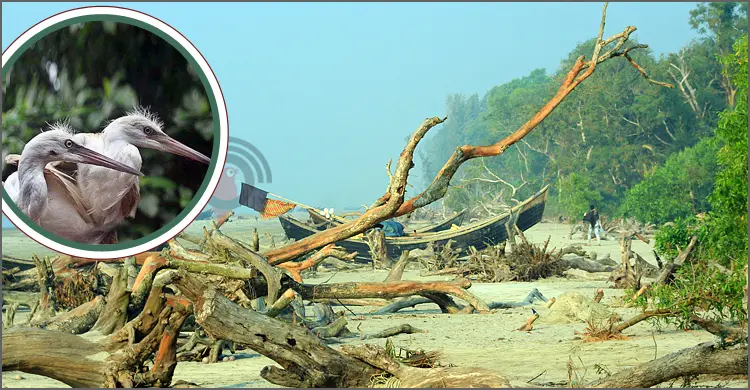
Thousands of migratory birds splashing in the water, the chirping of hundreds of native birds and flocks roaming the crop fields can no longer be seen in any forest or on the beaches of the Kalapara-Kuakata coastal area of Patuakhali. Where 50-60 bird species were once regularly seen in these coastal forests, only 10-15 species are now spotted, and in very small numbers.
Taimur Ali, in his sixties, of the Lemburban beach area of Kuakata, told Jagonews: "Once it was frightening to go into the Lemburban jungle. It took 30 to 40 minutes to walk from one side to the other. There were so many birds and nests! I did not even know all the birds of different colours and sizes. Now, never mind birds, even the jungle is gone."
Experts say birds have started to decline for several reasons, including the shrinking of forest area in natural disasters, deforestation, the lack of forest conservation, settlements built where forest remains, and excessive use of pesticides on cropland.
Fields without birds
Abdul Khalek (70), a farmer, told Jagonews: "We have been farming for the past 40 years. We used to plough with cattle then. When we ploughed, insects came up from under the soil, and birds competed to walk about and eat them. Birds were always present in the fields we ploughed and in the crops. But for several years now we have not seen birds as before."
Locals and people who work with birds said the forests of Kalapara-Kuakata once readily held magpie robins, crows, jungle fowl, sparrows, pigeons, hornbills, parakeets, ducks, paradise flycatchers, babblers, nightingales, peafowl, sunbirds, tailorbirds, black-headed ibises, hill mynas, bulbuls, kites, cormorants, waterhens, whistling ducks, cuckoos, egrets, mynas, doves, weaver birds, woodpeckers, kingfishers, owls and many other known and unknown species. But because of the loss of habitat, food shortages and various diseases, many species are now disappearing.
Mezbah Uddin, general secretary of the Kalapara zone of Bangladesh Poribesh Andolon (BAPA), told Jagonews: "A main source of food for birds is the water of rivers, water bodies and wells. Because of excessive pesticide use, too much silt is building up in these places. That is one of the main reasons birds are disappearing."
Salinity and lost forest
Subhashito Majumder, deputy assistant officer of the upazila livestock department, told Jagonews that birds will keep declining wherever there are few sanctuaries. Because of climate change, some forest areas in the region have become saline, and salinity causes food shortages for birds. That can be said to be why birds are declining, he said.
Najmatus Sakiba, assistant professor of zoology at Government BM College, Barishal, believes coastal areas need sanctuaries for birds to survive.
She said: "Birds need a healthy environment and sanctuaries to breed. But these areas now have no sanctuaries, which is a big obstacle to breeding. That is why birds are declining day by day."
Asked about it, Patuakhali divisional forest officer Abdullah Al-Mamun told Jagonews that forest is the true habitat of birds. But so far about 2,000 acres of forest in this coastal region have been lost to the sea because of climate change, one of the main reasons for the decline.
"Many of the trees whose fruit is in the birds' diet are also largely gone. That too is a big problem. So we have decided to plant saplings of banyan, keora, baen and other trees on 50 hectares at Char Bijoy, which has formed in the sea near Kuakata. We will start work shortly. We hope bird sanctuaries will gradually increase at least somewhat, and bird numbers with them."
Source: Jagonews24. First published in Bengali on The Agro News.


Comments
(0)